
Features
Artemis II crew conduct launch day rehearsal at Kennedy Space Center ahead of Lunar mission
NASA’s Artemis II crew completed a launch day rehearsal at Kennedy Space Center, practicing countdown procedures, spacecraft boarding and system checks ahead of their 2026 lunar orbit mission.
-
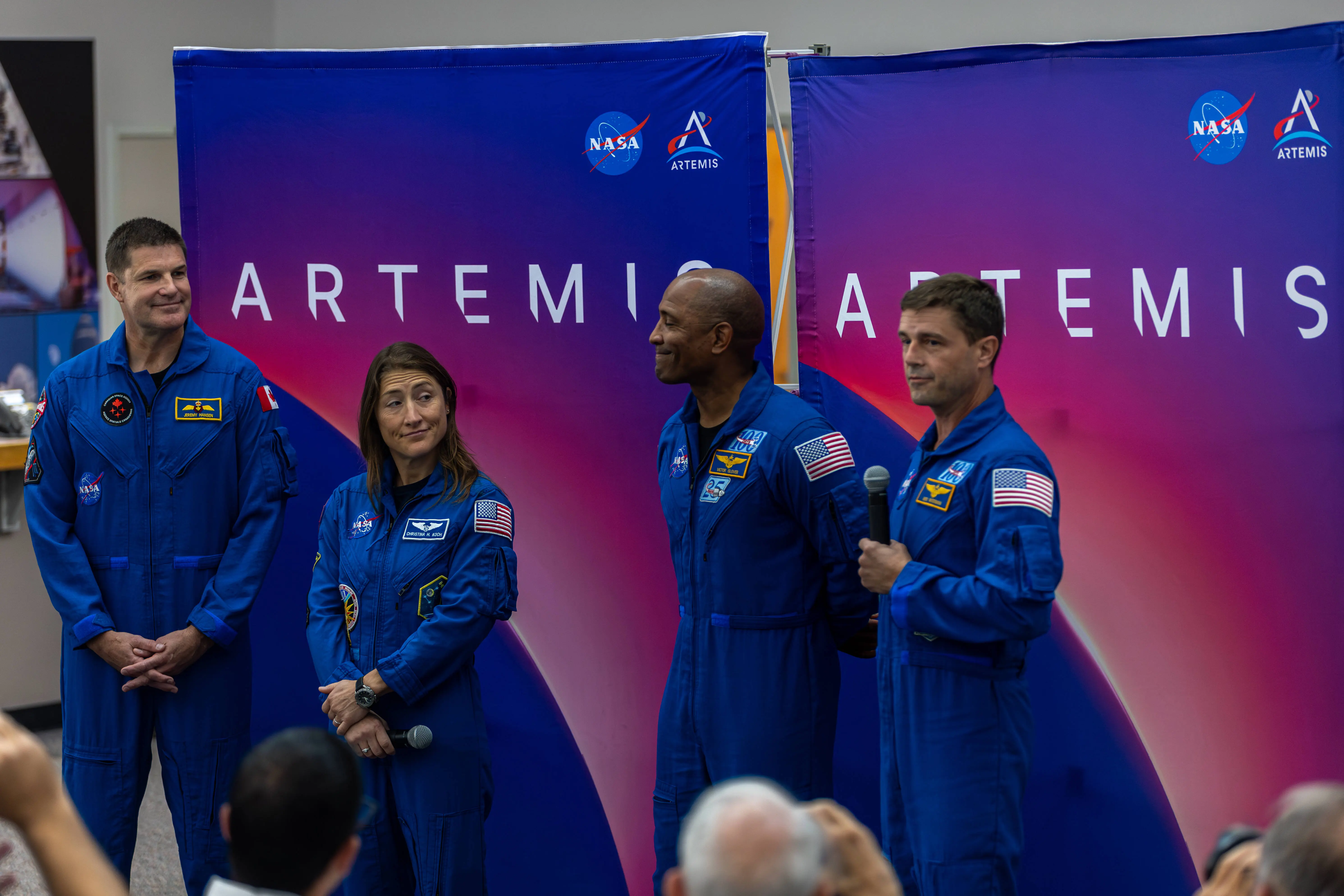 The four astronauts from the Artemis II crew to the moon speak to the media ahead of testing at Kennedy Space Center in Merritt Island, FL, on July 30, 2025. (Photo by Austin DeSisto/NurPhoto via Getty Images)
NASA’s Artemis II crew conducted a launch day rehearsal on December 20, 2025, at Kennedy Space Center in Florida, simulating the procedures that will take place on the actual mission.
The rehearsal, known as a countdown demonstration test, allowed astronauts to suit up in their Orion crew survival system spacesuits, enter and exit the Orion spacecraft and follow the sequence of events that will occur on launch day.
The four crew members involved in the mission are NASA astronauts Reid Wiseman, Victor Glover, Christina Koch and Canadian Space Agency astronaut Jeremy Hansen, who will travel around the Moon during Artemis II, according to NASA.
Countdown demonstration test procedures
The launch day rehearsal included key steps of the mission timeline, despite the Space Launch System (SLS) rocket not yet being positioned at the launch pad.
The crew boarded Orion inside the Vehicle Assembly Building (VAB), where engineers performed final preparations on the spacecraft, rocket, and supporting ground systems.
Activities during the rehearsal included practicing procedures for suiting up, traveling to the spacecraft, boarding Orion and verifying crew seating and interface points with the spacecraft systems.
NASA identified this rehearsal as a critical step to confirm that both crew and ground teams are fully aligned with the operational timeline for the mission.
Vehicle assembly building integration
Earlier in 2025, NASA completed stacking the Orion spacecraft on top of the SLS rocket inside the VAB at Kennedy Space Center.
The assembly included the launch abort system escape tower and involved verification tests of communications and interfaces between Orion, SLS, and ground systems.
Testing included end-to-end validation with NASA’s Near Space Network and Deep Space Network to ensure navigation and communications would function as expected during the mission, according to NASA reporting from November 20, 2025.
Integration at the VAB enables engineers to prepare all systems for launch and conduct rehearsals, such as the countdown demonstration test, before the rocket is rolled out to Launch Complex 39B.
Engineers also verified the power systems and sensor alignments, confirming that the software interfaces between Orion and SLS respond correctly to operational commands.
Crew training and mission readiness
To become familiar with each step of the mission, the Artemis II astronauts have conducted numerous simulations and procedure reviews.
Practicing different scenarios that might occur during launch, Moon trips and Earth reentry is part of their training.
NASA noted that all these preparations are conducted in collaboration with the entire mission team, which includes ground personnel, to ensure that all systems and teams are properly coordinated.
The astronauts collectively decided to name their Orion spacecraft Integrity during the dress rehearsal, which they would use.
In addition to this activity, the astronauts will be part of a more extensive and integrated set of simulations planned for the next few months to ensure flight readiness.
In addition to the aforementioned, the crew members will be trained in monitoring the life-support systems of the spacecraft, performing mid-journey navigation checks, and the separation of the spacecraft for the Moon's flyby operations.
The launch of Artemis II by NASA is scheduled for 2026, marking the first manned flight of the Artemis program.
The journey is planned to last more than ten days, with the spacecraft orbiting the Moon, and then a safe return of the crew to Earth.
According to NASA’s declaration in December 2025, the Artemis program aims not only to support scientific discovery and economic development but also to prepare for future human flights to the Moon and Mars.
Integrated testing of Orion, SLS and launch systems will continue to be conducted by NASA to ascertain the operational readiness before the rollout to Launch Complex 39B
Stay tuned for more updates.
TOPICS: Artemis II, Artemis II crew, Artemis II launch rehearsal, Artemis II mission, Artemis II mission updates, Kennedy Space Center Artemis, NASA Artemis II mission