
Features
ESA’s Juice spacecraft observes comet 3I/ATLAS ahead of delayed science data return in 2026
ESA’s Juice spacecraft observed interstellar comet 3I/ATLAS in November 2025, capturing NavCam images and collecting instrument data, with full science results expected to arrive on Earth in February 2026.
-
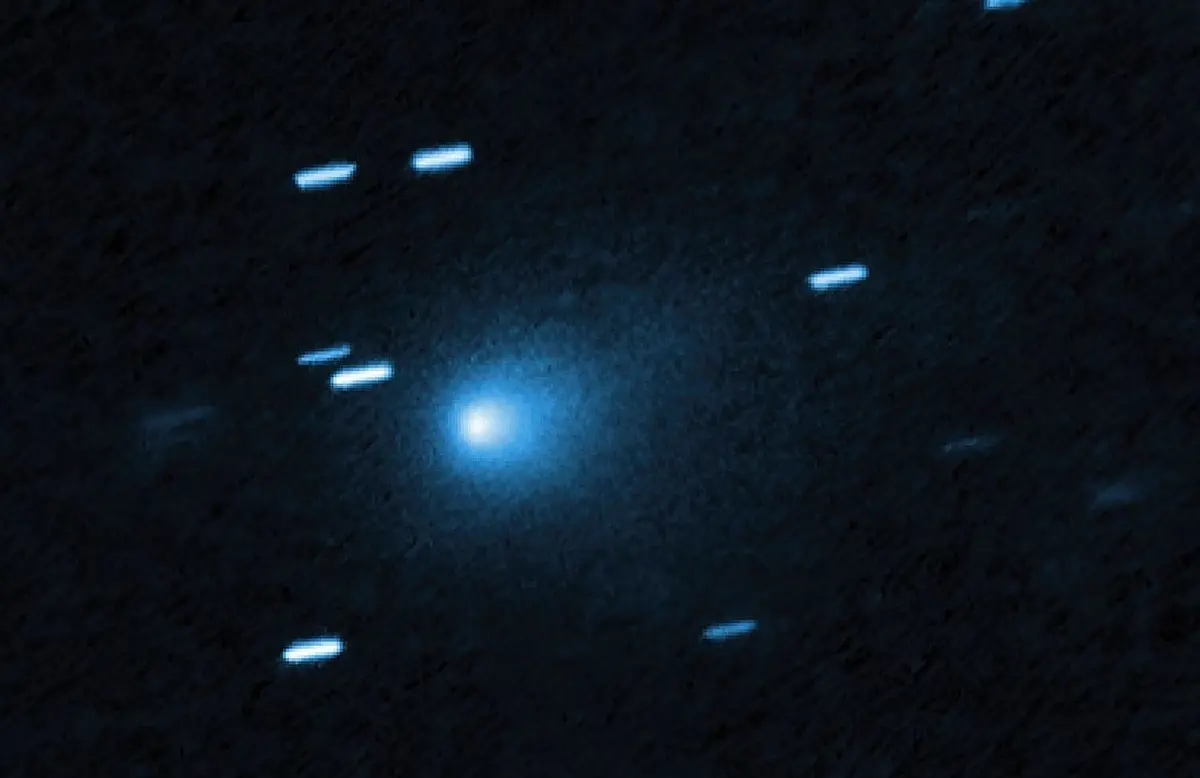 Comet 3I/ATLAS (Image via NASA)
The European Space Agency’s (ESA) Jupiter Icy Moons Explorer (Juice) spacecraft has conducted observations of the interstellar comet 3I/ATLAS as it moved away from the Sun and toward the outer Solar System.
The spacecraft captured images of the comet using its Navigation Camera (NavCam) on November 2, 2025, two days before its closest approach to the comet at a distance of approximately 66 million kilometers.
While the full science data from Juice will not reach Earth until February 2026, a portion of the NavCam image was downloaded in advance, revealing the comet’s coma and two tails.
These preliminary observations were reported by ESA and Universe Today.
The image taken by Juice’s NavCam shows the comet with a visible coma and two distinct tails.
The upper tail is composed of electrically charged gas, referred to as the plasma tail, while the lower tail consists of solid particles released by outgassing, known as the dust tail.
ESA noted that although NavCam is primarily designed for spacecraft navigation rather than high-resolution imaging, the captured image provided initial visual data on the comet’s activity.
The spacecraft’s closer observation occurs shortly after the comet’s perihelion, the point in its orbit nearest the Sun, which was expected to display increased outgassing and tail formation according to ESA’s December 4, 2025, update.
The NavCam image was partially downloaded to Earth, showing approximately one-quarter of the full frame before the complete dataset becomes available.
Use of scientific instruments and delayed data return
In addition to NavCam, Juice employed five science instruments to observe 3I/ATLAS between November 2 and November 25, 2025.
These instruments include JANUS, a high-resolution optical camera; the Moons and Jupiter Imaging Spectrometer (MAJIS); the ultraviolet imaging spectrograph (UVS); the Sub-millimeter Wave Instrument (SWI); and the Particle Environment Package (PEP).
ESA reported that data from these instruments will provide information on the comet’s composition, particle environment, and spectral characteristics.
The full dataset is scheduled to arrive on Earth between February 18 and 20, 2026. The delay is due to Juice using its main high-gain antenna as a heat shield, leaving the smaller medium-gain antenna to transmit data at a slower rate.
The collected measurements will include images, spectrometry, and particle data that are expected to clarify variations in the comet’s activity levels observed during the November 2025 period.
Observation context from multiple ESA missions
Comet 3I/ATLAS was first detected on July 1, 2025, by the Asteroid Terrestrial-impact Last Alert System (ATLAS) telescope in Río Hurtado, Chile, as reported by ESA on September 26, 2025.
Following its discovery, the comet moved behind the Sun, making Earth-based observations difficult.
ESA leveraged interplanetary missions, including Mars Express and the ExoMars Trace Gas Orbiter (TGO), to observe 3I/ATLAS in October 2025 as it passed near Mars, at a closest approach distance of 30 million kilometers.
Juice’s observation period in November 2025 allowed for imaging and instrument measurements from a different vantage point in the Solar System, enabling the collection of data shortly after the comet’s closest approach to the Sun.
The collected observations are expected to provide a more detailed understanding of the comet’s activity, tail formation, and composition once the full dataset arrives in February 2026.
Preliminary results from NavCam indicate the presence of a bright coma and two tails, while the additional science instruments will offer spectral, compositional, and particle measurements.
These combined observations will contribute to ESA’s ongoing monitoring of 3I/ATLAS as it continues its trajectory through the outer Solar System.
Stay tuned for more updates.
TOPICS: ESA Juice spacecraft, 3I/ATLAS, 3I/ATLAS comet observation, interstellar comet 3I/ATLAS, Jupiter Icy Moons Explorer