
Interstellar comet 3I/ATLAS shows rotating jets in a rare sun-facing tail
-
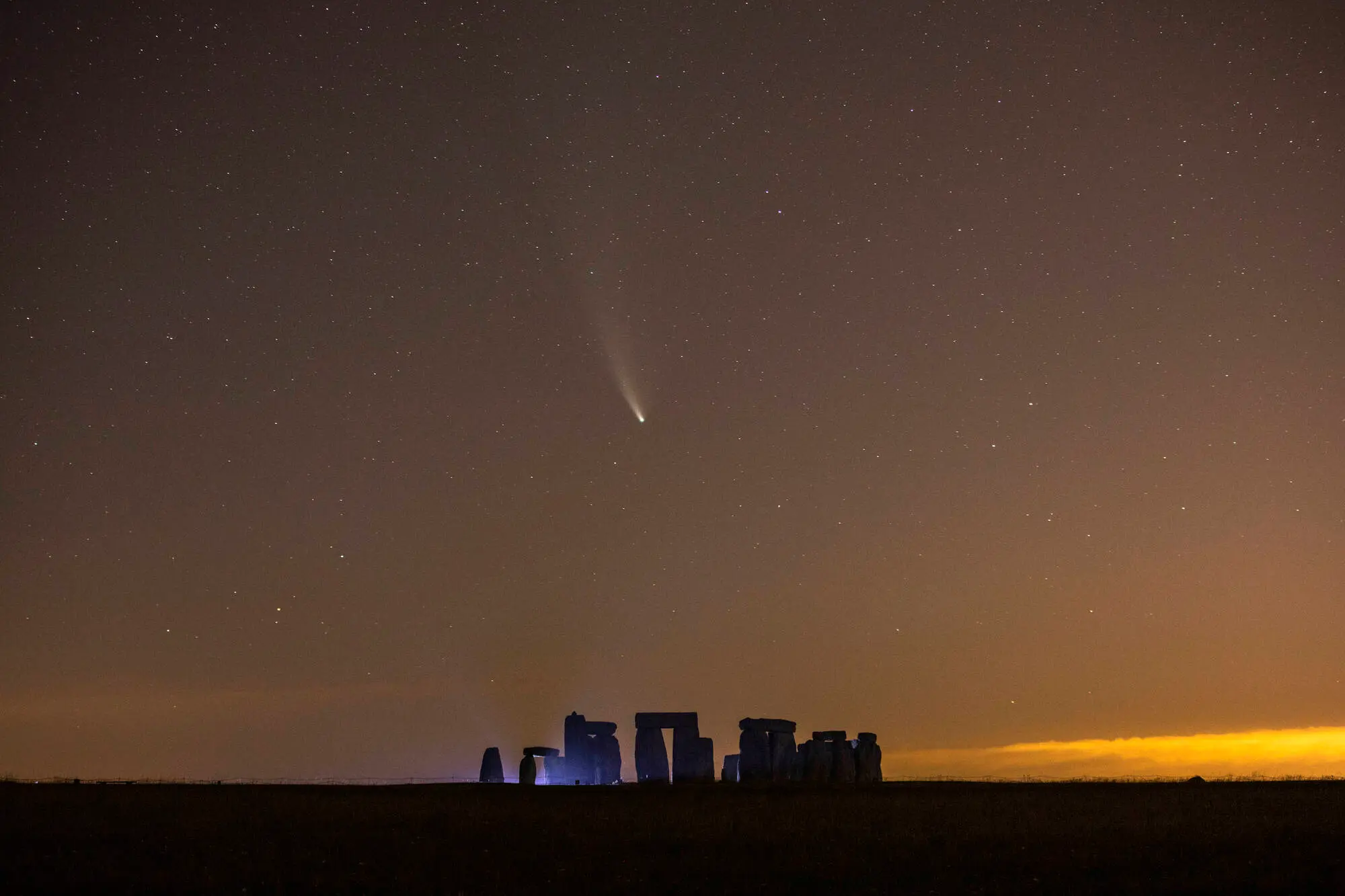 Comet NEOWISE passes over Stonehenge (Photo for reference, Image via Getty)
Space.com reported new findings about interstellar comet 3I/ATLAS as it moves away from Earth and continues its path out of the solar system.
Astronomers studying the object have identified repeating jet structures in a rare sun-facing tail, also known as an “anti-tail.” The observations show that these jets shifted position in a regular pattern over several hours, allowing researchers to estimate the comet’s rotation rate.
The data were collected over a period of more than two months in mid-2025 using ground-based telescopes in the Canary Islands.
3I/ATLAS is only the third known object confirmed to have entered the solar system from another star system, following ’Oumuamua in 2017 and 2I/Borisov in 2019.
While anti-tails and jet activity have been seen in comets formed within the solar system, this is the first time such behavior has been measured in an interstellar comet. Researchers say the results help explain how material leaves the comet’s solid center as it warms under sunlight.
The comet came closest to the Sun in late October 2025 and made its closest pass by Earth in December.
Although it is now moving away, scientists are still studying the data collected during its approach to learn more about its shape, movement and origin.
_________________________________________________________Jet motion and rotation signals
The research team identified jet structures within the sun-facing anti-tail of 3I/ATLAS on seven separate nights between early and late August 2025.
These jets appeared to change direction in a repeating cycle lasting about 7 hours and 45 minutes.
Based on this motion, the scientists inferred that the comet’s nucleus completes one full rotation roughly every 15 hours and 30 minutes. This estimate is shorter than earlier rotation periods proposed for the object.
The jets are linked to “outgassing,” a process in which frozen material turns directly into gas as the comet warms, carrying dust away from the surface.
The study notes that this behavior is common in solar system comets but had not previously been documented in an interstellar one. In their paper, the researchers wrote, “Characterizing jets in 3I thus represents a rare opportunity to investigate the physical behavior of a pristine body formed in another planetary system.”
Observations also showed a change in the shape of the coma over time. Before August, dust formed a sunward fan, which later evolved into a clearer tail pointing away from the Sun. This shift corresponded to the growing influence of solar radiation as the comet approached the Sun.
_______________________________________________________Observations and path through the solar system
The data used in the study were collected over 37 nights between July 2 and September 5, 2025. Scientists used the Two-meter Twin Telescope at the Teide Observatory in Tenerife.
By observing the comet during this period, they were able to track changes in its dust and gas as it approached the Sun. In some images, the sun-facing tail was measured to be up to approximately 620,000 miles, or 1 million kilometers, in length.
3I/ATLAS made its closest approach to the Sun on Oct. 30, 2025, at a distance of about 130 million miles. It later passed closest to Earth on Dec. 19, coming within around 168 million miles.
Since then, the comet has been moving away toward the outer solar system and is expected to leave it completely. Like ’Oumuamua and 2I/Borisov before it, it is not expected to return.
Researchers noted that even short visits by interstellar objects can provide valuable information for study. The paper refers to the jets as occurring in a “sun-facing ‘anti-tail’,” highlighting the unusual geometry involved.
Although the comet is now receding, the measurements already collected continue to inform studies of comet activity beyond the solar system.
__________________________________________________________
Stay tuned for more updates.TOPICS: Astronomy, 3I/ATLAS, 3I/ATLAS anti-tail, 3I/ATLAS comet observation, 3I/ATLAS interstellar object, 3I/Atlas nearing sun, 3i/ATLAS recent updates
- What Europa Clipper and Parker Solar Probe discovered about interstellar comet 3I/ATLAS
- 3I/ATLAS defies easy answers as Avi Loeb sticks with rank 4 assessment
- Hubble data reveal dust plumes from rare high-energy impacts in a nearby star system
- Ursid meteor shower peaks tonight, closing out 2025’s final skywatching show