
Features
James Webb Space Telescope confirms first runaway supermassive black hole in distant galaxy
James Webb Space Telescope confirms the first runaway supermassive black hole in the Cosmic Owl galaxy, observing its tail and bow shock, providing direct evidence of black hole ejection during galaxy mergers.
-
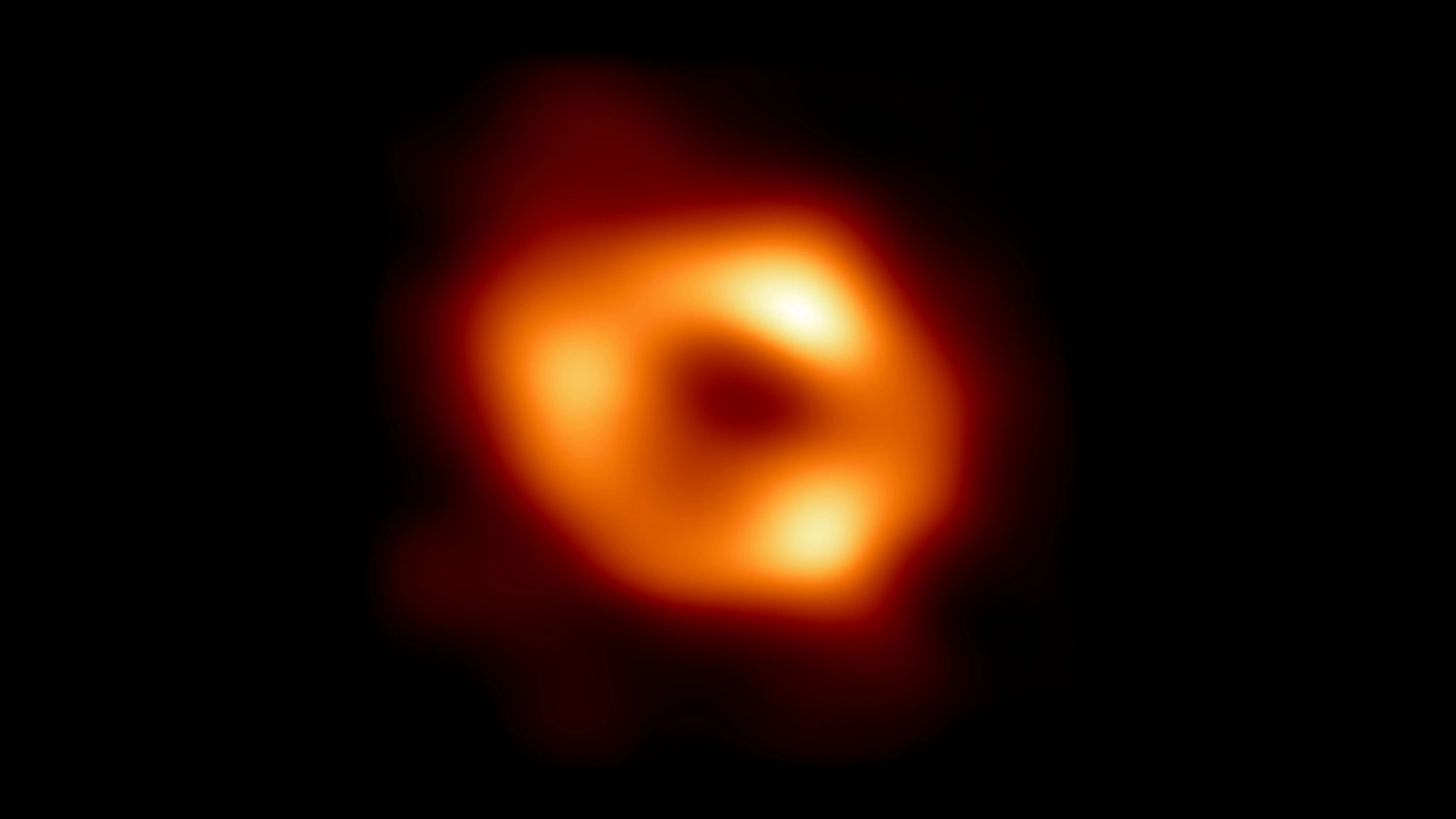 In this handout photo provided by NASA, This is the first image of Sgr A*, the supermassive black hole at the centre of our galaxy, with an added black background to fit wider screens. It's the first direct visual evidence of the presence of this black hole. It was captured by the Event Horizon Telescope (EHT), an array which linked together eight existing radio observatories across the planet to form a single Earth-sized virtual telescope. The telescope is named after the event horizon, the boundary of the black hole beyond which no light can escape. The image of the Sgr A* black hole is an average of the different images the EHT Collaboration has extracted from its 2017 observations. In addition to other facilities, the EHT network of radio observatories that made this image possible includes the Atacama Large Millimeter/submillimeter Array (ALMA) and the Atacama Pathfinder EXperiment (APEX) in the Atacama Desert in Chile, co-owned and co-operated by ESO is a partner on behalf of its member states in Europe (Image via Getty)
The James Webb Space Telescope has confirmed the first observed case of a runaway supermassive black hole by identifying direct physical evidence of its motion outside a galactic center.
Using spectroscopic data, researchers determined that the object is a supermassive black hole that has been displaced from its host galaxy and is traveling through intergalactic space.
The confirmation answers whether such objects, long predicted by theory, can be observed directly.
According to Universe Today, the detection was made in a galaxy system known as the Cosmic Owl, located about 8.8 billion light-years from Earth, where Webb data revealed signatures consistent with a supersonic black hole moving through gas.
Identification of the runaway Black Hole
The confirmed runaway supermassive black hole is associated with a system called the Cosmic Owl, composed of two ring galaxies in the process of merging.
Observations showed a linear structure extending far from the galactic cores.
Earlier studies suggested the feature could be a wake produced by an ejected black hole, but confirmation required spatially resolved spectroscopy.
Researchers used the James Webb Space Telescope’s Near-Infrared Spectrograph Integrated Field Unit to observe the tip of this linear structure.
The data showed emission-line patterns and velocity shifts consistent with gas being compressed by an object moving faster than the local speed of sound.
The research team reported that these observations match predictions for a supermassive black hole traveling through the surrounding medium after being expelled from its original position.
Mechanism behind the ejection
Theoretical models have proposed two main mechanisms capable of ejecting a supermassive black hole from a galaxy.
One involves gravitational interactions among three black holes during a galaxy merger, where one black hole can be accelerated and expelled.
The second method is gravitational wave recoil, which happens when the merged black hole is given a kick because two black holes merge and emit gravitational waves asymmetrically in different directions.
It is stated in the paper submitted to The Astrophysical Journal Letters by Pieter van Dokkum and his team that both mechanisms are spontaneous phenomena occurring during mergers of galaxies.
In the case of the Cosmic Owl system, the combined evidence of two active galactic nuclei is indicative of a merger event wherein black holes of the progenitor galaxies not only crossed paths but also one was knocked out.
Evidence from the Bow Shock and Tail
Two observed structures were central to confirming the runaway nature of the black hole: a long gaseous tail and a bow shock at its leading edge.
The tail extends roughly 62 kiloparsecs, equivalent to about 200,000 light-years, and shows conditions suitable for gas accumulation and star formation.
In contrast, the region ahead of the black hole exhibits higher pressure and ionized gas consistent with shock compression.
Spectral data from Webb revealed a clear velocity gradient of about 600 kilometers per second across a region roughly one kiloparsec wide near the bow shock.
The researchers reported that the alignment of velocity, ionization state, and spatial structure supports the interpretation of a supersonic object moving through the intergalactic medium.
Role of Webb observations
The James Webb Space Telescope played a central role by providing high-resolution infrared spectroscopy capable of mapping gas motion and composition simultaneously.
Earlier Hubble Space Telescope images identified the extended tail, but Webb’s data enabled direct measurement of gas kinematics at the suspected black hole location.
Universe Today reports that these combined observations allowed researchers to confirm predictions made in earlier studies of the Cosmic Owl system.
The authors concluded that the linear feature is the wake behind a runaway supermassive black hole and that the bow shock was detected as anticipated.
Broader context and future searches
Predictions that supermassive black holes could be ejected from galaxies date back several decades, but direct confirmation had been lacking. This finding establishes an observational example consistent with those models.
The research team noted that future wide-field surveys, including those from the Euclid mission and the Nancy Grace Roman Space Telescope, may help identify additional cases by searching for similar tails and shock signatures in merging galaxies.
The confirmation demonstrates that displaced supermassive black holes can be detected through their interaction with surrounding gas, providing a new observational pathway for studying black hole dynamics during galaxy evolution.
Stay tuned for more updates.
TOPICS: James Webb Space Telescope, Black Holes, Cosmic Owl Galaxy, NASA
More James Webb Space Telescope
on Primetimer:
- NASA’s James Webb Space Telescope emission measurements reveal cooler-than-expected dayside on TOI-561 b
- James Webb Space Telescope spots mysterious twin helium tails streaming from a distant hot Jupiter
- Astronomers warn Chilean hydrogen project could threaten one of Earth’s darkest skies
- NASA’s Webb telescope detects the earliest known supernova from 730 million years after the Big Bang