
Love Is Blind: Italy Reunion redefines what the experiment actually tested
-
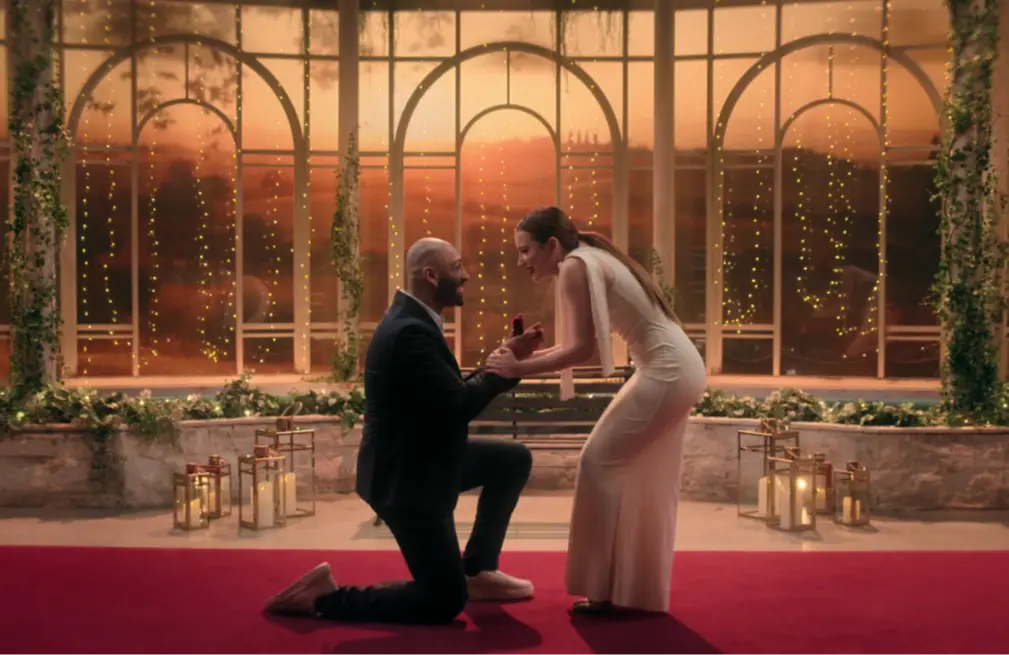 Gergana and Parmi (Image via Netflx)
Love Is Blind: Italy concluded its season not by answering its title question, but by reframing it. The first season clarified that the experiment was never solely about whether love can form without sight.
Instead, it tested how far emotional connection can carry a relationship once structure, time pressure, and real-world consequences are restored.
From the beginning, the premise emphasized emotional purity: voices without faces, feelings without context, commitment without precedent.
The reunion reframed that premise by showing that emotional connection was not the endpoint being measured.
It was the starting condition. What followed—cohabitation, family scrutiny, conflict, and decision-making—became the real test.
Rather than validating or disproving the concept of blind love, the reunion positioned the experiment as a stress test for transition: how people move from emotional certainty to practical partnership.
Love Is Blind: Italy and what the experiment was really measuring
The final episodes documented the point at which the experiment’s protective framework dissolved.
Couples left the pods and encountered the variables that had been intentionally removed: schedules, s*x, money, distance, family opinion, and unresolved personal history.
The reunion revisited these moments not as dramatic turning points, but as data points revealing what the experiment actually measured. For some couples, emotional alignment translated into shared decision-making.
Alessandro and Hyoni navigated cultural differences, parental expectations, and long-term planning with relative consistency. Their wedding was presented not as proof that love is blind, but as evidence that emotional connection paired with compatible values can withstand acceleration.
For others, the transition exposed gaps that emotional intimacy alone could not bridge. Gergana and Parminder’s storyline illustrated this most explicitly. Their emotional bond remained intact through the altar, yet readiness did not.
At the reunion, both emphasized that the relationship itself was not rejected, but the timeline was. The experiment tested whether feelings could form quickly; it did not guarantee that commitment should follow at the same speed.
Karen and Nicola’s arc further reframed the experiment’s scope. Their journey demonstrated that emotional compatibility can lead to marriage, but marriage requires skills beyond connection.
The reunion revealed that unresolved conflict patterns persisted after the cameras stopped rolling. The experiment successfully paired them emotionally, but it did not equip them with shared mechanisms for repair. The reunion also revisited relationships that unraveled earlier.
Ludovica and Davide’s experience underscored how emotional intensity can obscure structural incompatibility. Their bond formed quickly and felt authentic, yet disagreements about independence, lifestyle, and emotional labor accumulated.
The reunion clarified that the experiment surfaced attraction and vulnerability, but not alignment in daily life. Across storylines, a consistent pattern emerged. Emotional truth was rarely disputed. What differed was how participants interpreted what emotional truth obligated them to do next.
The reunion reframed the pods as an environment that amplifies feeling while suspending consequence. In that space, participants were encouraged to prioritize emotional honesty above all else. Outside it, emotional honesty became only one variable among many.
The experiment tested whether people could recognize a connection without sight. It did not test whether they could integrate that connection into an already complex life.
Episodes 8 and 9 showed participants grappling with this integration in real time. Conversations about s*x, relocation, family approval, and mental health surfaced late but carried disproportionate weight.
The reunion contextualized those conversations as inevitable rather than disruptive. They were not obstacles to love; they were components of it.
Importantly, the reunion resisted framing outcomes as success or failure. Couples who married were not portrayed as having “won,” nor were those who separated depicted as having misunderstood the experiment.
Instead, the reunion suggested that the experiment measured willingness: willingness to be vulnerable, to commit quickly, and to confront uncertainty without traditional cues.
What it did not measure was sustainability. That responsibility returned to the participants once the experiment ended. Several cast members noted that clarity arrived only after the show removed its scaffolding.
The reunion emphasized that love developed in isolation behaves differently once exposed to community, history, and accountability. The experiment accelerated intimacy but deferred consequences. The reunion restored it.
By the end of the season, Love Is Blind: Italy no longer asked whether love can exist without sight. It asked whether love, once found, can survive without shared pace, shared tools, and shared expectations.
The reunion thus redefined the experiment’s purpose. It was not a shortcut to marriage, but a lens into how people respond when emotional certainty arrives before readiness. The outcomes did not negate the premise. They clarified its limits.
In that sense, the experiment succeeded precisely where it appeared most uncertain. It showed that love can begin in the dark—but what follows requires vision.
Stay tuned for more updates.
TOPICS: Love Is Blind: Italy, Love Is Blind: Italy reunion
- Love Is Blind: Italy Reunion questions where friendship ends and emotional betrayal begins
- Grand gestures, little repair: What Love Is Blind: Italy reveals about accountability
- When the pods end: How Love Is Blind: Italy exposes the limits of emotional matchmaking
- Love Is Blind: Italy Reunion reveals how a missing apology unraveled Karen and Nicola's marriage