
Features
NASA completes assembly of the Nancy Grace Roman Space Telescope
NASA has completed assembly of the Nancy Grace Roman Space Telescope, preparing for final testing and launch by May 2027 to observe galaxies, stars, black holes and exoplanets across the cosmos.
-
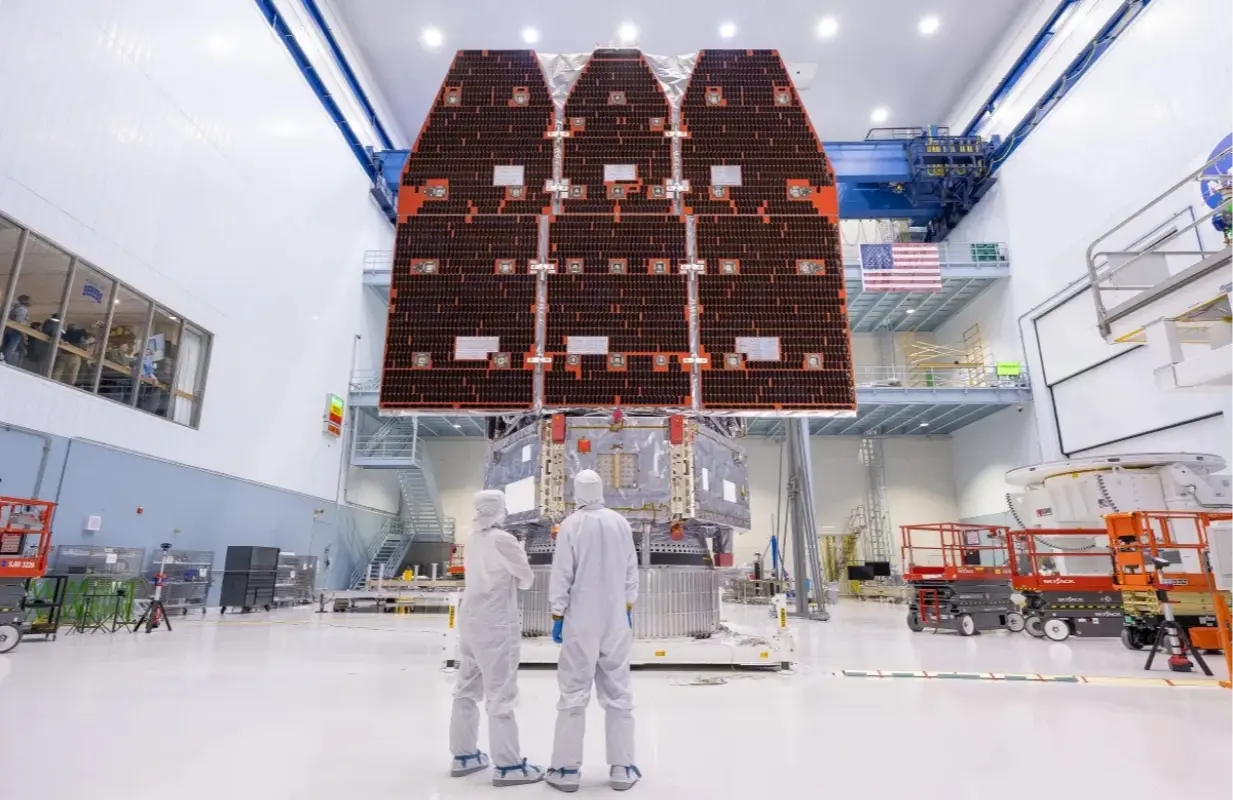 NASA’s Nancy Grace Roman Space Telescope (Image via NASA)
NASA has completed the assembly of the Nancy Grace Roman Space Telescope, joining its inner and outer segments at the Goddard Space Flight Center in Greenbelt, Maryland, on November 25, 2025.
This milestone marks the end of the telescope’s primary construction phase and the beginning of final testing.
According to NASA, the mission is scheduled to launch by May 2027, with the possibility of an earlier launch in fall 2026.
Following testing, the observatory will be transported to NASA’s Kennedy Space Center in Florida for launch preparations on a SpaceX Falcon Heavy rocket.
Final integration and testing
The assembly process involved connecting the telescope’s two main portions in a controlled, clean-room environment at the Goddard Space Flight Center.
NASA Associate Administrator Amit Kshatriya stated that the observatory is entering its final stage of testing following integration.
This testing phase ensures that all systems perform according to specifications before being shipped to the launch site.
The observatory will undergo a series of functional and environmental tests to confirm operational readiness. NASA reports that teams are following a structured schedule to maintain the planned launch timeline.
Instruments and observation capabilities
The Nancy Grace Roman Space Telescope has a total of two scientific instruments: the Wide Field Instrument and a technology demonstration of the Coronagraph Instrument.
The Wide Field Instrument features an incredibly powerful 288-megapixel camera that can capture images of vast portions of the sky in infrared light simultaneously.
NASA says the data collected by this instrument will be hundreds of times faster than that of the Hubble Space Telescope, which is expected to total approximately 20 petabytes over the five years of its main mission.
The Coronagraph Instrument aims to test techniques for detecting planets around other stars by blocking the light from the star and capturing the light reflected from the planet.
Pre-planned observations using the coronagraph are scheduled during the first eighteen months of the mission.
Survey programs
Roman will conduct three main surveys using the Wide Field Instrument, which will comprise 75% of its primary mission.
The High-Latitude Wide-Area Survey will map over a billion galaxies to examine dark matter and the formation of cosmic structures.
The High-Latitude Time-Domain Survey will repeatedly observe the same regions to monitor changes over time, contributing to the study of dark energy and variable phenomena.
The Galactic Bulge Time-Domain Survey will focus on the center of the Milky Way, using microlensing to detect planets in various orbits, rogue planets and isolated black holes.
The remaining 25% of observation time will be allocated to programs selected in consultation with the scientific community, including the Galactic Plane Survey.
Data access and management
NASA has stated that all data collected by Roman will be publicly available without an exclusive use period.
The mission includes a General Investigator Program to support scientists in analyzing the data across multiple research objectives.
NASA, through the Goddard Space Flight Center and the Jet Propulsion Laboratory, is operating the telescope in collaboration with Caltech/IPAC, the Space Telescope Science Institute, and its industrial partners, including BAE Systems, L3Harris Technologies and Teledyne Scientific & Imaging.
Mission objectives and timeline
The Nancy Grace Roman Space Telescope will report its findings through NASA's channels, as the instrument will operate in the infrared and thus have access to the entire universe of galaxy, star, black hole, and exoplanet research.
In 2026, following the successful completion of all testing procedures, the observatory will be relocated to the launch site in the summer, with the main launch window scheduled for May 2027.
The mission is expected to generate a substantial amount of data, which will not only support current astronomical research but also open up a wide range of applications in both astrophysics and planetary science.
Stay tuned for more updates.
TOPICS: Nancy Grace Roman Space Telescope, Coronagraph Instrument Roman telescope, NASA, NASA astronomical missions 2027, NASA Goddard Space Flight Center telescope, NASA telescope launch 2027, Roman Space Telescope assembly, SpaceX Falcon Heavy NASA launch, Wide Field Instrument Roman telescope