
NASA monitors MAVEN spacecraft issue ahead of Mars solar conjunction
-
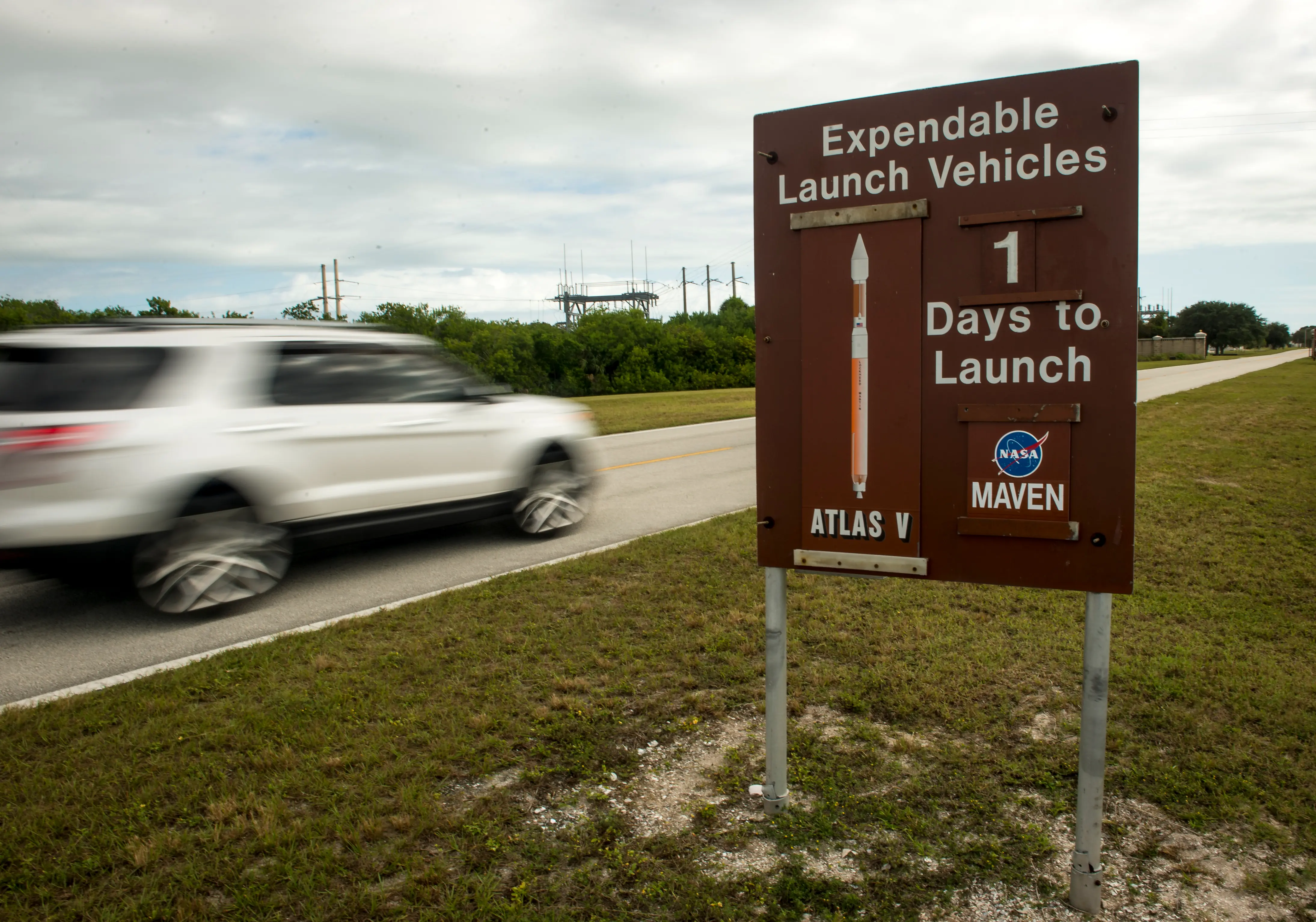 In this handout photo provided by NASA, a sign along the NASA Kennedy Space Center causeway displays to passersby that there is one day remaining until the scheduled launch of the United Launch Alliance Atlas V rocket with NASA's Mars Atmosphere and Volatile Evolution (MAVEN) spacecraft onboard from Cape Canaveral Air Force Station Space Launch Complex 41 November 17, 2013 in Cape Canaveral, Florida. The space agency's Mars Atmosphere and Volatile EvolutioN mission (MAVEN for short) is on a mission to study the upper atmosphere of Mars in hopes to discover how the planet lost most of its atmosphere and liquid water (Image via Getty)
NASA is actively monitoring its MAVEN (Mars Atmosphere and Volatile Evolution) spacecraft following a loss of signal on December 6, 2025, according to NASA’s announcement on December 23, 2025.
The agency further noted that the actions taken to regain contact were accompanied by the coordination with NASA's Deep Space Network, as well as the continuous analysis of the fragments of data obtained from the radio science campaign conducted on the same day.
NASA indicated that the MAVEN mission, which started in 2014, not only has the role of studying the Martian upper atmosphere but also, at times, serves as a communications relay for the surface missions.
NASA went on to mention that during the Mars solar conjunction which is going to start on December 29, 2025, the communication with the MAVEN and other Mars missions would be cut off temporarily until January 16, 2026.
MAVEN Signal Loss and Recovery Efforts
Timeline of Signal Loss
NASA has informed that on December 9, 2025, MAVEN's telemetry confirmed all subsystems were working well just before it went behind Mars on December 6, 2025.
NASA has also informed that once the spacecraft was back in the planet's vicinity, there was no signal detection by the ground stations.
NASA has mentioned that the recovery process was put into operation straight away which included the sending of commands to MAVEN via the Deep Space Network and the monitoring of any signal return.
On December 15, 2025, NASA reported that tracking data from December 6 was recovered and analyzed as part of the ongoing radio science campaign to identify the events that caused the loss of contact.
Recovery and Observation Efforts
NASA very recently, on December 23, 2025, disseminated news that MAVEN's reference orbit had been located via additional observing attempts.
Rover Curiosity made efforts on December 16 and 20 using the Mastcam instrument to capture an image of MAVEN; however, the NASA agency confirmed that the spacecraft was not observed.
The NASA organization has indicated that tracking data is being analyzed in order to interpret the conditions of rotation and orbit of the MAVEN spacecraft at the moment of signal loss.
As part of recovery efforts, NASA's investigation includes analysis of unexpected spacecraft rotation and possible changes in orbit trajectory.
Impact on Surface Missions
NASA announced on Dec 15, 2025, that the loss of signal from MAVEN affects the comms relay for Mars missions on the surface.
MAVEN is one of four orbiters that serve as a communication link between rovers and Earth.
The NASA team reassured that the less active orbiters, namely Mars Reconnaissance Orbiter and Mars Odyssey, along with the ExoMars Trace Gas Orbiter of the European Space Agency are being used to keep the Perseverance and Curiosity rover communications going.
In the meantime, NASA has reported changes in surface operations that rely on more orbital passes and altered rover daily planning to keep science activities conducted while MAVEN is offline.
Upcoming Mars Solar Conjunction
NASA made it known on the 23rd of December, 2025, that the Solar conjunction period between Mars and the Earth will start on the 29th of December, 2025 and will last until the 16th of January, 2026.
The space agency disclosed that all communications with the planetary missions, including MAVEN are to be put on hold during the entirety of this time.
NASA is planning to resume operations for the MAVEN spacecraft after the solar conjunction has ended; the Sun’s position will continue to limit the monitoring and data analysis activities.
MAVEN Mission Information
On the 9th day of December in 2025, NASA reported that MAVEN was launched in November 2013 and entered Mars' orbit in September 2014.
NASA indicated that one of the spacecraft's aims is to examine the Martian upper atmosphere, ionosphere and the impact of solar wind to gauge the atmospheric loss and the planet's habitability.
NASA also mentioned that the spacecraft has been working as a communication link for the planet's surface missions and that it had spent ten years orbiting Mars in 2024.
Stay tuned for more updates.
TOPICS: MAVEN spacecraft, Mars orbiters, Mars solar conjunction, MAVEN signal loss, NASA Mars mission