
Features
NASA releases new MAGE model to improve space weather prediction
NASA’s CGS releases the MAGE model to improve space weather prediction, providing simulations of solar storms, auroras, and their impacts on Earth and space missions.
-
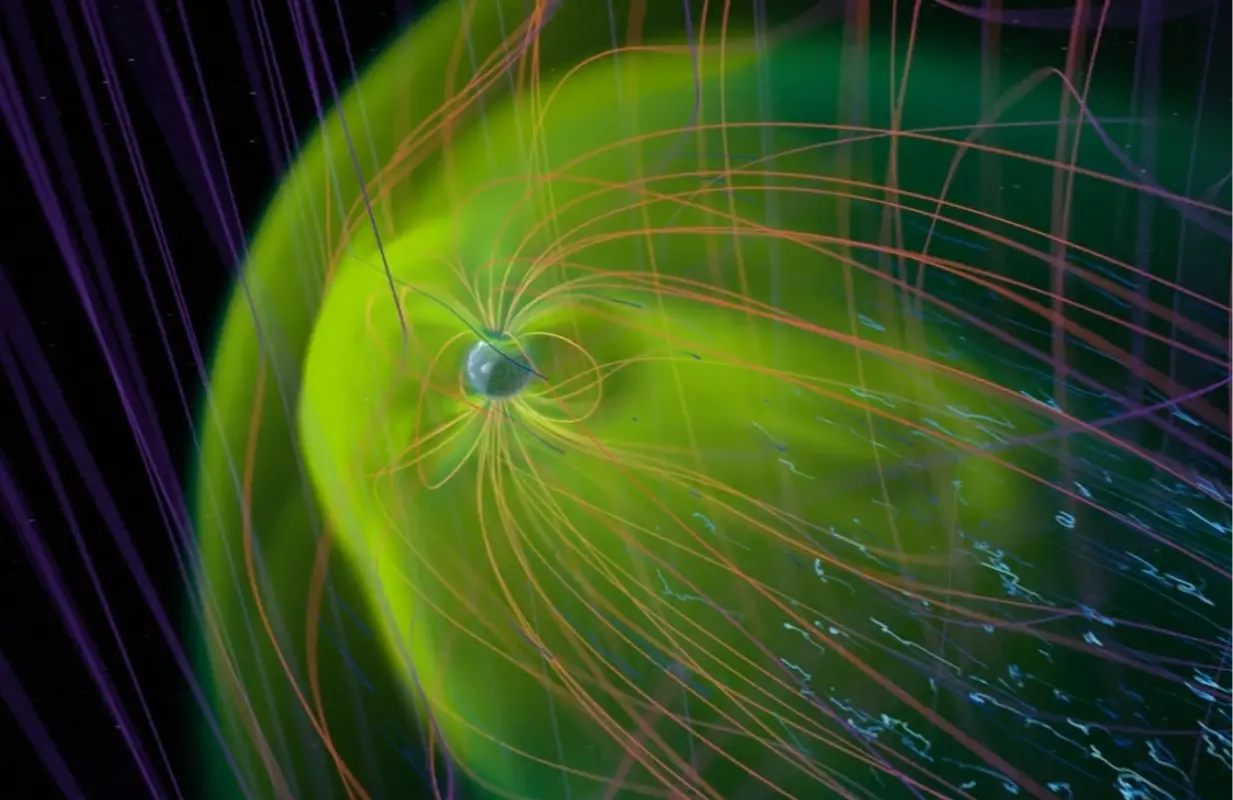 An image of a simulation by the MAGE model of Earth’s magnetosphere being hit by a geospace storm in May 2024 (Image via NASA)
NASA’s Center for Geospace Storms, also known as CGS, has released the MAGE model to improve predictions of space weather.
The MAGE (Multiscale Atmosphere-Geospace Environment) model uses data from multiple NASA missions to simulate how geospace, including Earth’s magnetosphere, ring current, and upper atmosphere, responds to solar disturbances.
Access to MAGE is available through NASA’s Community Coordinated Modeling Center and GitHub.
Alongside the model, CGS provides an analysis and visualization package that allows scientists to process simulation results.
NASA reported this release on December 12, 2025, and stated that the model is intended to support research in heliophysics and advance understanding of solar-driven events.
Design and purpose of the MAGE model
MAGE combines several smaller predictive models into a single framework, enabling a comprehensive view of how geospace reacts to solar activity.
According to Slava Merkin, director of CGS at Johns Hopkins University’s Applied Physics Laboratory, the model allows scientists to study interactions between the magnetosphere, upper atmosphere, and solar disturbances.
CGS is one of three DRIVE (Diversify, Realize, Integrate, Venture, Educate) science centers funded by NASA.
DRIVE centers are multidisciplinary, integrating modelers, theoreticians, computer scientists, and observers across multiple institutions in the United States.
The development of MAGE involved over 50 experts from seven institutions, combining their efforts to improve predictive modeling of solar effects on Earth’s space environment.
Applications of the MAGE model
In May 2024, the MAGE model was used to simulate several strong solar flares and coronal mass ejections impacting Earth.
The simulations indicated a geospace storm reaching a G5 rating, the highest level on the geomagnetic storm scale recorded in two decades.
The model mapped the interactions between the magnetosphere, ring current, and upper atmosphere during the storm.
Observed auroras appeared in areas including the southern United States, which corresponded with model predictions.
The results illustrate the model’s capability to represent the movement of magnetospheric particles, plasma flows, and magnetic field changes during solar disturbances.
These capabilities support efforts to predict the effects of solar activity on power grids, communication systems, navigation tools, satellites, and astronaut safety.
NASA emphasized the relevance of such predictions for Artemis missions to the Moon and planned crewed missions to Mars.
Accessibility and support for researchers
NASA has made MAGE and its associated analysis tools publicly accessible.
The Community Coordinated Modeling Center hosts the software for use by scientific teams, while GitHub contains both the model and the visualization package.
NASA’s Scientific Visualization Studio collaborates with CGS to provide visual simulations of geospace storms, including particle heating, magnetic field lines, and plasma flows.
These visualizations allow researchers to examine solar storm impacts on Earth’s magnetosphere and upper atmosphere with precise detail.
Connection to NASA DRIVE Science centers
MAGE is part of NASA’s DRIVE Science Center program, which encourages collaborative research and development of computational models.
DRIVE centers diversify the use of observational tools, integrate existing platforms, venture into new technologies, and educate the next generation of heliophysicists.
CGS focuses on geospace and solar storm interactions. Other DRIVE centers, such as COFFIES and SHIELD, study the Sun’s magnetic field cycles and the heliosphere, respectively.
These centers leverage NASA missions and computational tools to improve understanding of space weather, solar activity, and conditions across the solar system.
NASA’s science website provides information on DRIVE Science Centers, including MAGE, and resources for researchers and students.
Stay tuned for more updates.
TOPICS: NASA MAGE model, Artemis Moon mission, CGS NASA, geospace storms, NASA DRIVE Science Centers, space weather prediction