
Features
NASA Roman Space Telescope to study thousands of cosmic voids across the universe
NASA’s Roman Space Telescope will study thousands of cosmic voids, mapping galaxy distributions to investigate dark matter, dark energy and the universe’s large-scale structure through precise observations.
-
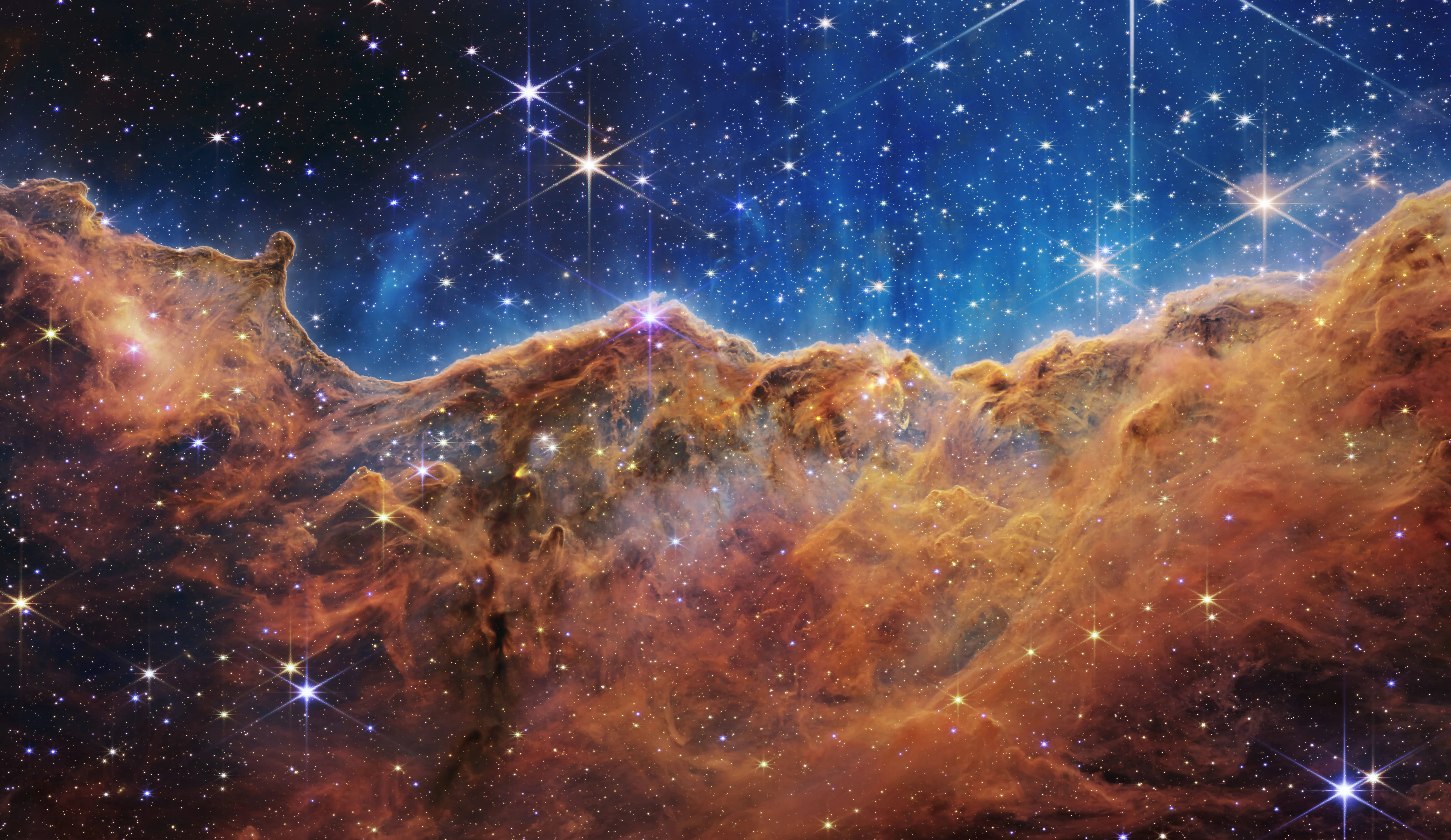 In this handout photo provided by NASA, a landscape of mountains and valleys speckled with glittering stars is actually the edge of a nearby, young, star-forming region called NGC 3324 in the Carina Nebula, on July 12, 2022 in space. Captured in infrared light by NASA's new James Webb Space Telescope, this image reveals for the first time previously invisible areas of star birth (Image via Getty)
NASA’s Nancy Grace Roman Space Telescope is set to conduct observations of cosmic voids throughout the universe, providing measurements of regions largely empty of galaxies.
Cosmic voids are areas of space with few galaxies, typically found within the surfaces of giant bubble-like structures hundreds of millions of light-years across.
The Roman Telescope will allow researchers to map these voids in detail and determine how their distribution and shapes relate to the components of the universe, including normal matter, dark matter, and dark energy.
These observations will be conducted as part of Roman’s High-Latitude Wide-Area Survey, according to NASA, on December 15, 2025.
Cosmic voids and their role in the universe
Cosmic voids are defined by their low density of galaxies, surrounded by walls of higher-density regions.
Scientists study these voids to understand the influence of dark energy and dark matter on the universe's large-scale structure.
Normal matter and dark matter exert gravitational forces that slow cosmic expansion, while dark energy contributes to accelerating it.
Researchers use the distribution of galaxies and voids to evaluate how these forces interact over time.
Alice Pisani of CNRS in France and Princeton University stated that voids are dominated by dark energy, making them suitable for examining its properties.
Observational approach of the Roman Telescope
The Roman Telescope's High-Latitude Wide-Area Survey is set to explore areas of the universe that lie beyond the Milky Way's plane, and will be covering around 2,400 square degrees, which is the same as 12,000 full moons, the Space Telescope Science Institute revealed.
Such a study aims to identify 40,000 galactic voids of all sizes, including those with a diameter of at least 20 million light-years.
Besides that, the instrument will note the galactic locations as well as their cosmological redshifts from the spectroscopic data.
Redshift measurements are converted to physical distances using models that assume specific properties of dark energy and matter.
Giovanni Verza of the Flatiron Institute and New York University noted that Roman’s capability to observe wide areas of the sky with high depth will enable the detection of faint and distant galaxies.
Determining void shapes and universe components
Astronomers will determine the three-dimensional shapes of cosmic voids by statistically stacking observations of multiple voids.
On average, voids are expected to be spherical due to the uniform and isotropic nature of the universe on large scales. Deviations from spherical shapes provide data for adjusting models of the universe’s composition.
Pisani compared the process to determining a recipe from the final product, where correct assumptions about matter and dark energy result in expected shapes, while discrepancies indicate adjustments are needed.
Roman’s spectroscopic observations will provide the data necessary for this method, improving estimates of cosmological parameters.
Collaboration and technical management
The Nancy Grace Roman Space Telescope is managed by NASA’s Goddard Space Flight Center in Greenbelt, Maryland, with contributions from NASA’s Jet Propulsion Laboratory in Southern California, Caltech/IPAC in Pasadena, California, and the Space Telescope Science Institute in Baltimore.
The telescope’s science team includes researchers from multiple international institutions.
Industrial partners include BAE Systems, Inc. in Boulder, Colorado; L3Harris Technologies in Melbourne, Florida and Teledyne Scientific & Imaging in Thousand Oaks, California.
Research findings and methodologies will be published in peer-reviewed sources, including The Astrophysical Journal.
The telescope will also provide open-access data to the scientific community, supporting further research on cosmic voids and large-scale structure.
Stay tuned for more updates.
TOPICS: NASA Roman Space Telescope, cosmic voids, dark energy research, High-Latitude Wide-Area Survey, Roman Telescope observations
More NASA Roman Space Telescope
on Primetimer: