
NASA’s Galileo images reveal bizarre spider-like mark on Europa - Fueling new discussions about possible life
-
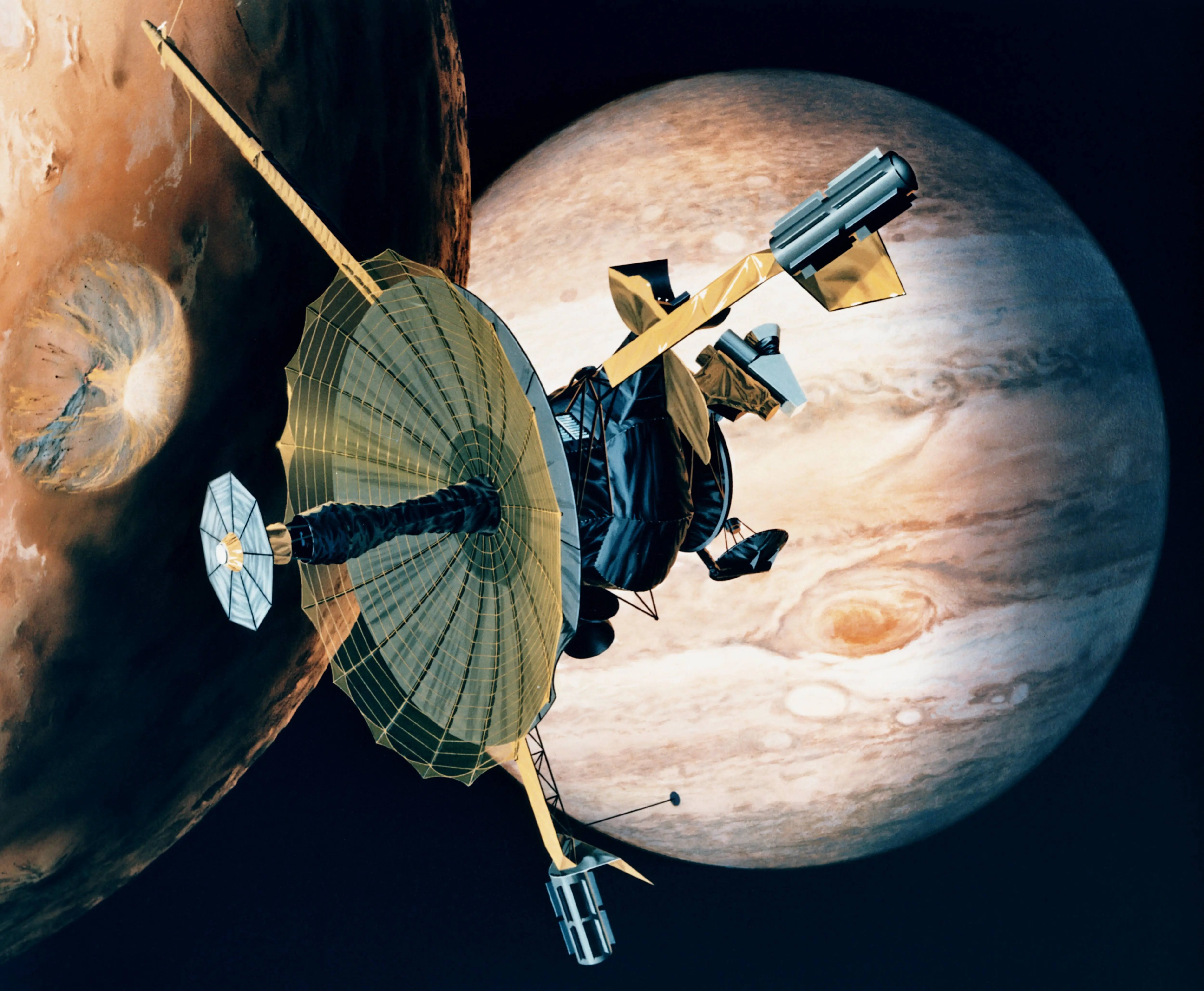 NASA's Galileo probe passing over one of Jupiter's 16 moons (Image via Getty)
NASA’s Galileo mission revealed an unusual spider-like or starburst-like mark on Jupiter’s moon, Europa, sparking a new discussion among scientists decades later.
Popularly called Damhán Alla or the “wall demon,” the mark on Jupiter’s icy moon Europa may be a spot where briny water once pushed up through cracks in the icy surface.
The mark was first observed by the Galileo spacecraft in the late 1990s; however, scientists are now drawing similarities between the spider-like mark and the features commonly seen on Earth’s frozen lakes, suggesting that the structure on Europa might be the result of “briny water eruptions beneath the ice.”
It has led scientists to discuss the possibility of “subsurface liquid water” and, eventually, life on Europa.
The scientists conducting the research are Prof. Lauren Mc Keown from the University of Central Florida, Trinity College Dublin alum Dr. Jennifer Scully, and several others from NASA’s Jet Propulsion Lab (JPL), Brown University, and the Planetary Science Institute.
The starburst structure comprises branch-like arms, resembling “lake stars” on Earth. Lake stars are branching patterns that form when snow falls on frozen lakes, creating ridges in the ice.
More details on the latest research on the star-like mark on Jupiter’s Europa
In a statement published by Trinity College Dublin, Prof. McKeown shared that she and Prof. Scully have been on the project together.
“Jen conducted a geomorphological analysis of the feature [star-like pattern] using images from Galileo, and I ran analogue experiments and field tests to examine our hypothesis,” Prof. McKeown said after their observations were published on December 2, 2025, in the Planetary Science Journal.
As for the name, Prof. McKeown stated that she and Prof. Scully named it Damhán Alla because they wanted the bizarre mark to have a name that would differentiate it from similar marks found on Mars formed by gas flow processes.
Unlike those found on Mars, researchers believed that the one on Europa may have formed after salty water seeped out of cracks in the ice.
According to Prof. McKeown, the research is “really exciting” and significant as it could indicate life on Europa.
“Surface features like this can tell us a lot about what’s happening beneath the ice. If we see more of them with Europa Clipper, they could point to local brine pools below the surface,” she added.
On Earth, star-shaped formations in lakes occur when snow falls on frozen bodies of water. After the snow falls on the lake’s surface, it creates holes, which allow the water below to come up and melt the surrounding snow.
As soon as the snow melts, it creates those branch-like ridges, giving the lake a star-like appearance.
According to the researchers leading the study, such phenomena were common in nature, pointing out the “movement of fluids and energy through different surfaces.”
The scientists believe that Europa’s star-like formation may have the same origin story; however, the only difference is that the water is salty.
The reason this has sparked a discussion among experts is that it could imply that small pockets of water are trapped beneath Europa’s frigid surface, rather than being completely frozen solid.
While the researchers continue their study using the images obtained from the Galileo mission, they hope that NASA’s Europa Clipper mission, set to reach Jupiter in April 2030, will provide them with higher-resolution images for further examination.
“It is wonderful to think that they may give us a glimpse into processes occurring on Europa and maybe even other icy ocean worlds in our solar system,” Prof. McKeown said.
Stay tuned for more updates.
TOPICS: Europa exploration, Jupiter, Moon, Star-like scar on Jupiter's Europa