
NASA's Expedition 74 carries out expanded biomedical and technology studies on the ISS
-
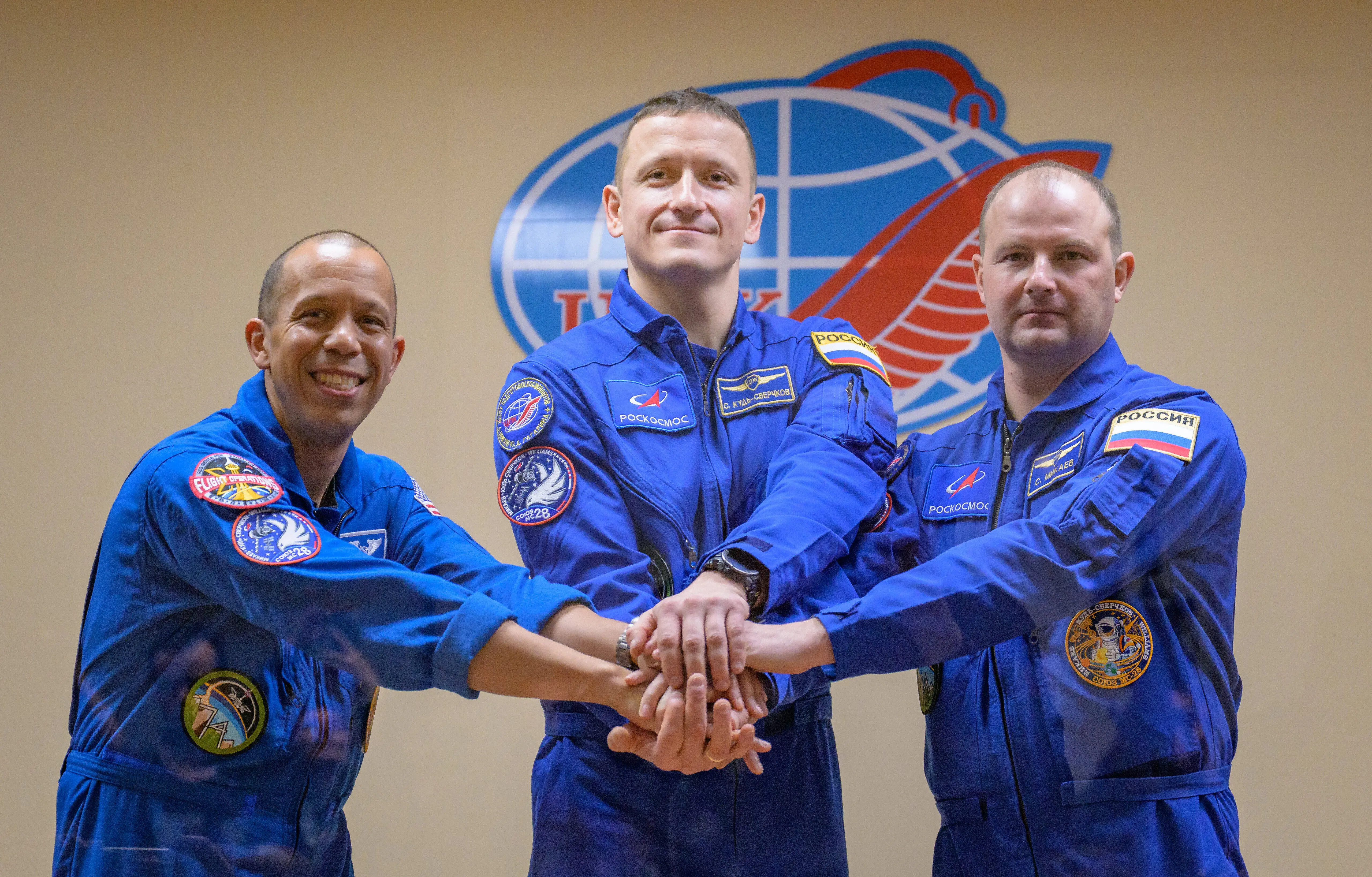 In this handout image provided by NASA, astronaut Chris Williams, left, and Roscosmos cosmonauts Sergey Kud-Sverchkov, and Sergei Mikaev, right, are seen in quarantine, behind glass, during a press conference at the Cosmonaut Hotel on November 26, 2025 in Baikonur, Kazakhstan. Expedition 74 crewmembers: NASA astronaut Chris Williams, Roscosmos cosmonauts Sergey Kud-Sverchkov and Sergei Mikaev, are scheduled to launch aboard their Soyuz MS-28 spacecraft on November 27 (Image via Getty)
NASA's Expedition 74 crew conducted a series of biomedical and technology investigations aboard the International Space Station, focusing on heart health, robotics and stem cell research.
Flight Engineer Zena Cardman installed sample cassettes into the Advanced Space Experiment Processor for the Pharmaceutical In-space Laboratory, which examines methods for pharmaceutical production in microgravity, according to NASA reports on December 15, 2025.
The crew also continued packing a Japanese cargo craft while maintaining and inspecting laboratory hardware. These operations contribute to ongoing efforts to expand research capabilities on the orbital outpost.
Expanded biomedical and technology research conducted by NASA’s Expedition 74 on the ISS
Robotic operations and material experiments
Cardman performed maintenance on the Astrobee free-flying robotic helpers, swapping memory cards and verifying the docking interface.
The cube-shaped Astrobees are positioned at the docking station for recharging, data transfer and system monitoring.
These devices are being prepared for an educational robotic challenge that enables students to program the robots remotely.
Cardman also set up hardware for the Indium Flow in Microgravity experiment in the Destiny laboratory module’s EXPRESS rack.
This study heats Indium to temperatures between 200 and 400 degrees Celsius to observe its behavior in microgravity, which could inform space repair techniques and improvements in satellite thrusters, as outlined by NASA.
The experiment also records detailed temperature and flow data to support engineering models for metal handling in space.
Cardiovascular and biomedical research
Roscosmos cosmonaut Oleg Platonov conducted research on the effects of microgravity and space radiation on the endothelium, the thin layer of cells lining blood vessels.
Electrodes and finger cuffs measured blood flow and pressure to provide data for cardiovascular studies applicable to both spaceflight and Earth-based health.
Flight Engineer Chris Williams analyzed stem cell samples using the KERMIT fluorescence microscope to examine their potential for enhanced manufacturing and regenerative medicine applications.
NASA reported that these investigations aim to expand biomedical knowledge in low-gravity environments.
Data from these studies will help refine medical protocols for long-duration missions and improve predictive models of cardiovascular risk in astronauts.
Cargo operations and station maintenance
Station Commander Mike Fincke managed the transfer of decommissioned life support hardware from the Tranquility module into the HTV-X1 cargo spacecraft from JAXA, scheduled for disposal in late January.
Cardman, Williams, and JAXA Flight Engineer Kimiya Yui assisted with these operations.
Besides that, Roscosmos Flight Engineer Sergey Kud-Sverchkov replaced the orbital plumbing gear in the Zvezda service module, and the crew performed inspections of module hatches, smoke detectors, and ventilation systems.
According to NASA updates on December 12 and 15, 2025, Flight Engineer Sergei Mikaev was involved in maintaining the ventilation system and took pictures of the flow converters for later analysis.
These maintenance activities ensure the continuous operation of critical systems and support upcoming scientific experiments on the station.
Sensory and vestibular studies
Expedition 74 also investigated balance and sensory adaptation in microgravity. Williams and Cardman participated in the CIPHER experiment, using virtual reality goggles and visual cues to study vestibular function, cardiorespiratory fitness and muscle performance.
Roscosmos Flight Engineers Kud-Sverchkov and Mikaev conducted similar sensory experiments for their Virtual study, tracking vision and equilibrium responses in weightlessness.
Japanese Aerospace Exploration Agency (JAXA) flight engineer Kimiya Yui put the material sample carriers in the Kibo module airlock for the robot exposure experiments that are going to be done outside the station.
These will evaluate the impact of space radiation and very low temperatures on the materials.
The major activities of the 74th space mission, along with the ongoing research in biomedicine, robotics and materials science on the International Space Station, are the direct result of the combined efforts of the crews.
All operations, scientific work and service performances were documented and coordinated through NASA and JAXA.
Stay tuned for more updates.
TOPICS: Expedition 74, International Space Station, ISS, ISS updates, JAXA HTV-X1 cargo operations, NASA, NASA Expedition 74