
Features
NASA's PExT demonstration supports reliable multi-network space communications
NASA’s PExT technology demonstration proves spacecraft can seamlessly switch between government and commercial networks, enhancing reliable communications, interoperability, and future commercial partnerships for missions in near-Earth and beyond.
-
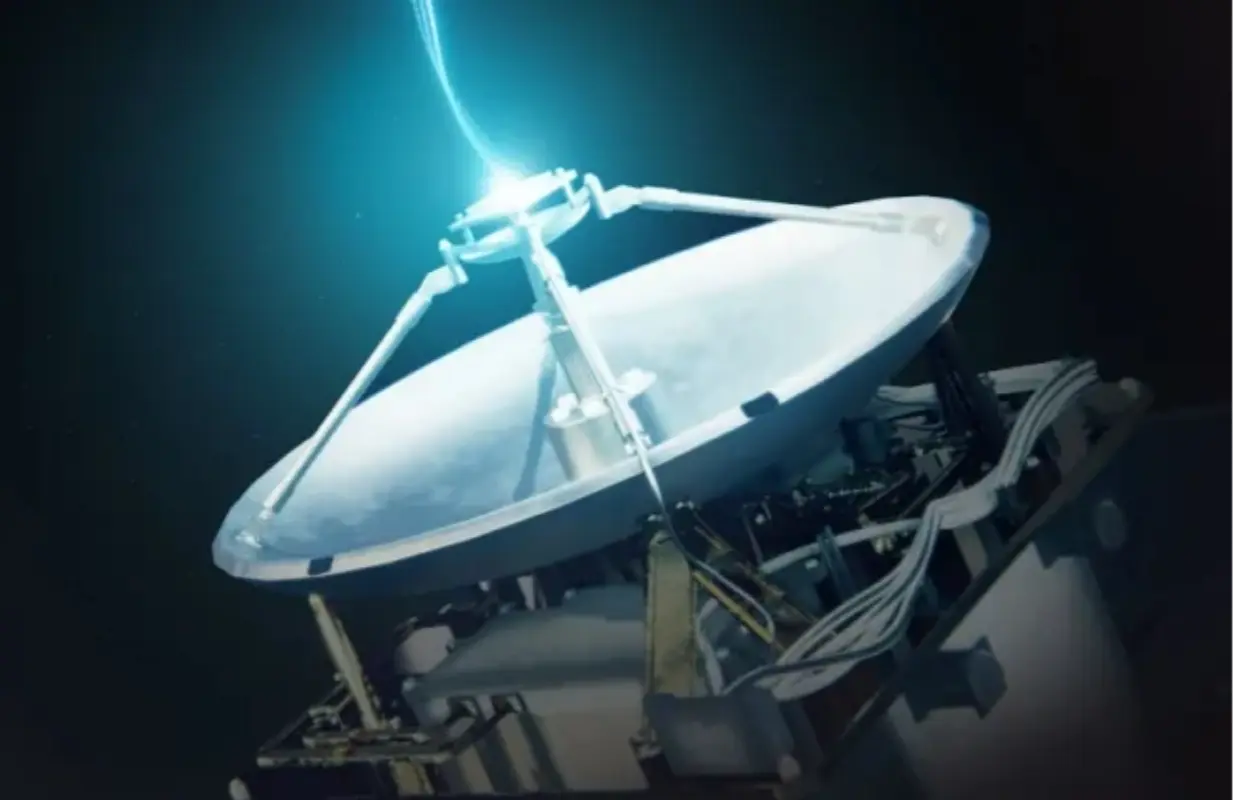 An artist’s concept of the Polylingual Experimental Terminal transmitting data in space (Image via NASA)
NASA’s Polylingual Experimental Terminal, or PExT, technology demonstration is testing whether spacecraft can switch seamlessly between government and commercial communications networks, similar to how cell phones roam between networks on Earth.
The demonstration aims to support NASA missions with reliable communications for navigation, spacecraft health monitoring, and scientific data transmission.
According to NASA, on December 19, 2025, PExT has proven that interoperability between government and commercial satellite networks is possible near Earth.
The demonstration also contributes to NASA’s plans to expand commercial partnerships for future missions to the Moon and Mars.
Wideband technology and interoperability
Wideband technology enables data transmission across a broad range of frequencies, allowing NASA missions to connect with multiple communication networks.
This capability supports interoperability between government assets, such as NASA’s Tracking and Data Relay Satellite (TDRS) fleet, and commercial networks operated by SES Space & Defense and Viasat.
Kevin Coggins, deputy associate administrator for NASA’s Space Communications and Navigation Program, stated that the demonstration shows government and commercial network integration is achievable, enhancing mission reliability.
Wideband terminals can continue to use updated commercial network features even after launch and during active mission operations.
The technology also allows missions to switch automatically between networks in case of signal degradation or outages, ensuring continuous connectivity.
PExT demonstration mission
The PExT payload launched on July 23, 2025, aboard the BARD spacecraft, provided by York Space Systems and developed by Johns Hopkins Applied Physics Laboratory.
The compact wideband terminal communicates over Ka-band frequencies, commonly used by both NASA and commercial satellites.
The demonstration included real-time spacecraft tracking, mission command execution, and high-rate data transmission.
Tests involved coordination between the BARD spacecraft, NASA’s TDRS fleet, and commercial satellites.
The successful completion of these operations demonstrated that future NASA missions could maintain communications across multiple networks without interruption, providing redundancy in case of network disruptions.
The demonstration also validated the terminal’s ability to operate with multiple commercial partners simultaneously, proving its compatibility with diverse satellite infrastructures.
Extended testing and future applications
Due to the mission’s results, NASA extended the PExT demonstration for an additional 12 months.
Planned activities include new direct-to-Earth communication tests with the Swedish Space Corporation, beginning in early 2026.
The extended testing period will continue through April 2027. NASA intends to purchase satellite relay services for low Earth orbit science missions from U.S. commercial providers by 2031.
The demonstration is part of NASA’s broader effort to commercialize space communications through public-private partnerships, allowing missions to access commercial services while maintaining interoperability with government infrastructure.
PExT’s demonstration is funded and managed by NASA’s SCaN Program within the Space Operations Mission Directorate at NASA Headquarters.
York Space Systems provided the host spacecraft, and Johns Hopkins Applied Physics Laboratory developed the payload.
Commercial satellite tests were conducted with SES Space & Defense and Viasat.
Greg Heckler, capability development lead at NASA SCaN, explained that the demonstration validates wideband terminals as a means for missions to access multiple networks, similar to the evolution of cellular networks.
The PExT demonstration marks a first-of-its-kind in-flight test enabling spacecraft to communicate with both government and commercial networks.
Wideband terminals provide multiple access points, lower latency, and potential cost savings for future NASA missions transitioning to commercial networks.
The ongoing tests will continue to support NASA’s plans for expanding near-Earth commercial communications infrastructure and applying these capabilities to missions beyond low Earth orbit.
Stay tuned for more updates.
TOPICS: NASA PExT demonstration, future NASA missions, NASA, NASA SCaN program, NASA updates, Polylingual Experimental Terminal