
Neil Patrick Harris sets the tone as What's in the Box? turns prizes into liabilities
-
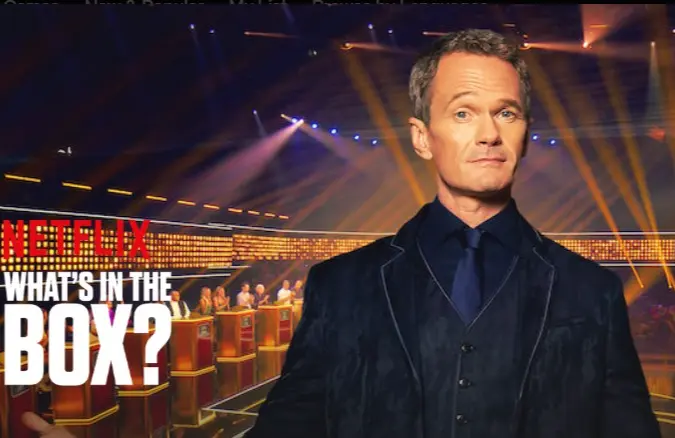 Neil Patrick Harris (Image via Netflix)
Neil Patrick Harris sets the tone as What’s in the Box? turns prizes into liabilities from its opening moments, introducing a competition format where winning early creates risk rather than safety.
The Netflix series establishes its central rule quickly: prizes can be stolen, swapped, donated, or used against their holders, transforming success into exposure.
The premiere episode introduces eight pairs of contestants standing before 13 sealed gold boxes, each containing a high-value reward. Harris explains the premise succinctly:
“If you can open a box… you win what’s inside.”
He immediately follows with the condition that defines the game:
“Once you’ve won a prize, you’ve got to hold on to it.”
From the first box, What’s in the Box? makes clear that control, not knowledge alone, determines survival.
Teams earn access to boxes by answering nearest-number and ordering questions, then search a grid for three key words that unlock each prize. Decoy words and Wildcards interrupt progress, often reversing fortunes instantly.
The Open Road box exemplified the show’s structure. Binh and Andrew initially seized control after answering closest on the Empire State Building window question.
They identified one correct keyword but lost control due to a “Lose Control” Wildcard, sending them back into the contestant pool and reopening the box to others.
Luke and Leona advanced next, correctly identifying “electric” as a keyword before triggering a “Who’s Next” Wildcard.
Forced to choose another team to take their place, they selected Macy and Jasmine, introducing alliance-based strategy into the game’s opening hour.
From its opening box to its final Wildcard, What’s in the Box? frames every win as temporary, ensuring that momentum never settles and that no team can protect a prize without consequence.
What’s in the Box? establishes risk through power shifts
Macy and Jasmine’s turn redefined the stakes. They completed the Open Road box by identifying “vehicle” and “luxury” alongside “electric,” opening the box to reveal a Lucid Air Pure electric vehicle. Harris then escalated the moment by adding a second car, declaring,
“How ’bout two Lucid cars, baby?”
The reward immediately painted a target on the pair. Harris acknowledged the shift onscreen, noting they had taken the lead and would now face heightened attention from competitors. Contestants reacted accordingly, with Luke stating,
“I am comin’ for those cars.”
Throughout the episode, Harris functioned as both narrator and enforcer, clarifying consequences without softening outcomes.
When Freeze Out, Steal, and Extra Turn Wildcards appeared, he paused gameplay to outline their effects precisely, ensuring players understood the cost of each reveal.
The Crowd Control box reinforced the show’s core mechanic. Binh and Andrew used a Freeze Out Wildcard to block Macy and Jasmine from participating in that box entirely, illustrating how possession invites retaliation.
Later, Joey and Scott capitalized on ordering questions to complete “music festival experience,” claiming the box while surviving multiple near-eliminations.
By the end of Episode 1, What’s in the Box? had firmly established its identity. Knowledge earned access, but endurance depended on navigating shifting alliances, absorbing losses, and managing visibility. Harris summarized the premise earlier in the episode when he said,
“It’s a battle for power and possession.”
The premiere concluded with a reset rather than a resolution, signaling that no prize remains safe for long.
What’s in the Box? positions every victory as temporary and every advantage as negotiable, setting the tone for a season defined by reversals rather than accumulation.
Stay tuned for more updates.
TOPICS: What's in the Box?, Netflix, Neil Patrick Harris