
New gravitational lensing study adds evidence to The Hubble Tension debate
-
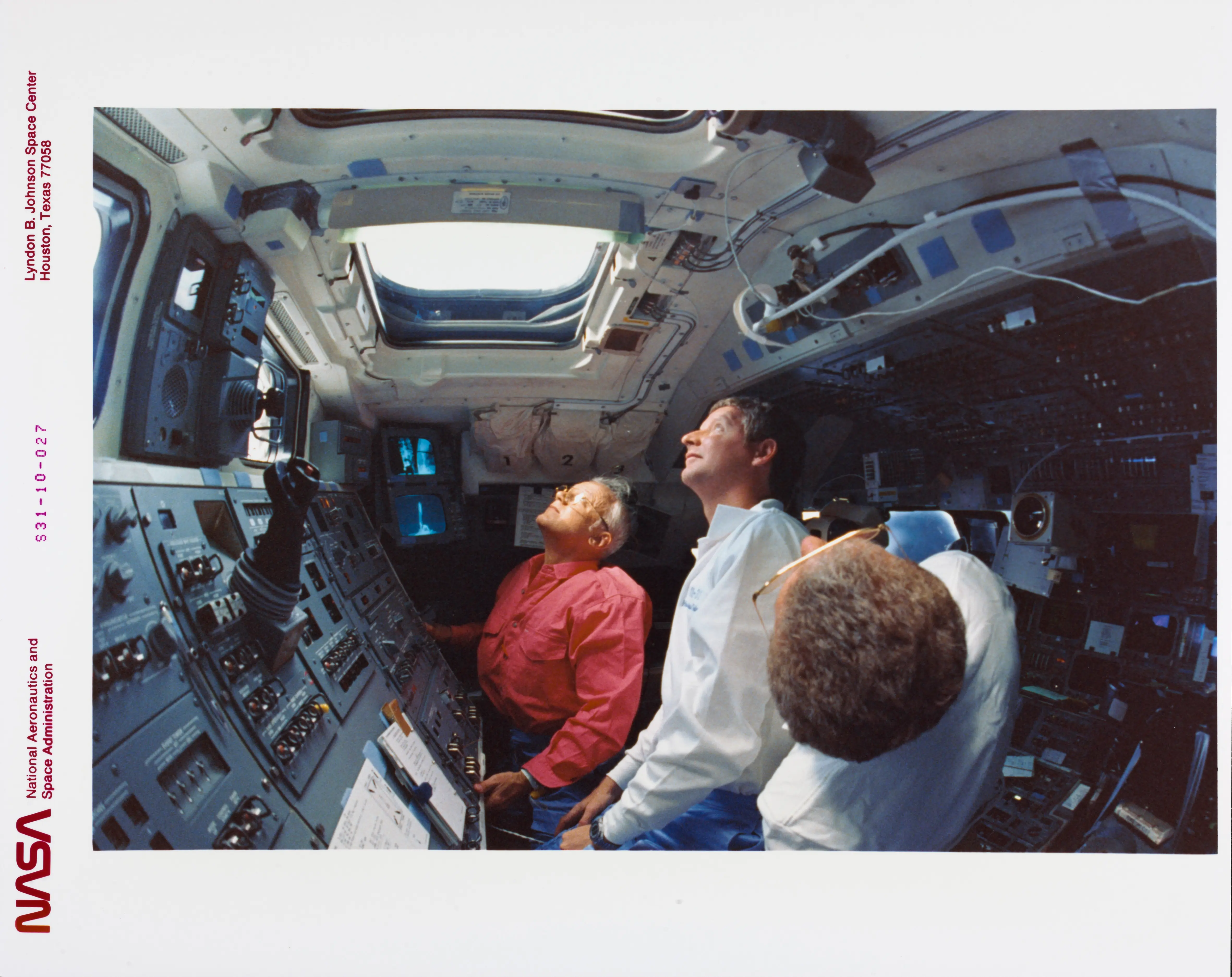 STS-31 NASA Mission crew members monitoring the Hubble Space Telescope (HST) deployment checkout procedures, from Space Shuttle Discovery, Orbiter Vehicle (OV) 103, 24th-29th April 1990; they are are Commander Loren J Shriver, Mission Specialist (MS) Steven A Hawley, and MS Bruce McCandless II (1937 - 2017) looking up at overhead windows W7 and W8 and the HST on the remote manipulator system (RMS) outside them (Image via Getty)
The Hubble Tension refers to the persistent difference in measurements of the Hubble Constant, the value that describes the rate at which the universe is expanding.
A recent study by the TDCOSMO Collaboration provides updated Late Universe measurements using gravitational lensing of quasars, supporting the existence of this discrepancy.
The study reports a Hubble Constant of 74.3 kilometers per second per megaparsec, consistent with previous Late Universe measurements and statistically distinct from Early Universe values derived from the Cosmic Microwave Background.
According to Universe Today and NASA, the findings confirm that the tension is not an artifact of measurement errors, using an alternative method and updated observational data.
New measurements using gravitational lenses support The Hubble Tension
Hubble constant and the discrepancy
The Hubble Constant defines the relationship between the distance to an astronomical object and the speed at which it moves away from Earth.
Late Universe measurements rely on observable objects such as quasars, Cepheid variable stars, and Type 1a supernovae.
These objects have known properties that allow astronomers to estimate distances. By measuring their redshift and comparing it to expected luminosities, scientists calculate the expansion rate of the universe.
Late Universe techniques generally produce values around 73 kilometers per second per megaparsec.
Early Universe measurements, in contrast, examine the Cosmic Microwave Background, the radiation from the early universe shortly after the Big Bang.
This method typically yields a Hubble Constant around 67 kilometers per second per megaparsec. The approximately 6-kilometer difference between these two approaches has persisted through decades of research.
NASA notes that this discrepancy influences calculations of the universe’s expansion rate and estimated age, which space telescope observations have refined to about 13.8 billion years.
The difference between Early and Late Universe measurements is referred to as the Hubble Tension.
Gravitational lensing method
The TDCOSMO study uses a gravitational lensing technique that differs from the traditional local distance ladder method.
Gravitational lensing is a phenomenon where the light from a faraway quasar is bent by a massive foreground galaxy, and hence multiple images of the same object are produced.
By observing time delays in events happening in the quasar images, scientists can figure out differences in the light paths.
These results, along with the mass of the lensing galaxy, offer a value of the Hubble Constant.
The study is largely about dealing with the Mass-Sheet Degeneracy that can warp the figures if the galaxy’s mass is not distributed in a way that is accurately measured.
By looking at stellar kinematics in the lensing galaxies, scientists become able to ascertain the mass more accurately because the stars moving more rapidly point to a more massive galaxy.
The movements of these stars that allowed for the gravitational lens to be modeled more accurately were measured using data from the James Webb Space Telescope and other cutting-edge instruments.
Study results and implications
Using eight gravitational lens systems, the TDCOSMO Collaboration calculated a Hubble Constant of 74.3 kilometers per second per megaparsec, aligning closely with previous Late Universe measurements.
Universe Today emphasizes that this value is derived using a completely different method than the traditional distance ladder, reducing the likelihood that the discrepancy is caused by observational errors.
The study’s results confirm that Late Universe measurements are consistent across independent techniques and differ from Early Universe measurements, demonstrating that the Hubble Tension persists.
Although the study does not provide a solution to the Hubble Tension, it validates its existence.
Continued observations of gravitational lenses, combined with measurements from telescopes such as Hubble and Webb, will support further investigation.
NASA notes that understanding this discrepancy may require revising models of the universe, testing alternative theories of gravity, or considering additional early universe phenomena.
Stay tuned for more updates.
TOPICS: Hubble Tension, Hubble Constant, Cosmic Microwave Background, Gravitational lensing, James Webb Space Telescope Hubble Constant, Late Universe measurements, NASA Hubble Space Telescope, TDCOSMO Collaboration