
New NASA and ESA images show 3i/Atlas glowing with activity as the interstellar comet prepares for its December close flyby
-
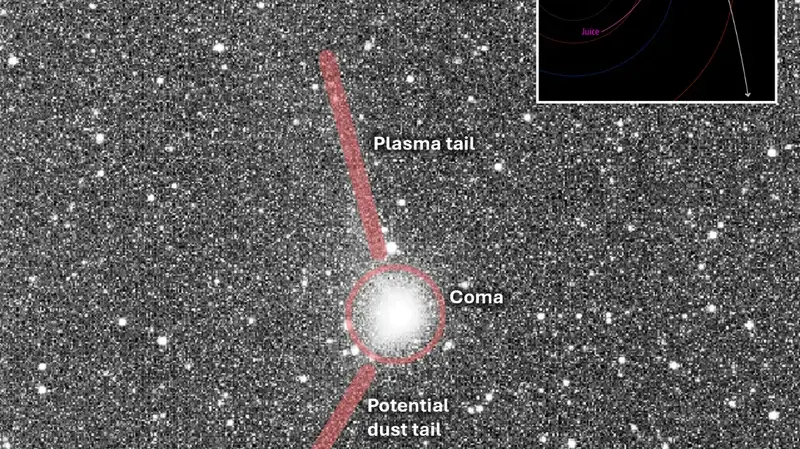 Image via science.nasa.gov
NASA and the European Space Agency have shared new photos of the interstellar comet 3I/ATLAS, and the pictures show the comet glowing beautifully as it slowly makes its way toward Earth this month. The tone around it is calm but curious.
Scientists say there is nothing to worry about, but it is still a rare moment because comets from outside our solar system almost never pass by us.
A comet that came from very far away
3I/ATLAS was first seen in July this year. Soon after, scientists realised it was not a normal comet that circles the sun. It came from far beyond our solar system, which makes it only the third such visitor ever found.
It has been travelling through space for millions or even billions of years, moving extremely fast. It entered our solar system from the direction of the Sagittarius constellation. And just like the earlier interstellar objects, it will not stay. It is on a one-way path and will eventually leave again after passing by us.
What Hubble saw in its new image
NASA’s Hubble Telescope photographed the comet on November 30. At that time, the comet was still very far — about 178 million miles away. In the picture, the stars behind the comet appear as long lines, simply because Hubble was following the comet as it moved.
Scientists think the solid centre of the comet is quite small, but the gas and dust around it make it look much larger and brighter than it really is.
ESA’s Juice spacecraft also spotted activity
ESA’s Juice spacecraft, which is on its way to study Jupiter’s moons, also took a photo when the comet was most active right after it passed close to the sun. Only a small part of the picture has reached Earth so far, but even that shows a shining cloud around the comet and two tails — one made of gas and one made of dust. This is a sign that the sun’s heat is waking up the comet and making it shed more material.
How close will it come?
The comet will pass closest to Earth on December 19, still about 170 million miles away. This is a safe distance. It cannot be seen with just the eyes, but people with telescopes may be able to catch it in the early morning sky until next spring.
NASA clears the rumours
Some people online wondered if the comet could be something unusual or even a spacecraft. NASA has clearly said this is not the case. All signs so far show it is simply a natural comet behaving as expected.
For now, scientists are enjoying this rare chance to study a visitor from far beyond our solar system, something we do not get to see very often.
TOPICS: 3I/ATLAS, 3i/ATLAS recent updates
- Rare interstellar comet 3i/Atlas set to fly past Earth safely on December 19, scientists confirm
- Interstellar comet 3I/ATLAS shows a growing green glow as its chemistry evolves
- Gemini North observations show changes in Interstellar Comet 3I/ATLAS after perihelion
- "They should focus on national security": Avi Loeb critiques the government’s approach to UAPs and 3I/ATLAS data