
New study finds interstellar object 3I ATLAS behaves like "pretty typical of ordinary comets"
-
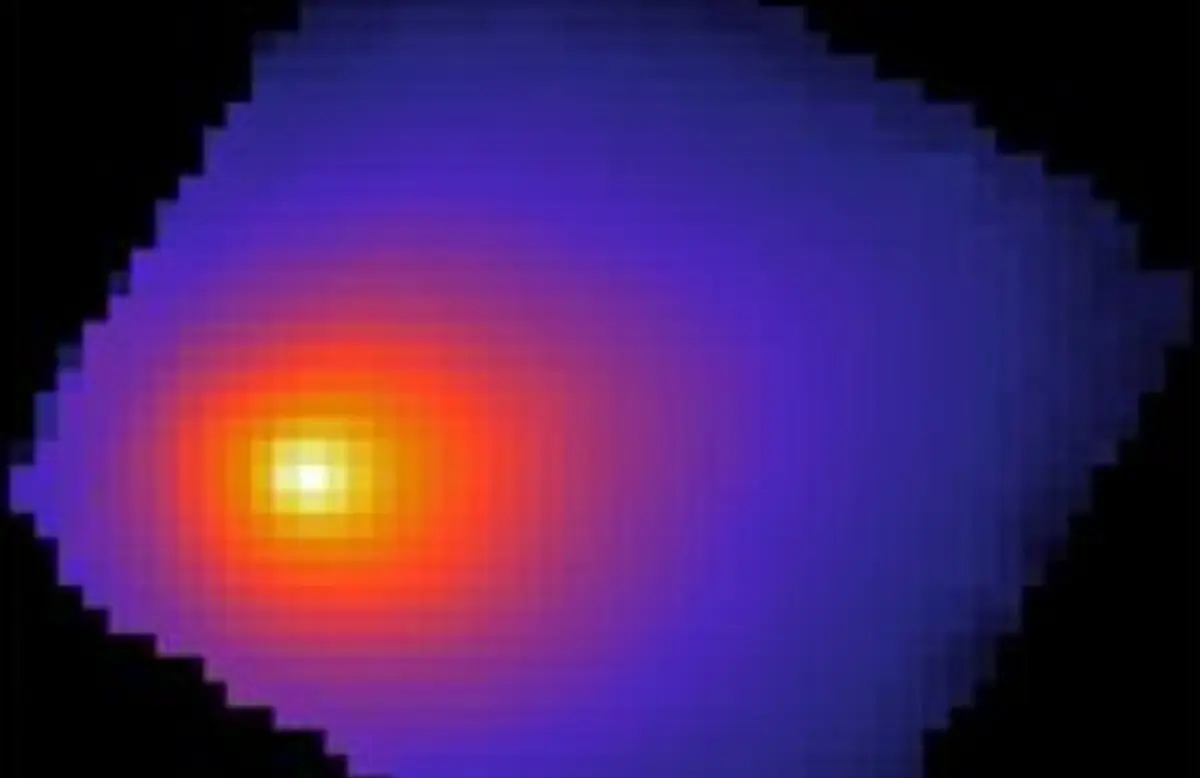 Comet 3I/ATLAS (Image via NASA)
Comet 3I/ATLAS, the third confirmed interstellar object to pass through the Solar System, exhibits characteristics consistent with ordinary comets.
According to a recent study published in Research Notes of the American Astronomical Society, its non-gravitational acceleration is caused by outgassing from the nucleus, a process that produces a small push on the comet along its trajectory.
Lead author Marshall Eubanks explained,
"We measured the non-gravitational acceleration of 3I/ATLAS using long-baseline astrometry from NASA’s Psyche spacecraft and ESA’s Mars Trace Gas Orbiter. The results are pretty typical of ordinary comets, and certainly not record-breaking."
SpaceWeather also noted that the observed acceleration does not indicate an artificial origin, clarifying that all comets experience non-gravitational effects from sublimating material.
Study finds that Interstellar Comet 3I/ATLAS shows standard comet properties
Discovery and observational history
NASA’s ATLAS (Asteroid Terrestrial-impact Last Alert System) survey telescope in Rio Hurtado, Chile, first reported observations of 3I/ATLAS on July 1, 2025.
Archival pre-discovery images were collected from three additional ATLAS telescopes worldwide and from the Zwicky Transient Facility at Caltech’s Palomar Observatory, extending the observational record to June 14, 2025.
NASA identifies 3I/ATLAS as interstellar because its orbit is hyperbolic, meaning it does not follow a closed path around the Sun.
The comet’s name reflects its discovery system, with "I" indicating interstellar origin and "3" marking it as the third confirmed interstellar object.
The comet poses no threat to Earth. NASA reports that the closest approach will be 1.8 astronomical units, roughly 270 million kilometers.
Perihelion is expected around October 30, 2025, at 1.4 astronomical units from the Sun, just inside Mars’ orbit.
Observations are ongoing through September 2025 before the comet moves too close to the Sun, with renewed monitoring scheduled in December 2025.
Non-gravitational acceleration and physical properties
The non-gravitational acceleration of 3I/ATLAS arises from jets of icy material sublimating from the nucleus, producing a small recoil force. Eubanks explained,
"Until recently, finding non-gravitational accelerations in comets required observations over multiple orbits—which we will never have for interstellar objects. Now, using interplanetary spacecraft, we can measure these small accelerations—just a few hundred millionths of Earth’s gravity—during a single flythrough of the solar system."
In the case of 3I/ATLAS, the acceleration is about 5 × 10⁻⁷ m s⁻², which is similar to that of small comets from the Solar System.
The scientists used this value together with the carbon dioxide production data to calculate the mass of the comet as being close to 44 million metric tons and its radius somewhere between 260 and 370 meters, i.e., a normal size for a comet.
SpaceWeather highlighted that non-gravitational acceleration in comets is a natural effect and does not indicate an artificial origin.
The recoil produced by outgassing acts as a minor propulsion, nudging the comet along its orbit.
This distinguishes 3I/ATLAS from 1I/‘Oumuamua, the first known interstellar object, which showed acceleration without visible outgassing.
Observations from NASA and ESA assets
NASA continues to monitor 3I/ATLAS with various assets such as Hubble, Webb, TESS, Swift, SPHEREx, the Mars Reconnaissance Orbiter, MAVEN, the Perseverance rover, Europa Clipper, Lucy, Psyche, Parker Solar Probe, and PUNCH.
Hubble observations on July 21, 2025, showed a teardrop-shaped dust halo around the nucleus, thus confirming the active outgassing.
The estimates of the diameter vary from 440 meters to 5.6 kilometers. SOHO, ESA/NASA, and other spacecraft are sources of more data to determine its trajectory, physical characteristics, and composition.
The joint observations provide an accurate model of 3I/ATLAS's acceleration and the size of its nucleus thereby giving a strong indication that its characteristics are those of a small cometary one from the Solar System.
Stay tuned for more updates.
TOPICS: 3I/ATLAS comet, 3I/ATLAS outgassing, 3i/ATLAS recent updates, ESA Psyche Mars Trace Gas Orbiter, interstellar comet 2025, interstellar objects Solar System, NASA 3I/ATLAS observations, non-gravitational acceleration comets
- Why interstellar comet 3I/ATLAS could reshape what we know about planet formation
- Interstellar comet 3I/ATLAS shows a growing green glow as its chemistry evolves
- Gemini North observations show changes in Interstellar Comet 3I/ATLAS after perihelion
- New image reveals comet 3I/ATLAS emerging from behind the Sun over Egypt