
Who was Barbara Rose Johns? Robert E. Lee statue in US Capitol replaced with civil rights icon
-
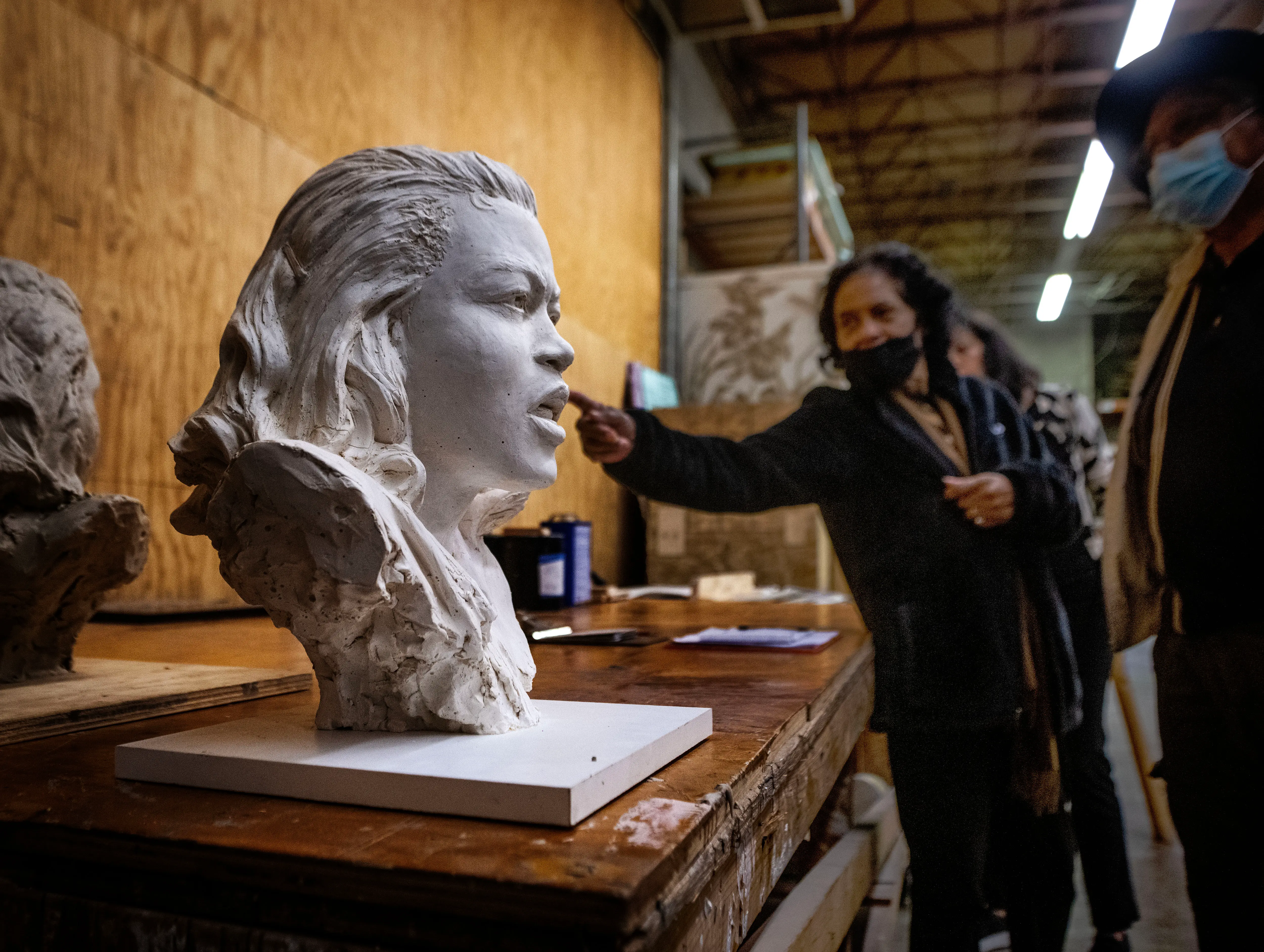 MT. RANIER, MD - MARCH 24: Family members of the late Barbara Rose Johns study versions of her likeness sculpted by Steven Weitzman, who is sculpting a statue of her to replace Robt. E. Lee in the Capitol, in his studio in Mt. Ranier, MD. (Photo by Bill O'Leary/The Washington Post via Getty Images)
A statue of teen civil rights icon Barbara Rose Johns Powell has replaced that of Confederate general Robert E. Lee at the US Capitol, five years after the latter’s removal. Virginia Governor Glenn Youngkin unveiled the bronze sculpture on Tuesday, December 16, commemorating the late activist.
Barbara Rose Johns, niece of civil rights leader and preacher Vernon Johns, is widely known for leading protests against racial segregation during the 1950s. Born in New York City in 1935, she grew up in Prince Edward County, Virginia.
At 16, Powell was a student of Robert Russa Moton High School in Farmville. The all-Black institution was segregated based on the race of the students. According to The New York Times, the school lacked basic amenities such as laboratories, a gym, and a cafeteria.
A page dedicated to Barbara Rose Johns on the attorney general of Virginia’s website notes that the segregation was constitutionally justified by the discredited legal doctrine of “separate but equal.” The website states:
“‘Separate but equal’ rulings infamously stated that it was legal for government entities and institutions to keep people of different races apart, as long as the resources were the same in value and quality.”
In 1951, Barbara Rose Johns led a student walkout against the lack of resources at R. R. Moton High School. The demonstration drew the NAACP’s attention and later led to the landmark Davis v. County School Board of Prince Edward County case. It became one of the five cases, which combined into Brown v. Board of Education.
Eventually, the US Supreme Court declared the racial segregation of students in public schools unconstitutional. Following the monumental legal victory, Barbara Rose Johns studied at Drexel University and earned a degree in library science. She married William Powell, moved to Philadelphia, and raised five children.
Barbara died in 1991 of bone cancer and was commemorated by Virginia in December 2025. Her statue was approved to replace that of the Confederate general in December 2020.
Conservative internet users criticize the VA governor after the statue of Barbara Rose Johns was replaced by Robert E. Lee's sculpture
Today we gathered in Emancipation Hall of the U.S. Capitol to dedicate the Barbara Rose Johns statue, to honor her legacy as a trailblazer, and ensure her story of courage and conscience is a story for generations to come.
— Governor Glenn Youngkin (@GovernorVA) December 17, 2025
You can’t tell the story of Virginia, or the story of… pic.twitter.com/lO7MjFDLmkVirginia Governor Glenn Youngkin shared some pictures from the US Capitol's Emancipation Hall, unveiling the bronze sculpture dedicated to the teen civil rights icon. The Republican politician wrote in an X post:
“Today we gathered in Emancipation Hall of the U.S. Capitol to dedicate the Barbara Rose Johns statue, to honor her legacy as a trailblazer, and ensure her story of courage and conscience is a story for generations to come.”
He added:
“You can’t tell the story of Virginia, or the story of how our nation overcame segregation, without telling the story of Barbara Rose Johns.”
The tweet was met with opposition from conservative netizens, primarily the MAGA supporters.
“We could have honored her without erasing Robert E. Lee. You should know better than this,” a user wrote.
“Robert E. Lee statue should be put in the front of the capital,” another user declared.
“We want the statue of Robert E. Lee back, it was stolen from us,” one user asserted.
“Can’t think of a bigger disappointment than Youngkin,” another one added.
A user came up with a suggestion:
“Why not just add Barbara? Don't know why they had to tear down Robert E Lee. Robert E Lee was first offered to command the Union army, which he turned down to serve Virginia.”
However, unlike the user suggested, only two statues per state are allowed. Until December 2020, the bronze sculptures of George Washington and Robert E. Lee were commissioned by the state of Virginia. While the statue of the first president of the US remained a part of the National Statuary Hall Collection, the Confederate general’s sculpture was removed.
Former Virginia Governor Ralph Northam requested a bill to remove the statue of ideas from Representatives Jennifer Wexton and the late A. Donald McEachin. They wrote in a letter (via The Hill):
“These statutes aimed to rewrite Lee’s reputation from that of a cruel slave owner and Confederate General to portraying him as a kind man and reluctant war hero who selflessly served his home state of Virginia.”
They asserted:
“As Virginians, we have a responsibility to not only learn from but also confront our history. As part of this responsibility, we must strive for a more complete telling of history by raising up the voices, stories, and memories of minorities and people of color.”
Early this morning, I witnessed the removal of the Robert E. Lee statue from the U.S. Capitol.
— Rep. Jennifer Wexton (@RepWexton) December 21, 2020
It was a historic & overdue moment.
I’m proud the work @RepMcEachin & I started a year ago led to this. We deserve to be represented by a figure who truly embodies Virginia’s values. pic.twitter.com/EIZwNaO8pXAfter it was confirmed that a statue of Barbara Rose Johns will replace that of Robert E. Lee, Rep. Wexton welcomed the decision in a tweet and expressed pride over her and McEachin’s work. She wrote in December 2020:
“Early this morning, I witnessed the removal of the Robert E. Lee statue from the U.S. Capitol. It was a historic & overdue moment. I’m proud the work @RepMcEachin & I started a year ago led to this. We deserve to be represented by a figure who truly embodies Virginia’s values.”
Robert E. Lee’s statue was removed and relocated to the Virginia Museum of History & Culture.
TOPICS: Civil rights movement, Barbara Rose Johns, Robert E. Lee, Protests, Virginia