
Why are the iconic doughnut signs disappearing from California? Report explains disappearance
-
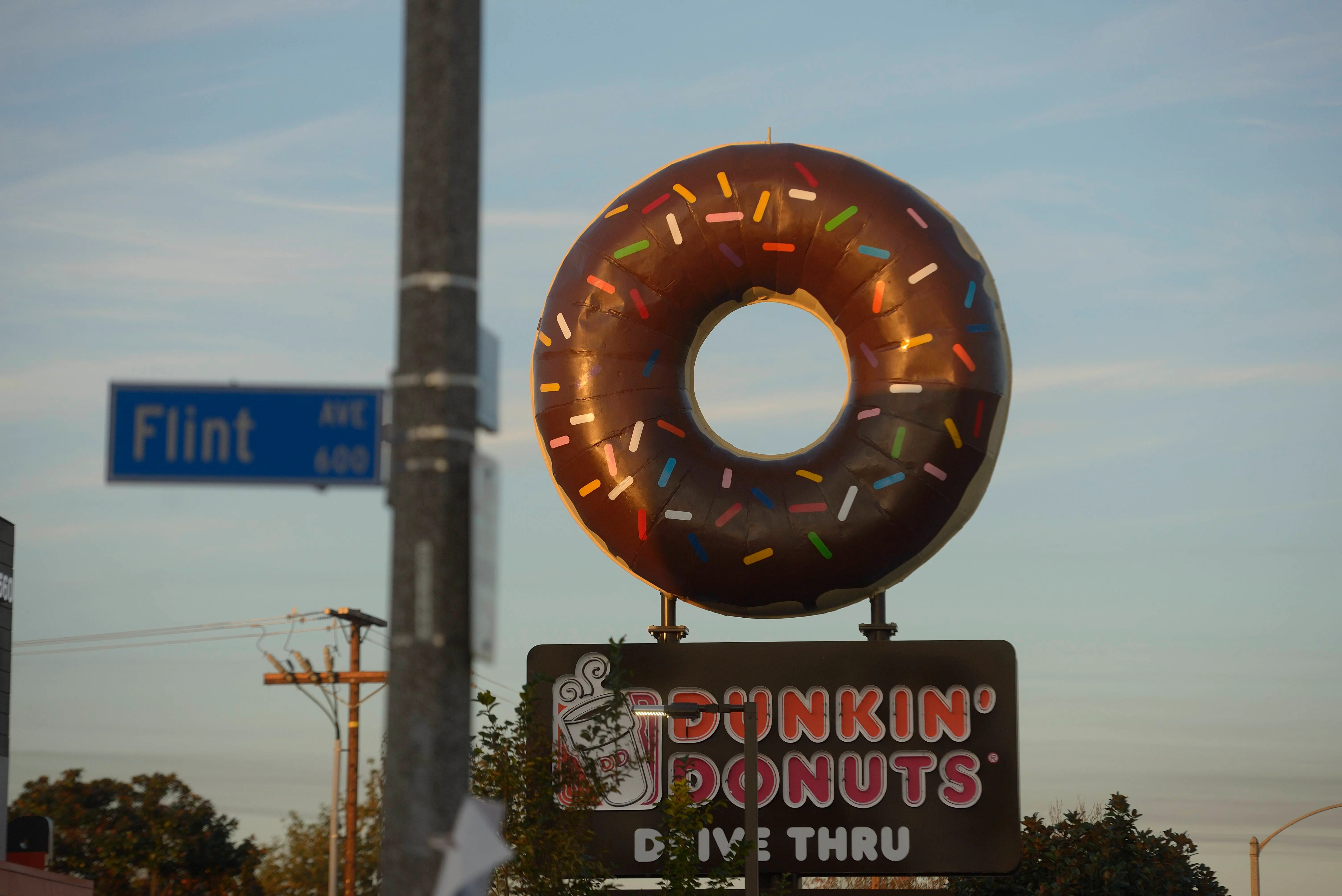 A giant donut sits atop a Dunkin' Donuts sign on Seventh Street in Long Beach (Image via Getty)
The gigantic doughnut-shaped signs spread across Southern California are gradually disappearing.
The signs, which are "almost like the Hollywood sign, in some ways," according to Adrian Scott Fine, president of the LA Conservancy, are so iconic that they appear in major films and music videos, including Iron Man 2 and Justin Timberlake's song Can't Stop the Feeling.
"If you're going to experience LA, you need to experience a giant doughnut," Adrian told SFGATE in a report published on December 7.
According to Fine, when the signs were first built, they sat on "spaces that were vacant land, and the area hadn’t really developed yet, or it was kind of happening at the same time, and so land wasn’t as expensive." But as the neighborhoods grew, "these were often located on sites that were suddenly very desirable and much more valuable than having a tamale or a bulldog sitting on it."
Another reason why the signs are disappearing is the increasing "development pressures of the city that was growing," added Fine.
California’s giant doughnut signs are slowly melting away https://t.co/HgOxjPb4gl pic.twitter.com/cEn29WfcLn
— New York Post (@nypost) December 12, 2025
"We've lost a lot": Adrian Scott Fine on the disappearance and rebuilding of the iconic doughnut signs
Furthermore, Adrian Scott Fine emphasized that while it may seem many giant doughnuts still exist, a significant number have already disappeared over time.
"While it may seem like we still have a lot of the giant doughnuts, we’ve lost a lot. Although there are more efficient ways to build something like this now, a modern big doughnut would be cost-prohibitive given different building and seismic codes. It would be much more difficult to actually achieve that today," he said.
Fine also shared that local communities in Southern California have helped preserve some giant doughnut signs. He explained that when a new business was about to replace an old Angel Food Doughnut location in Long Beach, residents protested the removal of the large pale pink doughnut, calling it a "landmark."The new tenant eventually agreed to keep the doughnut.
"'No, we love this doughnut. It is a landmark to us,' said the people," Fine said.
Fine added:
"It's very much part of the culture of the community that people came out for."
According to the outlet, the big doughnut figures were part of a trend in Los Angeles called programmatic architecture, which started in the 1920s and 1930s. During this time, businesses started to build their buildings in the shape of what they sold, in an attempt to attract passing cars.
"It was all about just super-sizing whatever it is that you were selling," Fine told the outlet.
He continued:
"In some ways, the doughnut was a resurgence of the earlier proliferation of: whatever product you were selling, you made it bigger so that you would attract somebody driving by to stop and spend some money. This is really dusting off an old idea."
Although there is no exact official number of how many giant doughnut signs still exist, architectural surveys estimate that fewer than a dozen of them still exist, including Randy’s Doughnuts in Inglewood, Dale’s Donuts in Compton, the Donut Hole in La Puente, and Donut King in Gardena, per The New York Post.
TOPICS: Doughnut, Southern California