
Avi Loeb discusses how the anti-tail of 3I/ATLAS appears to flip without responding to solar radiation
-
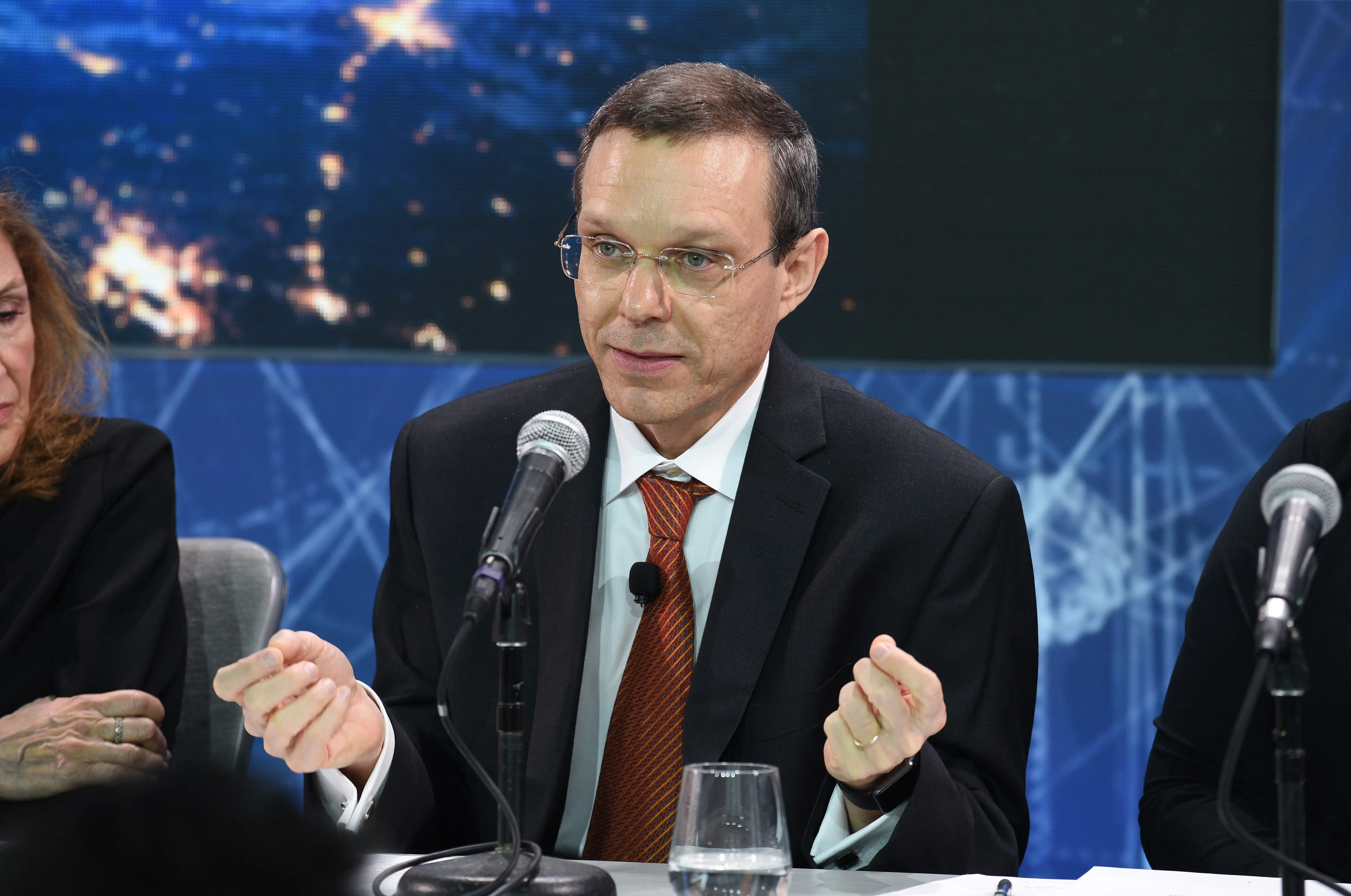 Avi Loeb (Image via Getty)
In a recent Medium post, published on December 9, 2025, Avi Loeb suggested that the images of 3I/ATLAS obtained through the Hubble Space Telescope before and after perihelion showed the “orientation of the anti-tail flipped relative to the direction of motion at perihelion.”
According to Loeb, the unique feature of the anti-tail can not be dismissed as “a matter of perspective,” as was the case with other natural comets.
In general, the anti-tail should have pushed away from the sun, especially due to the solar radiation and wind.
However, that did not seem to be the case for interstellar object 3I/ATLAS. As a result, Loeb deduced that its anti-tail must “contain something else.”
The Harvard physicist claims that 3I/ATLAS’s anti-tail is comprised of either “fragments of ice” which sublimate “before turning around” or large components that remain unaffected by radiation or wind.
The anti-tail has remained one of the primary anomalies of the interstellar object, as documented by Loeb, ever since its first reported discovery in July 2025.
Loeb has since urged experts to remain open to the possibility that it is a technological entity, despite NASA’s insistence on it being a natural comet.
Harvard physicist Avi Loeb highlights the unusual nature of interstellar object 3I/ATLAS’s anti-tail
The discussion about the anti-tail of 3I/ATLAS came to a head when Loeb spoke about the latest Hubble Space Telescope images in an interview on an episode of The Hannibal TV, uploaded to YouTube on December 10, 2025.
On November 30, the Hubble Space Telescope revisited the interstellar object since its first observation in July. In the new set of images, it could be seen at a distance of approximately 178 million miles away from Earth.
Hubble followed 3I/ATLAS as it traveled across space, which was why stars could be seen as “streaks of light” in the background.
While speaking about the anti-tail as observed in the latest images, Loeb said:
“It still shows the anti-tail. In other words, the glow, the halo around the 3I/ATLAS, the halo of light is extended in the direction of the Sun.”
Loeb continued to explain that in the first Hubble image obtained on July 21, when 3I/ATLAS was approaching the sun, the anti-tail was in the direction of the sun.
However, after it made its closest approach to the sun and is now receding, the anti-tail’s direction remains sunward, meaning that it “is opposite to the direction of motion.”
“Previously, it was in the direction of motion. So, it basically flipped orientation relative to the direction of motion when 3I/ATLAS came closest to the sun on October 29,” he added.
That said, Loeb criticized NASA for releasing blurry HIRise images of 3I/ATLAS during their November 19 press conference and dismissing such anomalies, as shown by the anti-tail, as insignificant.
Instead, Loeb praised the Japanese Space Agency, appreciating how they used an X-ray satellite to observe the interstellar object when it came favorably away from the sun.
He noted that it was the first time X-ray emissions from an interstellar object were reported, applauding the swiftness with which the Japanese Space Agency shared the details of their observations.
He went on to praise the European Space Agency as well, noting that they, too, “instantly” shared details from their Juice mission.
According to Loeb, the European Space Agency's swiftness showed that they wanted to share the details with the public, keeping them in the loop about the interstellar object.
He concluded by further calling out NASA for lacking “scientific enthusiasm” and acting with a “bureaucratic” attitude.
Stay tuned for more updates.
TOPICS: 3I/ATLAS, 3I/ATLAS anti-tail, 3i/ATLAS recent updates, Avi Loeb 3I/ATLAS, Avi Loeb 3I/ATLAS theory
- Interstellar comet 3I/ATLAS shines in fresh views from Hubble and the Juice spacecraft
- 3i/Atlas mystery deepens as Avi Loeb calls out experts rejecting his idea that the visitor could be technological
- Interstellar visitor 3I/Atlas makes surprise appearance in NASA’s Punch observations
- Is humanity ready for alien technology? Avi Loeb discusses the risks as 3I/ATLAS approaches