
Culinary Class Wars 2 exposes the limits of molecular gastronomy through Anh Sung-jae's critique
-
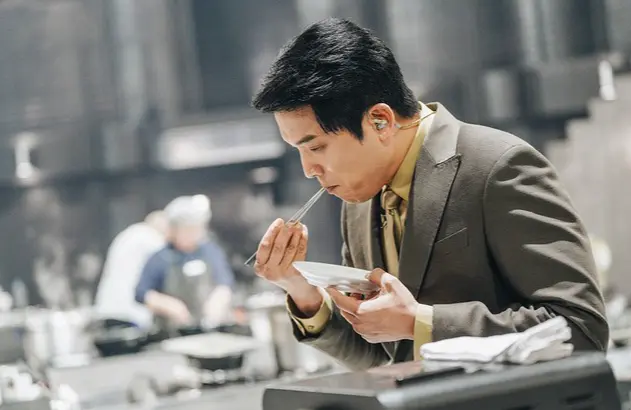 Anh Sung-jae (Image via Instagram/@netflixkr)
From its opening elimination round, Culinary Class Wars Season 2 establishes that technical ambition alone will not be enough to advance.
The clearest expression of that standard comes through Judge Anh Sung-jae, whose evaluation of a molecular gastronomy dessert in the premiere episode draws a sharp line between innovation as technique and innovation as relevance.
His critique, delivered during the Black Spoon Elimination Round, becomes one of the season’s earliest and most consequential statements about where modern fine dining now stands.
The moment centers on Shin Dong-min, known on the show as Culinary Innovator, a chef widely recognized for introducing molecular gastronomy to Korea in 2006.
Shin presents a dessert titled “-196°C Apple,” a dish built entirely around apples and constructed using sugar sculpting, liquid nitrogen, and temperature contrast.
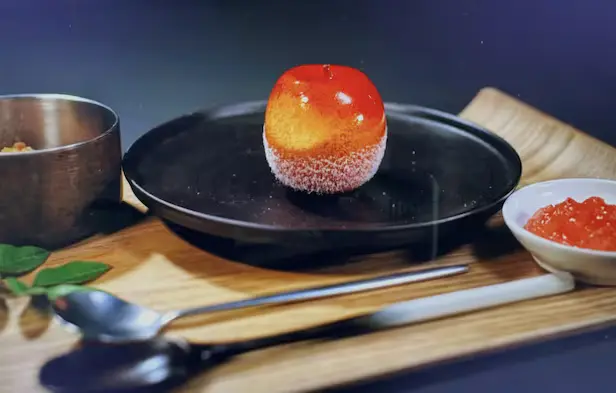
The dessert is visually striking: a red apple-shaped shell made of sugar encases powdered apple ice cream, paired with hot apple jam and jelly derived from apple pulp and peel.
The concept is rooted in deconstruction, reconstruction, and sensory contrast—hallmarks of molecular gastronomy at its height.
Anh Sung-jae acknowledges the technical proficiency on display. He confirms the dish’s history directly, asking,
“You created this 19 years ago?”
When Shin responds, “Yes, in 2007,” Anh situates the work within its original cultural moment. He says,
“At that time, this sort of molecular style of cooking was really popular. But it’s 20 years later.”
Culinary Class Wars and the boundary between technique and relevance
Anh’s critique does not dismiss molecular gastronomy outright. Instead, it frames the style as historically important but no longer sufficient on its own. Addressing the core techniques used, he states,
“The use of nitrogen, the use of isomalt… we’ve seen these before, right?” They’re tried and true techniques. And to me, it doesn’t read as innovative. It reminds me of 20 years ago.”
The judgment is decisive. Anh concludes,
“And that’s why you’ve been eliminated.”
The decision removes Shin Dong-min from the competition in the opening round, sending a clear signal to the remaining chefs. Familiarity with advanced methods does not guarantee survival. What matters is how those methods speak to the present.
The exchange reverberates through the kitchen. Contestants watching react with disbelief. One says,
“Man, if Chef Shin Dong-min got eliminated… we should brace ourselves.”
Another adds, “He’s an icon of our time.” The reaction underscores Shin’s stature within Korean gastronomy and amplifies the weight of Anh’s critique.
Shin himself later reflects on the outcome. “Ultimately, he thought it was dated,” he says.
“I actually thought I’d make it through pretty easily. I kind of preferred the raw apple.”
The comment aligns with Anh’s assessment, suggesting that the dish’s most compelling element may have been the ingredient itself rather than the techniques applied to it.
Anh Sung-jae’s position gains further clarity as the elimination round continues. Throughout the episode, his feedback repeatedly emphasizes balance, intent, and immediacy of flavor. When eliminating other contestants, he uses precise language:
“The seasoning wasn’t harmonious.”
“It was weirdly chewy.”
“I’m tasting some bad meat.”
Each critique focuses on how the dish reads in the moment of eating, not on how complex the process may have been.
That contrast becomes even sharper when Brewmaster Yun survives elimination with a set menu built around distilled soju, boiled pork, and zucchini stew. The dish is not technologically elaborate, but Anh praises the coherence behind it. He says,
“When it comes to cooking and preparing dishes that pair well with alcohol, it doesn’t matter what they are. To me, it’s the cook themselves. Their touch elevates.”
After tasting, he adds,
“Everything just went together, and it tasted really good. This is how people should cook this kind of food.”
Placed alongside Shin Dong-min’s elimination, the message becomes unmistakable. Technical spectacle does not outweigh clarity of purpose. Molecular gastronomy, once celebrated for subverting expectations, now faces scrutiny when its surprises no longer surprise.
As the competition continues, the elimination of Shin Dong-min remains a reference point. It signals that Culinary Class Wars 2 is not staging a nostalgia tour of culinary trends. Instead, it is drawing boundaries around what contemporary excellence demands.
Molecular gastronomy, as Anh Sung-jae’s critique makes clear, is no longer judged by its complexity alone. It is judged by whether it can move beyond its own history.
Stay tuned for more updates.
TOPICS: Culinary Class Wars season 2 , Chef Anh Sung-jae, Culinary Class Wars season 2 Episode 1
- Culinary Class Wars Season 2 keeps Paik Jong-won on the judging panel despite backlash
- Son Jong-won says Culinary Class Wars 2 strengthened bonds and reshaped his perspective
- Culinary Class Wars Season 2 Episode 7 shows how "bold flavor" becomes a psychological burden
- Culinary Class Wars Season 2 quietly reveals how leadership styles shape the kitchen