
Observations and calculations of micron-scale dust emission from 3I/ATLAS
-
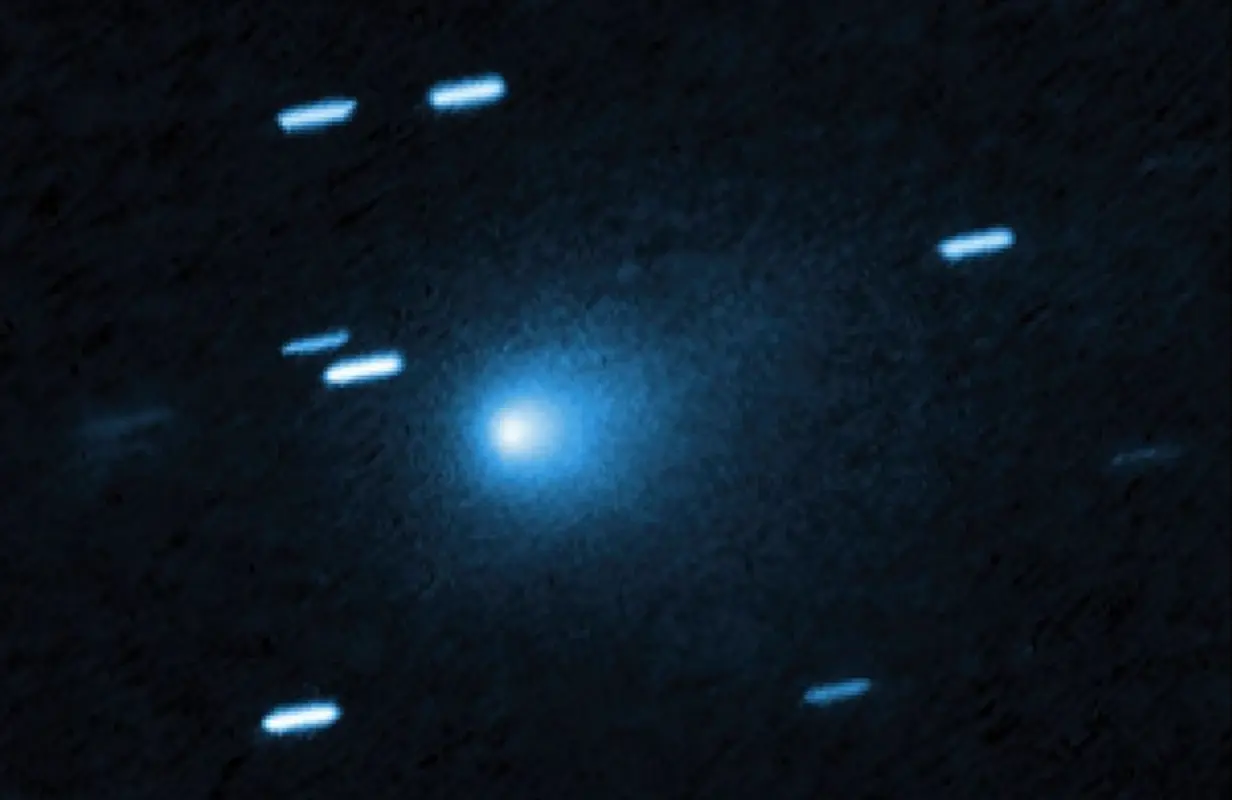 Comet 3I/Atlas (Image via NASA)
The observations and calculations of micron-scale dust emission from 3I/ATLAS indicate that the object released dust particles with characteristic sizes near 10 microns, inferred from imaging geometry, jet length, and brightness measurements. Telescope images obtained after perihelion show a distinct anti-tail whose extent and orientation constrain particle size through solar radiation forces and gas drag.
Calculations based on scattered sunlight and particle dynamics quantify the total dust mass and its supply rate. Together, the observational data and derived parameters describe the scale, timing, and magnitude of dust emission from 3I/ATLAS as reported by Avi Loeb on Medium on December 25, 2025.
Dust Emission Measurements and Mass Estimates for 3I/ATLAS
Telescopic imaging and observed dust structures
Images of 3I/ATLAS were acquired using the Two-Meter Twin Telescope and the Transient Survey Telescope in Tenerife, Spain.
The data include direct images and Laplacian-filtered versions that isolate fine-scale structures in the surrounding glow.
The images show both a tail and an anti-tail, with their orientations measured relative to the projected velocity vector and the anti-solar direction.
Brightness contours were used to trace the spatial distribution of scattered light around the object.
The observed anti-tail length of approximately 400,000 kilometers provides a geometric constraint on the dust particles responsible for the feature.
These observations form the empirical basis for estimating particle size and mass.
Constraints on particle size from dynamics
The extent and persistence of the anti-tail require dust particles that respond to solar radiation pressure and gas drag in specific ways.
Calculations indicate that particles significantly smaller than 1 micron would experience excessive solar acceleration and would not remain within the observed structure.
Particles substantially larger than 100 microns would not achieve the measured jet speed through drag from outflowing gas.
Using these limits, the characteristic particle radius is constrained to be near 10 microns.
This size range satisfies both the kinematic requirement for reaching the observed length and the dynamical requirement for acceleration within the gas flow associated with 3I/ATLAS.
Estimating dust mass from scattered light
The total luminosity of the glow surrounding 3I/ATLAS during the month following perihelion was compared to the reflected sunlight from an idealized spherical mirror with a radius of 10 kilometers.
This comparison relates the observed brightness to an effective scattering area.
Because the area of a single 10-micron particle is many orders of magnitude smaller, the observed luminosity implies a population of roughly 10^18 such particles.
With an estimated mass of about 10^-8 grams per particle, the total dust mass involved in scattering is approximately 10 million kilograms.
This estimate links optical observations directly to a quantitative mass budget.
Mass loss rate and supply timescale
The duration over which the dust mass must be supplied is determined by the time required for solar deceleration to disperse the particles.
For a jet length of 400,000 kilometers and a solar deceleration of about 0.01 centimeters per second squared, the supply time is approximately three million seconds, or about one month.
Dividing the total dust mass by this interval yields a dust mass loss rate near 3.3 kilograms per second.
This rate corresponds to about 0.7 percent of an estimated gas mass loss rate of roughly 500 kilograms per second.
The resulting dust-to-gas ratio aligns with values reported for interstellar environments, while indicating that the detected dust population is dominated by micron-scale particles.
Stay tuned for more updates.
TOPICS: 3I/ATLAS, 3I/ATLAS comet, 3i/ATLAS recent updates, Avi Loeb 3I/ATLAS
- Harvard astrophysicist Avi Loeb says 3I/ATLAS shows a sunward jet dominated by unusually large particles
- Breakthrough Listen focused technosignature searches on 3I/ATLAS as it neared Earth
- The Vera C. Rubin Observatory could detect a large number of interstellar comets like 3I/ATLAS
- Avi Loeb reports new radio constraints and size estimates for interstellar object 3I/ATLAS