
Harvard astrophysicist Avi Loeb says 3I/ATLAS shows a sunward jet dominated by unusually large particles
-
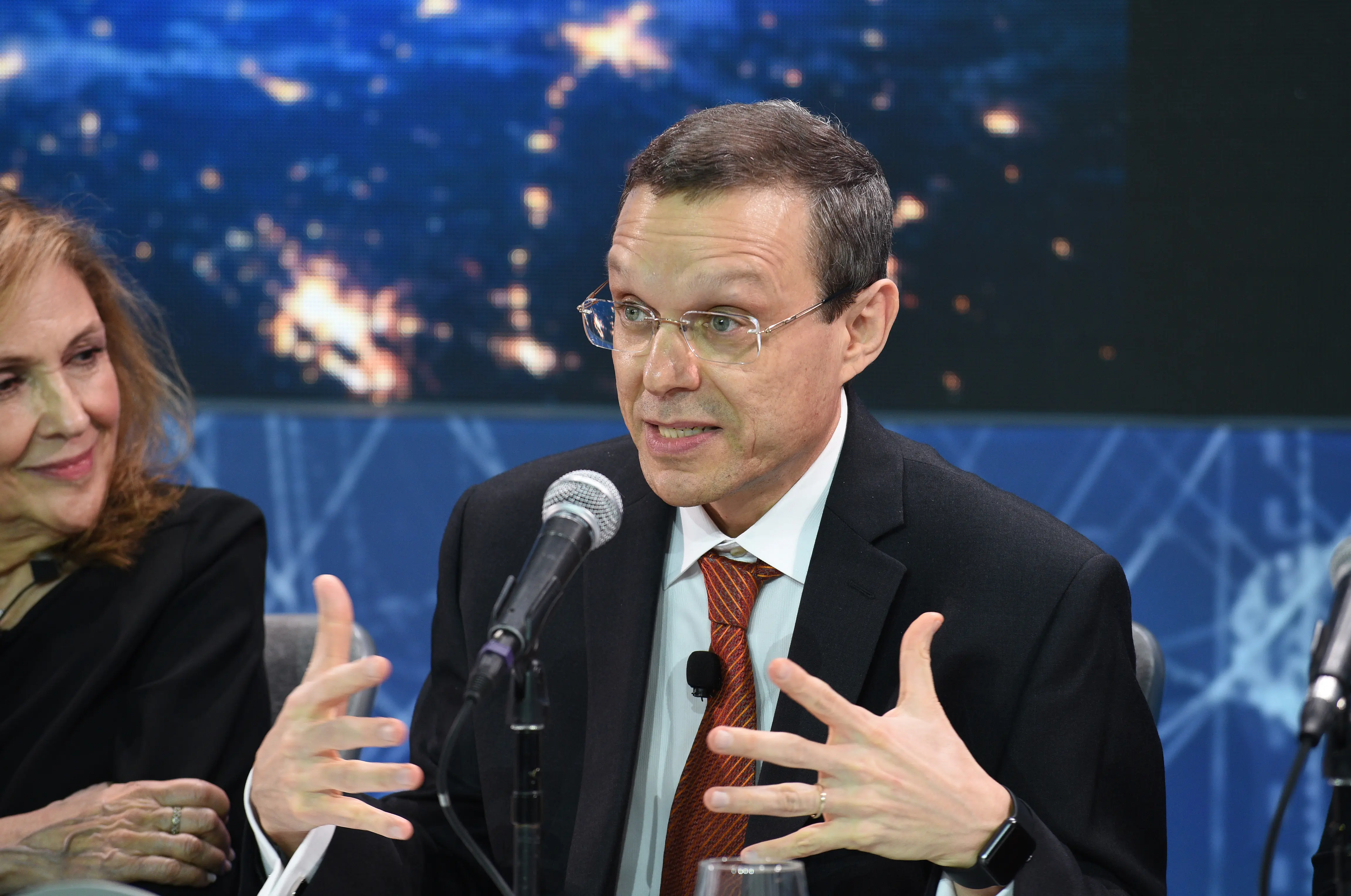 Avi Loeb (Image via Getty)
Harvard astrophysicist Avi Loeb published a new essay on Medium on December 25, 2025, in which he continued to examine the anti-tail of the interstellar comet, 3I/ATLAS, attempting to understand its unusual features.
Loeb examined the recent images of the comet’s anti-tail and attempted to scientifically argue that not only is the visitor’s jet much longer than that of typical comets, but it is also tightly collimated.
However, what made 3I/ATLAS stand out from the rest is the presence of unusually large particles in its anti-tail jet.
According to Loeb, such features were difficult to explain using the usual comet physics. However, he did not declare 3I/ATLAS an alien, but pointed out that its physical features were strange and worth looking into.
More details on Harvard astrophysicist Avi Loeb’s analysis of the anti-tail of the interstellar comet 3I/ATLAS
The interstellar object 3I/ATLAS’ recent images have shown that it has a long, one that stretches to hundreds of thousands of kilometers, and a tightly focused stream of material facing in the direction of the sun, which is referred to as the anti-tail.
However, when it comes to natural comets, the anti-tails are typically shorter and not so well-focused. Additionally, they are not as bright as 3I/ATLAS, and their composition is mainly fine dust.
Loeb studied this atypical behavior, trying to figure out what material comprises the anti-tail of the interstellar comet.
He noted that sunlight is an active entity that pushes on small particles in space.
The smaller the particle, the more it would be affected by the sun. Consequently, if the small dust particles are released toward the sun, through a sunward jet, they would quickly be stopped and pushed the other way because of the sun’s radiation.
For larger particles, on the other hand, it is more challenging for the solar wind to push them.
Based on this information, 3I/ATLAS’ anti-tail jet must comprise large particles since it is not affected by the solar wind and even extends up to 400,000 kilometers in length.
Even if the jet is made up of small dust particles, like natural comets, they need to be launched at an extremely high speed to be able to counter the sun’s impact.
Loeb argued that a natural comet can't get to that point, even with the “dust is perfectly dragged out by outflowing gas from the sublimation of volatiles on the surface of an icy rock by sunlight.”
Although larger particles appear to be the natural deduction, Loeb stated that it brought forth a different issue.
If the particles are too large, then the outflowing gas will not be able to push the material at a high speed.
Consequently, Loeb pointed out that the dust particles in 3I/ATLAS must be bigger than 1 micron and smaller than 100 microns to get the overall result. To him, such a restricted size range was unusual and not the same as seen in natural comets.
Moreover, the collimated tail of the interstellar comet stands out as an anomaly because it appears to be coming from a very small area on the surface of the object and is projected in a focused manner, unlike natural comets, whose jets are fuzzy and wider.
Loeb concluded his essay by not defining what 3I/ATLAS is but by pointing out that standard physics fails to explain the physical features of the visitor.
Thus, he hoped others would remain skeptical about 3I/ATLAS and continue to study its anomalies.
Stay tuned for more updates.
TOPICS: 3I/ATLAS, Avi Loeb, 3I/ATLAS anti-tail, Avi Loeb 3I/ATLAS, Avi Loeb 3I/ATLAS theory
- Breakthrough Listen focused technosignature searches on 3I/ATLAS as it neared Earth
- The Vera C. Rubin Observatory could detect a large number of interstellar comets like 3I/ATLAS
- Avi Loeb reports new radio constraints and size estimates for interstellar object 3I/ATLAS
- Interstellar comet 3I/ATLAS shows rotating jets in a rare sun-facing tail