
Inside the International Space Station after a quarter century of human habitation
-
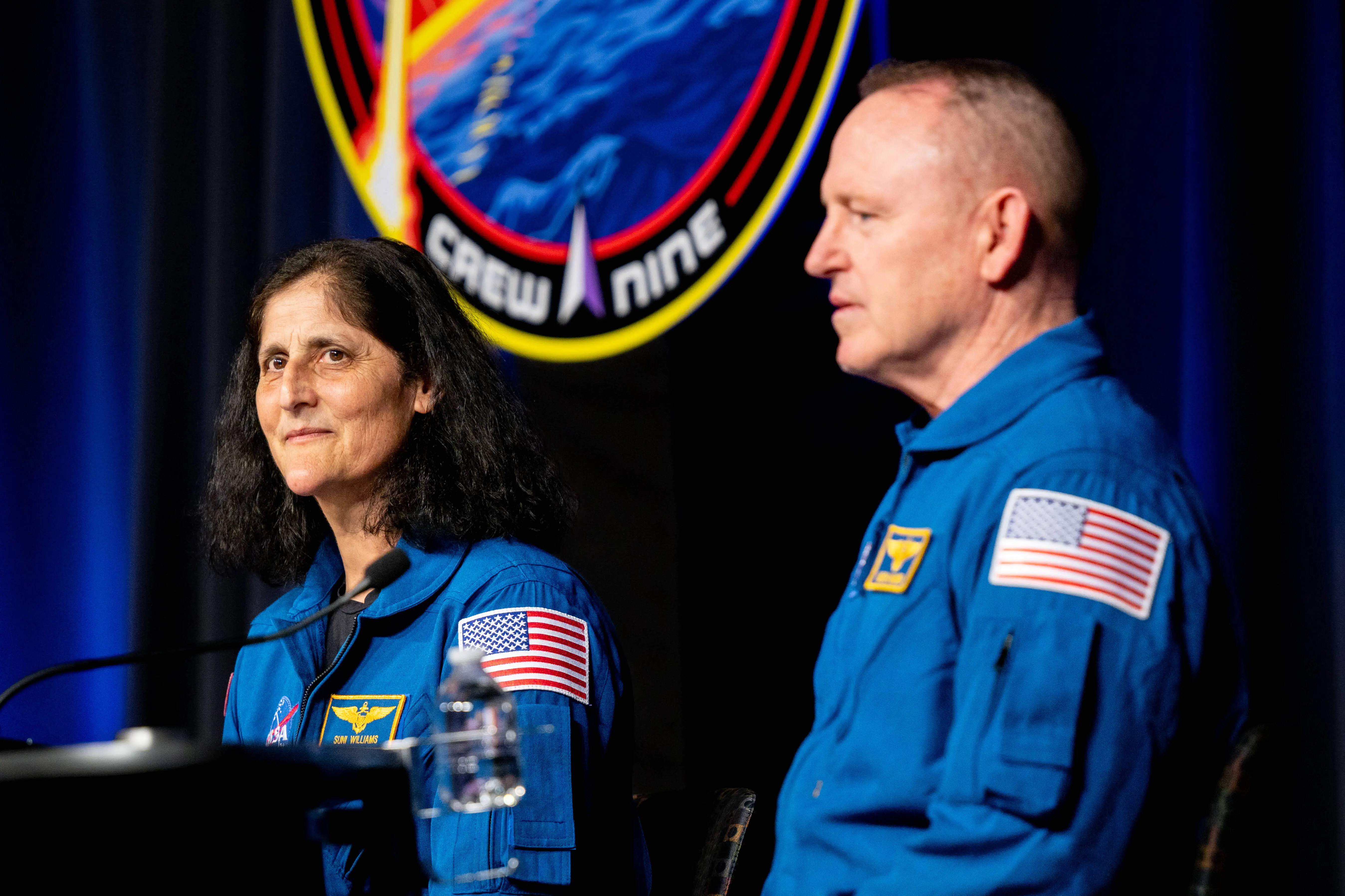 (L-R) Astronauts Sunita "Suni" Williams, and Barry "Butch" Wilmore speak during a news conference at the NASA Johnson Space Center on March 31, 2025 in Houston, Texas. Williams and Wilmore answered questions regarding their SpaceX Crew-9 mission and extended time on the International Space Station. The two astronauts were launched to the ISS aboard a Boeing Starliner spacecraft for a scheduled eight-day mission in June 2024. After spacecraft malfunctions the pair were directed to stay, prolonging the mission nine months. They returned to Earth on March 18 aboard a SpaceX Dragon spacecraft (Image via Getty)
Since its first continuous human occupancy in November 2000, the International Space Station has remained inhabited for 25 years, serving as a laboratory for scientific research, technological testing, and international collaboration.
According to NASA, the space station has supported missions involving astronauts and cosmonauts from 26 countries, with 290 visitors contributing to its operations and activities.
The orbiting laboratory enables training for future deep-space missions, including NASA’s Artemis program targeting the Moon and Mars, while maintaining continuous human presence in low Earth orbit.
The station combines scientific objectives with cultural and operational routines shared by its crews.
Human life and operations on the International Space Station after 25 Years
International crew interaction
The International Space Station is a common habitat and workplace that the crews use to go about their daily routines and carry out cultural practices.
Among the various things crew members do to keep up morale, they celebrate holidays and exchange food, music, and games, thus creating a good atmosphere for cooperation and interaction with international partners such as NASA, Roscosmos, ESA, JAXA, and CSA.
Meals on the station include both standard menu items and personal contributions from visiting astronauts. For example, French astronaut Thomas G.
Pesquet brought macarons for his birthday, while JAXA astronauts have hosted sushi meals.
Activities such as celebrating holidays with small decorations, costumes, and ceremonial objects are documented by NASA and demonstrate the establishment of shared routines among station occupants.
Recreational activities in orbit
Musical instruments have been part of the station since August 2001, beginning with an acoustic guitar and an electric keyboard.
Subsequent additions include an alto saxophone and instruments brought by astronauts, such as flutes, bagpipes, and a piccolo.
Collaborative performances have been recorded aboard the station, including duets by JAXA astronauts Soichi Noguchi and Naoko Yamazaki using a bamboo flute and a miniature stringed instrument in 2010.
Astronauts have also participated in concerts on Earth while in orbit, such as ESA astronaut Luca Parmitano performing a DJ set from the station and NASA astronaut Catherine Coleman performing a duet with a member of Jethro Tull.
Music is incorporated into crew routines as part of scheduled recreational periods.
Observation and data collection
The cupola module on the station provides seven observation windows for monitoring Earth and space operations.
Crew Earth Observations involve photography for scientific purposes, including hurricane tracking, wildfire monitoring, glacial retreat measurement, and urban growth studies, as reported by NASA.
These images also contribute to the NASA Disaster Response program, which collects pre-, during-, and post-disaster data.
Astronaut photography supports mission documentation and operational planning by providing visual records of orbital conditions.
The cupola also serves as a location for operational oversight, capturing imagery that supports both science and mission objectives.
Ground support operations
NASA Mission Control in Houston coordinates all station operations, including crew safety, mission planning, and logistics. Flight controllers manage spacecraft dockings, crew rotations, experiments, and annual milestones.
Operations staff organize routine interactions with crews, such as chess games or ceremonial events, to maintain communication and workflow between ground teams and orbiting personnel.
These practices reflect structured operational support that has continued throughout the 25 years of human presence.
Artistic activities in space
NASA astronaut Nicole Stott conducted the first watercolor painting aboard the station.
Stott’s activities were documented and later contributed to the Space for Art Foundation, which transforms art created by young patients into custom spacesuits worn by astronauts during station outreach events.
This program ties creative endeavors to human spaceflight activities in a way that does not change mission schedules or primary objectives.
As per NASA records, the International Space Station has been the facility where the world has come together, research has been conducted, operational training has been held, and cultural exchange has taken place for over 25 years.
The agreement to keep the station alive in orbit is a living example of how human presence has been harmoniously combined with scientific and operational goals in the region of low Earth orbit.
Stay tuned for more updates.
TOPICS: International Space Station, International Space Station research, International Space Station technology, ISS - International space station, NASA, NASA 25 years ISS, NASA International Space Station
- Vast invites scientists to pitch microgravity experiments for its upcoming Haven-1 commercial space station
- NASA's Expedition 74 carries out expanded biomedical and technology studies on the ISS
- Expedition 74 completes first full week aboard the International Space Station
- NASA cuts ISS livestream after a strange object appears on camera, sparking UFO questions online