
Features
Interstellar object 3I/ATLAS continues to display a Sun-facing anti-tail
Interstellar object 3I/ATLAS continues to display a Sun-facing anti-tail, confirmed by Hubble, Gemini and XMM-Newton observations, with explanations involving ice fragments and trailing objects.
-
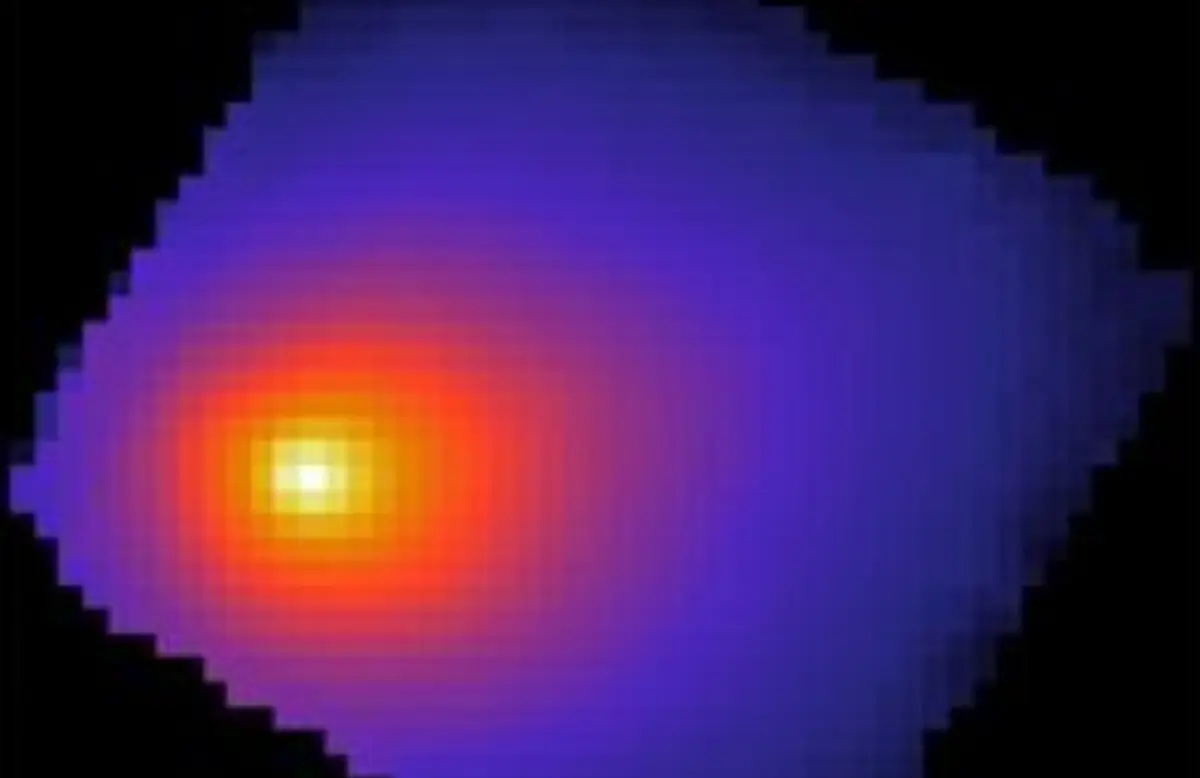 Comet 3I/ATLAS (Image via NASA)
The interstellar object 3I/ATLAS continues to exhibit a Sun-facing anti-tail as it travels through the inner Solar System. Observations suggest that the anti-tail is a physical feature, not a temporary perspective effect.
Images taken by Teerasak Thaluang on December 13, 2025, using a 0.26-meter telescope in Rayong, Thailand, show the anti-tail clearly extending toward the Sun.
Earlier Hubble Space Telescope images, taken on July 21 and November 30, 2025, also displayed the anti-tail at different positions relative to Earth, confirming its persistence.
This anti-tail remains aligned with the Sun even as the object’s position changes in its trajectory, demonstrating that Earth-based perspective effects do not cause it.
Distance and trajectory of 3I/ATLAS
As of December 14, 2025, 3I/ATLAS was approximately 270.5 million kilometers from Earth.
It will be closest to Earth, or perigee, by December 19, 2025, at a distance of 269.9097 million kilometers, plus or minus 0.0060 million kilometers, according to JPL Horizons data.
The light travel time from the source to Earth is approximately 15 minutes, resulting in a slight delay in the images we see. 3I/ATLAS went to the Sun before perihelion and is presently going further.
They are following this route with regular checks from both land and sky instruments to see if there are any changes in the position, brightness or tail pattern.
Observational evidence across multiple instruments
The anti-tail of 3I/ATLAS was first identified in Hubble Space Telescope images taken on July 21, 2025, when the object was 2.98 astronomical units from Earth.
Subsequent Hubble images, taken on November 30, 2025, showed the anti-tail at a distance of 1.91 astronomical units from Earth. Thousands of images captured between these dates also reveal the anti-tail pointing toward the Sun.
On November 26, 2025, four weeks after perihelion, 3I/ATLAS was imaged by the Gemini Multi-Object Spectrograph (GMOS) on Gemini North at Maunakea, Hawaii.
The images were obtained through four filters: blue, green, orange, and red. The green color of the glowing halo in these exposures is likely due to diatomic carbon molecules (C2), which emit green light.
The anti-tail extends in the same direction as the Sun-facing side of the object.
ESA’s X-ray space observatory XMM-Newton observed 3I/ATLAS on December 3, 2025, using its European Photon Imaging Camera (EPIC) for a total of 20 hours.
The X-ray emission is the result of interactions between the solar wind and the gas surrounding 3I/ATLAS.
Observations from JAXA’s XRISM mission earlier in December also recorded similar X-ray emissions, confirming the presence of an extended gaseous plume around the object for at least five months.
Proposed explanations for the anti-tail
Harvard Professor Avi Loeb and co-author Eric Keto have proposed explanations for the anti-tail in peer-reviewed studies.
Two papers associate the anti-tail with sunlight scattering by small ice fragments shed from the Sun-facing side of 3I/ATLAS.
These ice particles evaporate before they can be pushed away by solar radiation pressure, preventing the formation of a conventional cometary tail.
A third study by Loeb proposes that the anti-tail results from a swarm of objects trailing 3I/ATLAS due to its non-gravitational acceleration away from the Sun.
This persistent anti-tail has been confirmed across multiple observation platforms, including optical and X-ray telescopes.
Images collected over several months indicate that this is not a temporary observational effect, but a consistent feature of 3I/ATLAS.
Continuous monitoring is ongoing to collect further data on its structure, trajectory and material composition.
Stay tuned for more updates.
TOPICS: 3I/ATLAS, 3I/ATLAS distance from Earth, 3I/ATLAS observations, 3i/ATLAS recent updates, comet 3I/ATLAS NASA update, interstellar object 3I/ATLAS, Sun-facing anti-tail
More 3I/ATLAS
on Primetimer:
- "Dozen such coincidences" - Harvard Professor Avi Loeb says 3I/ATLAS and gamma-ray burst alignments are statistically expected
- Avi Loeb says academia discourages big questions as 3I/ATLAS approaches Earth
- Rare interstellar comet 3i/Atlas set to fly past Earth safely on December 19, scientists confirm
- New NASA and ESA images show 3i/Atlas glowing with activity as the interstellar comet prepares for its December close flyby