
James Webb Space Telescope uncovers clues to colossal stars in the early universe
-
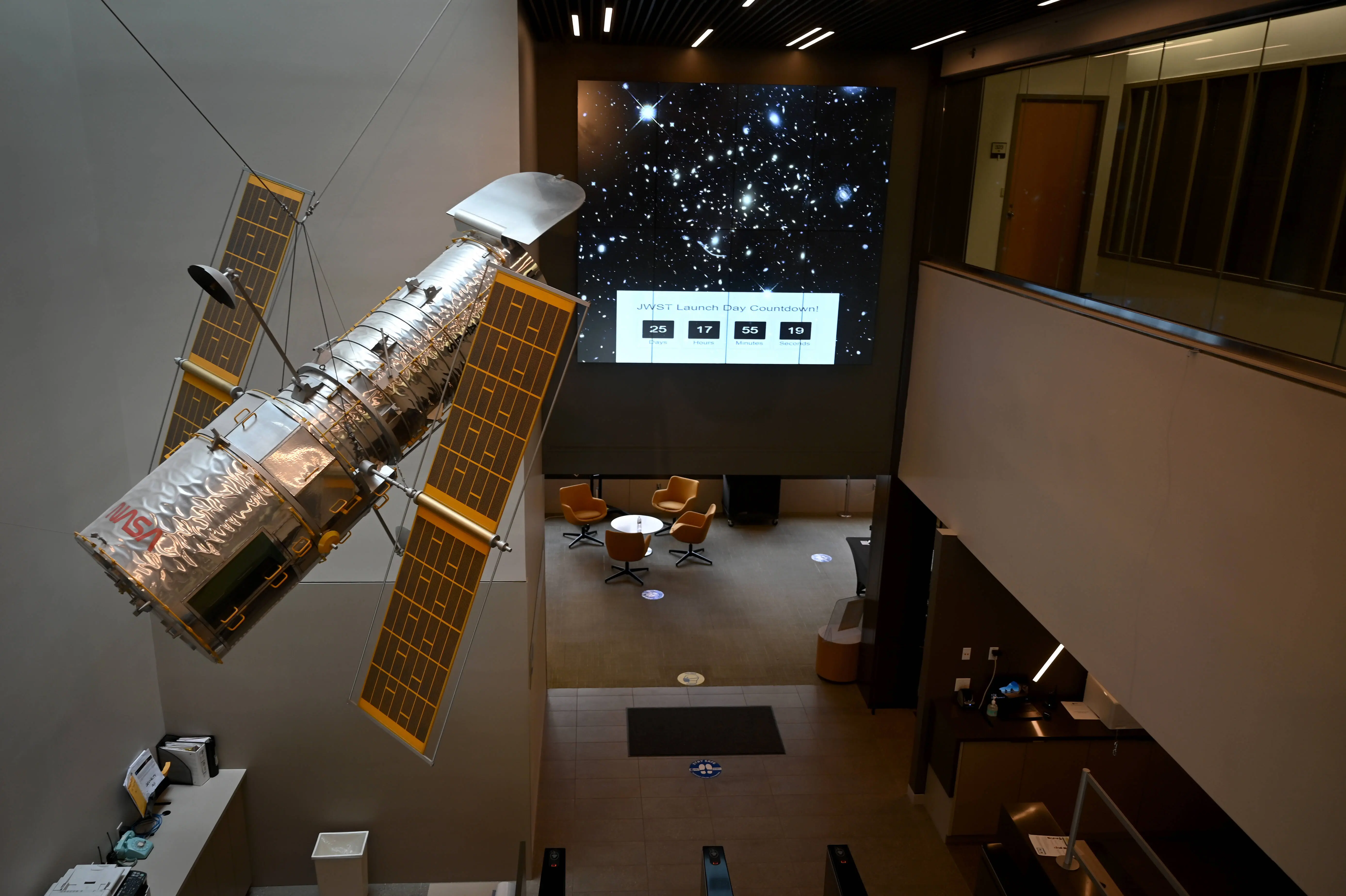 A model of the NASA Hubble Space Telescope (Image via Getty)
Space.com reports that astronomers using the James Webb Space Telescope (JWST) have found evidence for a type of very large star that may have existed in the early universe.
It is generally accepted that these stars came into existence shortly after the Big Bang and have ceased to exist at present. One of the hypotheses, as believed by scientists, is that these stars were much bigger than any of the stars currently known, and their lifespan was very short.
The evidence supporting such assertions is not direct images but chemical residues in the faraway galaxies. These residues are like the journals of the first stars' birth and death.
The revelation is based on studies of a galaxy known as GS 3073. This galaxy lies at a distance of approximately 12.7 billion light-years and is viewed as it was about 1.1 billion years after the Big Bang.
The data from JWST unveiled a chemical pattern that does not fit the one produced by theoretically known stars. Scientists are of the opinion that this pattern is the fingerprint of stars whose masses are from 1,000 to 10,000 times that of the sun.
After the death of the stars is likely to have been within a time period of about 250,000 years, they probably collapsed into a singularity.
The information obtained may, in fact, be the key to uncovering the origin of supermassive black holes at the dawn of the universe. In fact, such black holes with the mass of millions of suns that are already present in many young galaxies have been puzzling scientists for a long time as to how rapidly they grew. The research was published in the journal called The Astrophysical Journal Letters.
________________________________________________________Unusual chemistry points to early giant stars
The key evidence in this research comes from the chemical makeup of GS 3073. JWST data showed that the galaxy has an unusually high amount of nitrogen compared to oxygen. The nitrogen-to-oxygen ratio was measured at 0.46, which cannot be explained by normal stars or known stellar explosions.
Daniel Whalen of the University of Portsmouth said, “With GS 3073, we have the first observational evidence that these monster stars existed.” Scientists explain that chemical elements created inside stars are released into space when stars lose mass or die. These elements then become part of the gas in a galaxy, preserving a record of earlier stars.
Devesh Nandal of the Center for Astrophysics, Harvard and Smithsonian, said, “Chemical abundances act like a cosmic fingerprint.” He explained that the nitrogen levels in GS 3073 match predictions for extremely massive, early-generation stars.
To test this idea, researchers created computer models of stars with masses ranging from 1,000 to 10,000 times that of the sun. The models showed that these stars could produce large amounts of nitrogen through internal fusion processes.
Carbon made in the core moves into the outer layers, where it reacts with hydrogen to form nitrogen. Over time, this nitrogen spreads through the star and escapes into space, enriching the surrounding gas.
Stars smaller or larger than this mass range do not create the same chemical results, making these early giant stars the best explanation for the observations.
________________________________________________Early black holes and short-lived stars
The study also offers a possible answer to how supermassive black holes formed so early in cosmic history. Observations show that some galaxies, less than 1 billion years after the Big Bang, already contain black holes millions of times more massive than the sun.
Researchers suggest that these early massive stars ended their lives by collapsing directly into black holes.
Unlike many stars today, they likely did not explode as supernovae. Whalen said the stars “burned brilliantly for a brief time before collapsing into massive black holes.” Because there was no large explosion, much of the star’s mass could remain in the black hole.
GS 3073 contains an actively feeding supermassive black hole. Scientists believe it may have grown from smaller black holes formed by the collapse of these early stars, followed by mergers over time.
The research team plans to search for more galaxies with similar chemical signatures. Finding additional examples would help confirm that these massive early stars were common and played a key role in shaping early galaxies and black holes.
____________________________________________________
Stay tuned for more updates.TOPICS: Astronomy, Early Universe, Galaxies, James Webb Space Telescope, NASA
- Astronomers detect a pulsing sunward jet from interstellar object 3I/ATLAS
- NASA tests show ultra-thin material can shield spacecraft components from extreme vibration
- SpaceX beats bad weather to deploy 29 Starlink satellites in predawn Florida launch
- Why interstellar comet 3I/ATLAS could reshape what we know about planet formation