
3I/ATLAS exhibits a 14th anomaly in its jet-Sun geometry – Details explored
-
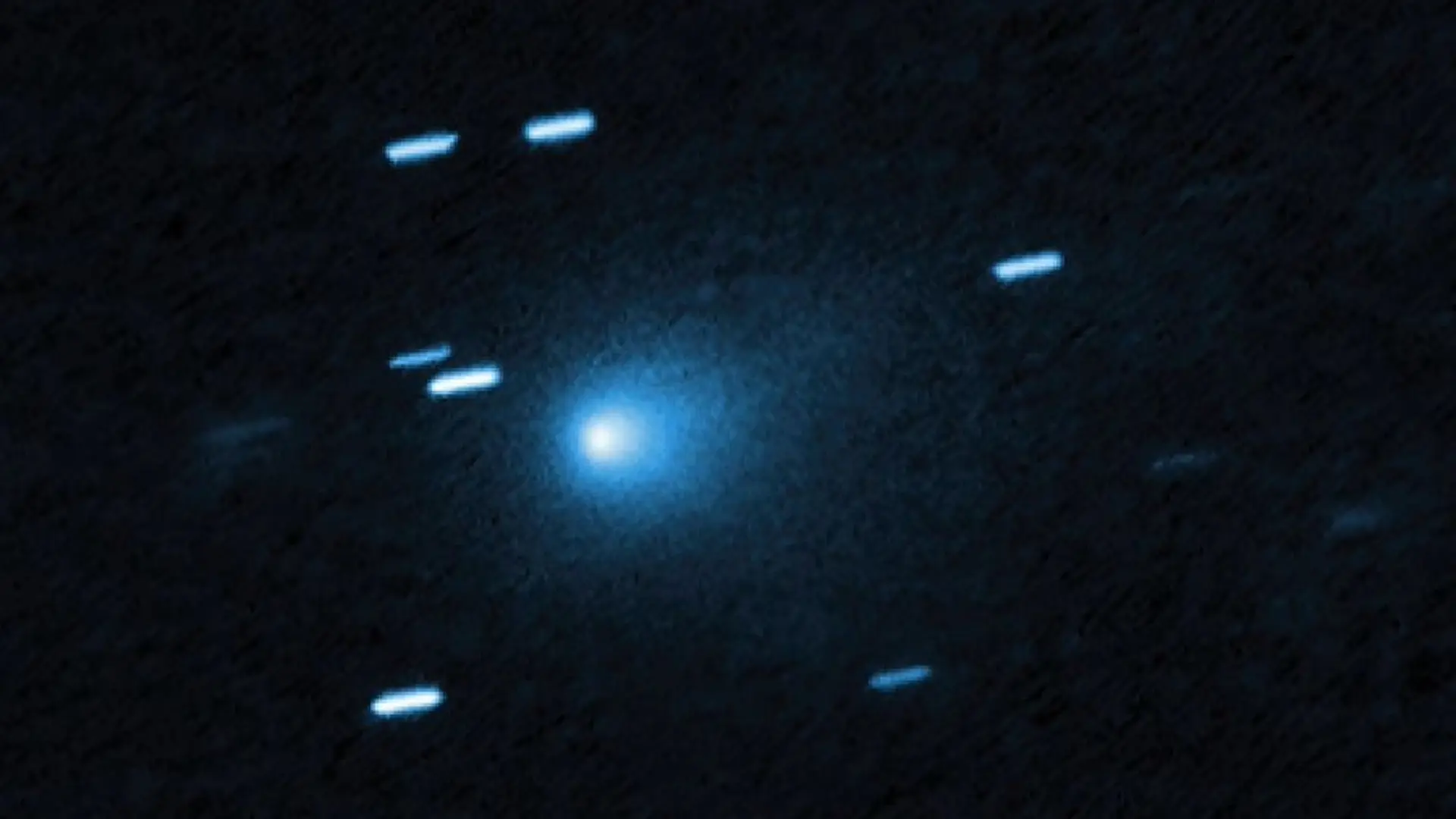 Interstellar object 3I/ATLAS (Image via NASA)
Harvard physicist Avi Loeb has added a 14th anomaly to his list of unusual and strange behaviors displayed by the interstellar object 3I/ATLAS. This anomaly concerns the geometry of its anti-tail jet in relation to the sun.
Based on a new paper, in which scientists reported the “periodic wobble” in the anti-tail of 3I/ATLAS during the July to August 2025 phase, 3I/ATLAS’s jet wobbles in a regular pattern, remaining extremely close to the object’s spin axis.
Loeb noted that the “jet base is offset by less than 8 degrees,” which, he believes, is a rare geometrical behavior and makes up for the 14th anomaly of the interstellar object 3I/ATLAS.
More details on Avi Loeb’s comments on interstellar object 3I/ATLAS’s 14th anomaly
After pointing out that the recent study implies that the anti-tail jet is almost aligned with the object’s rotation axis, Loeb explained why the alignment was unusual.
According to him, the geometry suggested that when far from the sun, one side of 3I/ATLAS is always facing the sun, meaning it has a “steady dayside” and a “steady nightside.”
However, the setting changed during perihelion, when the object passed closest to the sun, because the rotation axis is “nearly aligned with the direction of the sun.”
Loeb believes it is a strange phenomenon. According to him, if the jet of 3I/ATLAS is natural in origin, then the type of geometry and alignment it displays “constitutes a new 14th anomaly.”
“The new anomaly relates to the small probability of the rotation axis of the nucleus of 3I/ATLAS being aligned to within 8 degrees with the direction of the sun, when the interstellar object approached the sun at a heliocentric distance larger than 5 times the Earth-sun separation,” Loeb explained.
He claimed that the odds of such a precise alignment happening by pure coincidence were only 0.005.
Without the “special alignment,” the jet would not only showcase a larger angle in relation to the rotation axis but also a more significant wobble.
“With a larger misalignment angle, it could have featured prominent gaps in activity as its base exits the dayside and enters the nightside of 3I/ATLAS,” Loeb added.
The Harvard physicist went on to elaborate on the anomaly, noting how the images after perihelion still show a clear sunward anti-tail, which, to him, was unusual, given the object’s orientation and movement.
Even though the sun is now shining on the nightside part of the interstellar object, which should have been inactive, 3I/ATLAS continues to showcase a prominent sunward jet, which is unexpected.
If 3I/ATLAS is a comet of natural origin, then there needs to be a “new pocket of ice near the opposite pole of the rotation axis” to justify the emergence of the anti-tail after perihelion.
Moreover, it requires the presence of an active jet, which stops after passing by the sun.
However, Loeb claims these possibilities are rare and anomalous.
“The chance of two major pockets of ice being located near the rotation poles of 3I/ATLAS, so that one of them would be the dayside when 3I/ATLAS approaches the sun from a great distance and the other is on the dayside when 3I/ATLAS is on its way out of the solar system, while both being within 8 degrees o the nearest rotation pole … is the square of 0.005 or a tiny probability of merely 0.000025,” he wrote.
Due to such anomalous observations, Loeb believes it is difficult to declare 3I/ATLAS a natural comet.
Stay tuned for more updates.
TOPICS: 3I/ATLAS, Avi Loeb 3I/ATLAS, Avi Loeb 3I/ATLAS theory, Avi Loeb interstellar research
- Astronomers detect a pulsing sunward jet from interstellar object 3I/ATLAS
- New images show anti-tail of 3I/ATLAS measured at greater length than Earth-Moon distance
- Viewing 3I/ATLAS up close on December 19 – Which telescopes can help
- IAWN uses interstellar object 3I/ATLAS as a test case for future comet exploration