
IAWN uses interstellar object 3I/ATLAS as a test case for future comet exploration
-
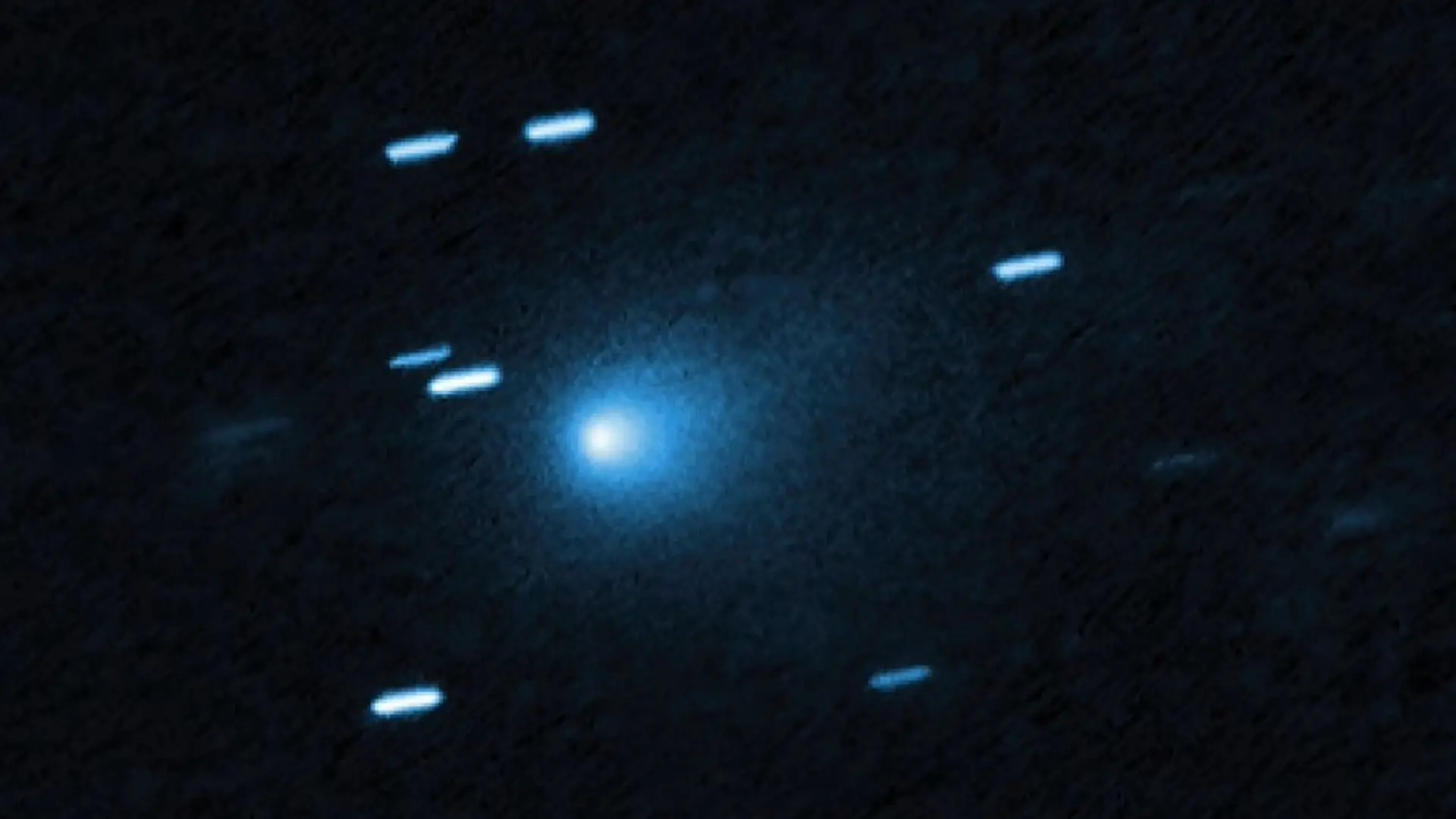 Interstellar comet 3I/ATLAS (Image via NASA)
Interstellar object 3I/ATLAS is heading toward Earth, making its closest approach Friday, and the United Nations’ International Asteroid Warning Network, or the IAWN, is monitoring its trajectory closely.
Despite making its closest approach, 3I/ATLAS will remain ~168 million miles away from Earth. The event will be tracked not only by space agencies but also by the United Nations’ IAWN.
The International Asteroid Warning Network is a joint effort by the United Nations and NASA to study interstellar objects, as it is using 3I/ATLAS as its test case to work on and potentially improve future comet exploration and the understanding of such interstellar visitors.
According to the IAWN’s official website, the campaign is described as:
“This 3I/ATLAS campaign is the 8th IAWN observing exercise since 2017 – IAWN holds these exercises roughly once a year.”
It also says that the IAWN had already planned to conduct a comet campaign in Fall 2025 to practice tracking comets, and with the observation of 3I/ATLAS, their plan was set into motion.
By studying 3I/ATLAS and its trajectory, the IAWN hopes to improve how well scientists can measure a comet’s position.
It further explains that the IAWN will “target comet 3I/ATLAS to exercise the capability of the observing community.”
More insights into the United Nations’ IAWN effort to study the interstellar object 3I/ATLAS
The 3I/ATLAS comet campaign began on Nove. 27, with a mid-campaign check-in on Dec. 9, and a closing date set for Feb. 3.
As of Monday, the campaign is halfway through its research and is expected to release its observations in a “peer-reviewed journal” in 2026, according to James Bauer, one of the principal investigators of the IAWN campaign.
In a statement to Live Science, published on December 15, Bauer explained that the IAWN is a collection of more than 80 observatories, where scientists from across the globe have contributed their efforts, sharing information on near-Earth objects.
Bauer added that NASA coordinates the campaign and that 3I/ATLAS was the first interstellar object to be studied since the launch of the campaign in 2017.
Besides studying their first interstellar object, the IAWN campaign also tracked asteroid Apophis in 2020 and 2021. It will set up a new campaign in 2027 and 2029, when the asteroid is expected to make another approach toward Earth.
While explaining the purpose and the future implications of these campaigns, Bauer said:
“The idea behind these campaigns is really to strengthen the technical capabilities for measuring sky positions, which we call astroemetry, for asteroids and comets.”
He also shared that the researchers working on the project will test a new astrometry technique to study the trajectory for 3I/ATLAS.
The observations will be crucial for the future of astronomy because they will allow experts to understand how to send spacecrafts to comets in the future.
“We want the community to use the latest and greatest techniques,” Bauer added.
3I/ATLAS became a perfect test object for their campaign because it coincided well with their campaign’s schedule.
Studying a comet’s position is difficult due to its changing brightness and other variables, including the properties of its coma, cloud of gas and dust, and its tail. Because of all these factors, its position and size are difficult to track.
3I/ATLAS, despite originating outside the solar system, behaved like a “comet’s comet,” showing characteristics similar to a normal comet. Consequently, researchers hoped to track it to understand the behavior of a natural comet.
Bauer concluded by appreciating the interest in the IAWN campaign, hoping it will result in improving Earth’s “vigilance” toward such objects in the future.
Stay tuned for more updates.
TOPICS: 3I/ATLAS, 3I/ATLAS interstellar object, IAWN’s training drill, NASA, United Nations
- Viewing 3I/ATLAS up close on December 19 – Which telescopes can help
- Why interstellar comet 3I/ATLAS could reshape what we know about planet formation
- What happens if 3i/Atlas is not a comet? Avi Loeb warns there is no human protocol for such a visit
- Interstellar object 3I/ATLAS continues to display a Sun-facing anti-tail