
What happens if 3i/Atlas is not a comet? Avi Loeb warns there is no human protocol for such a visit
-
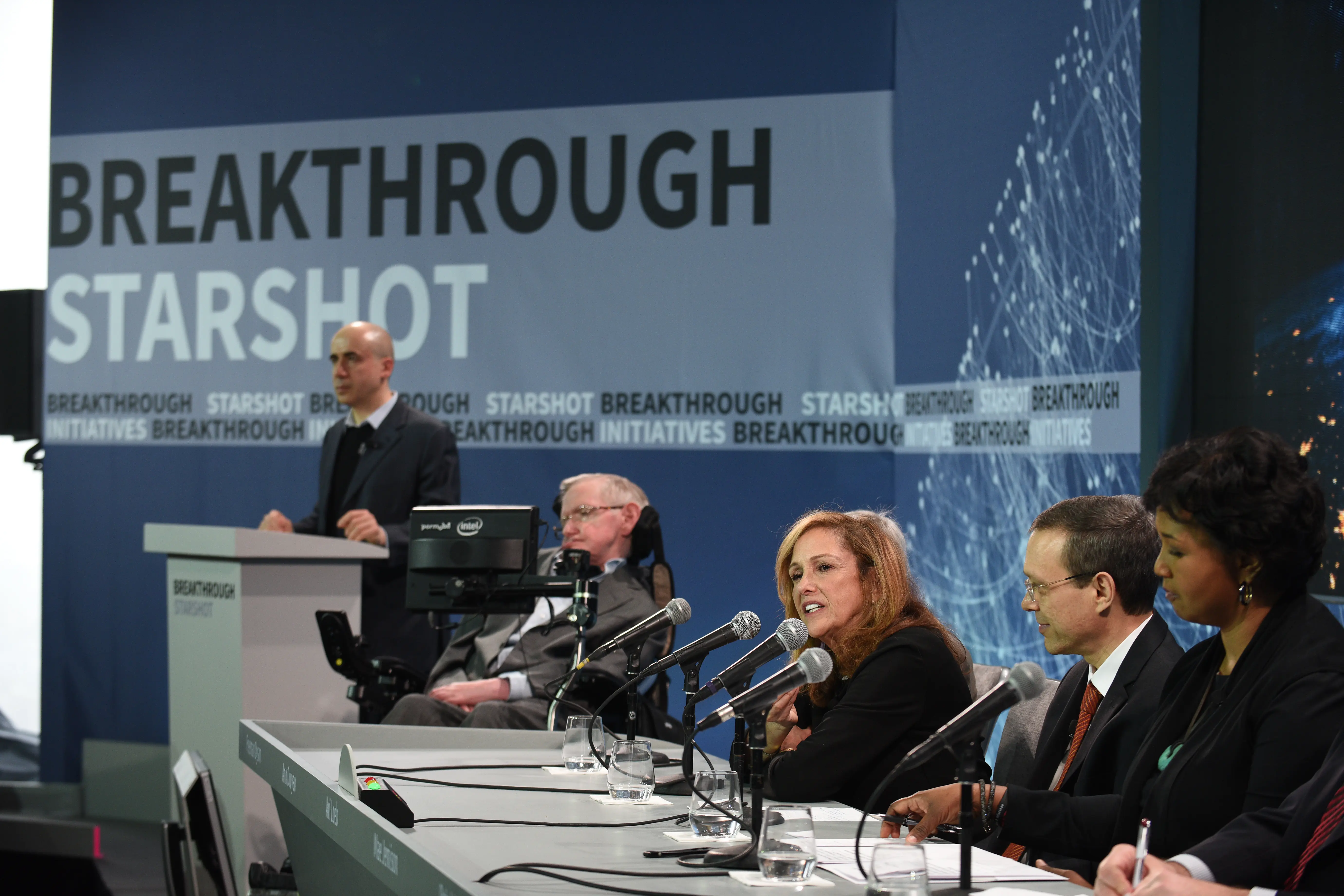 NEW YORK, NEW YORK - APRIL 12: (L-R) Yuri Milner, Breakthrough Prize and DST Global Founder; Stephen Hawking, CH, CBE, FRS, Dennis Stanton Avery and Sally Tsui Wong-Avery Director of Research, University of Cambridge; Freeman Dyson, Emeritus Professor, Princeton Institute for Advanced Study; Ann Druyan, Producer, Co-Founder and CEO of Cosmos Studios; Avi Loeb, Frank B. Baird, Jr. Professor of Science at Harvard University; Mae Jamison, Nasa Astronaut, Principal 100 Year Starship Foundation speak on stage as Yuri Milner And Stephen Hawking host press conference to announce Breakthrough Starshot, a new space exploration initiative, at One World Observatory on April 12, 2016 in New York City. (Photo by Bryan Bedder/Getty Images for Breakthrough Prize Foundation)
3I/ATLAS is a space object that came from outside our solar system. Scientists spotted it earlier this year. It is only the third such object ever seen passing through our space area.
On December 19, 3I/ATLAS will make its closest move past Earth. It will still be very far away. NASA has clearly said it is not dangerous and will not hit Earth.
Most scientists believe it is a normal comet, made of ice, gas, and dust.
Why does Avi Loeb think it is unusual?
Harvard scientist Avi Loeb says some things about 3I/ATLAS look strange. He is known for asking big questions about space, even when they sound uncomfortable.
He points out that the object’s path through space is very neat and well-aligned with the planets. He also says the timing of its closest pass near the Sun made it hard to see from Earth.
Loeb says these details are rare, not impossible, but unusual enough to study closely.
Could 3I/ATLAS be something other than a comet?
Avi Loeb does not say 3I/ATLAS is alien technology. What he says is simple: scientists should not ignore the question.
He believes that when something behaves differently than expected, it is worth checking all possibilities. That includes the very small chance that it is not fully natural.
Most experts still strongly believe it is just a comet.
What if it is not natural?
This is where Loeb raises his biggest concern.
He says humans have no plan if an object from space turns out to be artificial. There is no global rulebook. No emergency response. No agreed system between countries.
In simple words, humanity is not prepared for such a situation.
Loeb believes governments would only act after a serious scare. Only then would they spend money on space tracking, defense systems, or close-up cameras.
Is there any real danger?
Right now, no.
NASA and other space agencies say 3I/ATLAS shows no threat. It will pass quietly and continue its journey out of the solar system.
The changes people see are related to light, gas, and dust. These are common in comets.
Why this discussion still matters
Space is huge. There are billions of stars and planets. Many scientists already agree that life elsewhere is possible.
That does not mean every space object is alien. But rare visitors like 3I/ATLAS give scientists a chance to learn more.
What happens next?
Scientists will keep watching 3I/ATLAS using telescopes on Earth and in space. They want to learn its size, shape, and makeup.
On December 19, it will pass Earth safely.
Whether it is a simple comet or just a strange one, 3I/ATLAS reminds us of one thing:
the universe still has many surprises, and humans are still learning how to deal with them.
- Interstellar object 3I/ATLAS continues to display a Sun-facing anti-tail
- "Dozen such coincidences" - Harvard Professor Avi Loeb says 3I/ATLAS and gamma-ray burst alignments are statistically expected
- Avi Loeb says academia discourages big questions as 3I/ATLAS approaches Earth
- Rare interstellar comet 3i/Atlas set to fly past Earth safely on December 19, scientists confirm