
Features
New images show anti-tail of 3I/ATLAS measured at greater length than Earth-Moon distance
New images of interstellar object 3I/ATLAS show a sunward anti-tail extending over 500,000 kilometers, surpassing the Earth-Moon distance, based on observations from multiple telescopes.
-
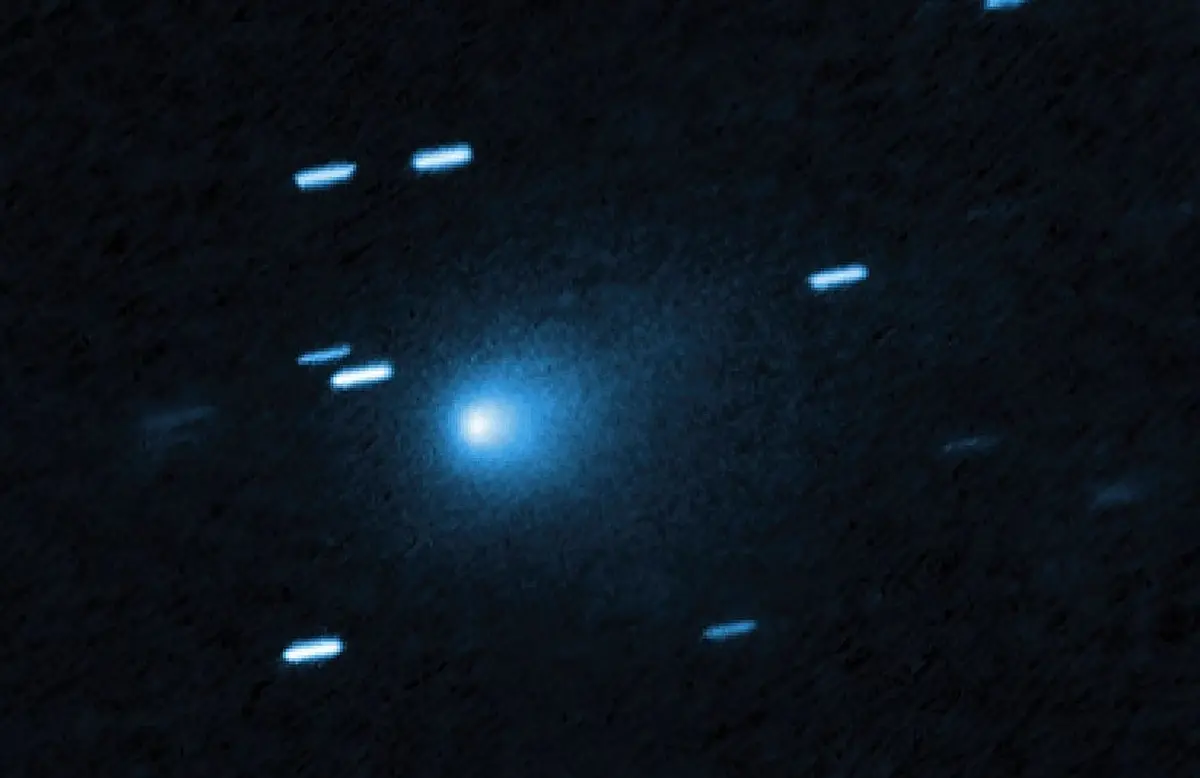 Comet 3I/ATLAS (Image via NASA)
Recent observations of the interstellar object 3I/ATLAS show that it possesses an anti-tail extending farther than the average distance between Earth and the Moon.
As of December 14–15, 2025, the object was approximately 270 million kilometers from Earth, approaching a perigee distance of 268.9 million kilometers on December 19, 2025.
Images from multiple telescopes in Italy, California and Thailand show a sunward-pointing anti-tail extending approximately 500,000 kilometers from the nucleus.
This distance exceeds the average lunar distance of 384,400 kilometers and represents the largest anti-tail observed for any comet or interstellar object to date.
Observations will continue to measure its evolution as the object recedes from Earth.
Observational data of the anti-tail
On December 15, 2025, a 0.25-meter telescope in Calabria, Italy, captured an image with a field of view spanning 0.86 by 0.39 million kilometers, according to Harvard Professor Avi Loeb.
The Larson-Sekanina rotational gradient filter applied to the image highlighted an anti-tail extending sunward for roughly 500,000 kilometers.
On December 14, 2025, a 14-inch (0.356-meter) telescope in June Lake, California, recorded a two-hour and 22-minute integrated image showing a green-blue anti-tail pointing toward the Sun across a 4.24-million-kilometer field.
Additionally, a 0.26-meter telescope in Rayong, Thailand, obtained images on December 13, 2025, at 21:30:26 UTC, producing rotational-gradient brightness maps confirming the anti-tail’s presence and orientation.
Observers credited include Toni Scarmato, Dan Bartlett, and Teerasak Thaluang. The images demonstrate that the anti-tail consistently points in the direction of the Sun, confirming its structure.
Physical properties and scale
To reach a length of approximately 500,000 kilometers over 45 days following perihelion, material in the anti-tail must move at a minimum sunward speed of 130 meters per second relative to the nucleus of 3I/ATLAS.
The material is composed of micrometer-sized dust or gas released from icy regions exposed to solar radiation and the solar wind.
The anti-tail’s size and persistence are unprecedented in cometary observations, as previous comets with anti-tails did not reach this scale.
Peer-reviewed studies authored by Avi Loeb and Eric Keto suggest that the anti-tail may result either from sunlight scattering by icy fragments or from a swarm of objects lagging the nucleus due to non-gravitational acceleration.
These explanations are being continually observed and analyzed.
Historical context and ongoing monitoring
Anti-tails in solar system comets typically appear as temporary perspective effects when Earth crosses the comet’s orbital plane.
For 3I/ATLAS, the anti-tail was first recorded in a Hubble Space Telescope image on July 21, 2025, when the object was 2.98 AU from Earth.
The tail remained visible in the November 30, 2025, Hubble image at 1.91 AU, as well as in thousands of intermediate images.
This indicates that the anti-tail is a persistent physical feature rather than a perspective effect.
Ongoing monitoring by ground-based and space-based observatories aims to collect further data on the anti-tail’s structure, formation and persistence.
Information gathered close to the perigee on December 19, 2025, will be able to further confirm its size, direction and surface features, thus enabling the study of the behavior of an interstellar object to be deepened.
3I/ATLAS observations continue to provide detailed information on the anti-tail and other morphological features, thereby enabling scientists to refine models of particle release, non-gravitational acceleration, and interstellar object characteristics.
The present dataset will be instrumental in the comprehensive catalog of interstellar observations, which will lead to a better understanding of the anti-tail phenomena of objects located beyond the solar system.
Stay tuned for more updates.
TOPICS: 3I/ATLAS, 3I/ATLAS anti-tail, 3I/ATLAS distance from Earth, 3I/ATLAS images, 3I/Atlas nearing sun, 3i/ATLAS recent updates, Avi Loeb 3I/ATLAS, comet 3I/ATLAS NASA update
More 3I/ATLAS
on Primetimer:
- Viewing 3I/ATLAS up close on December 19 – Which telescopes can help
- IAWN uses interstellar object 3I/ATLAS as a test case for future comet exploration
- Why interstellar comet 3I/ATLAS could reshape what we know about planet formation
- What happens if 3i/Atlas is not a comet? Avi Loeb warns there is no human protocol for such a visit