
Features
NASA IXPE identifies source of X-rays in black hole jet
NASA’s IXPE identifies the source of X-rays in the black hole jet of galaxy 3C 84, confirming inverse Compton scattering and supporting the synchrotron self-Compton model.
-
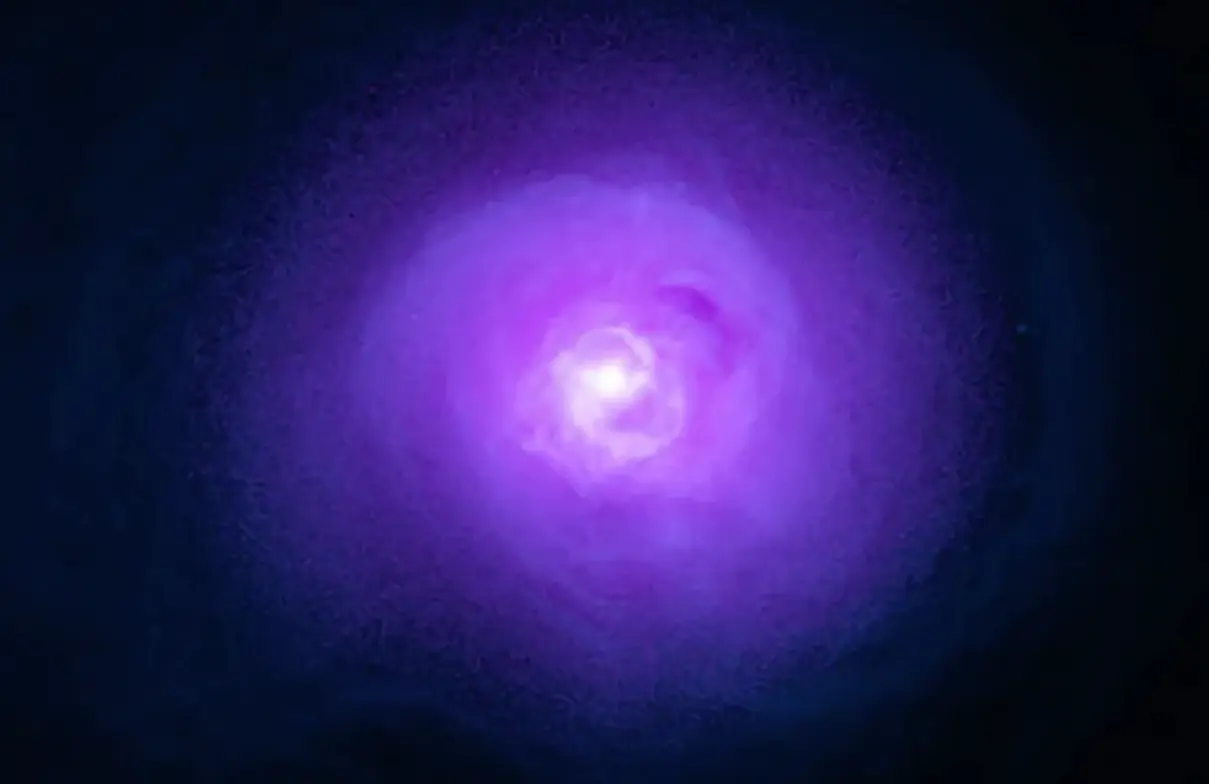 Chandra & IXPE composite image of the Perseus Cluster (Image via NASA)
NASA’s Imaging X-ray Polarimetry Explorer (IXPE) has determined the origin of X-rays in the jet of a supermassive black hole, providing a direct answer to a long-standing question in X-ray astronomy.
The discovery was made during IXPE’s observation of the Perseus Cluster, the brightest galaxy cluster observable in X-rays, over a period of 60 days between January and March 2025.
The study focused on the active galaxy 3C 84 at the center of the cluster.
Findings from IXPE, combined with data from the Chandra X-ray Observatory, NuSTAR, and the Neil Gehrels Swift Observatory, indicate that the X-rays in 3C 84’s jet originate from inverse Compton scattering.
The results were published in The Astrophysical Journal Letters by the American Astronomical Society.
IXPE observation campaign
IXPE’s observation of the Perseus Cluster lasted more than 600 hours, marking the mission’s longest continuous observation of a single target. This was also IXPE’s first observation of a galaxy cluster.
The campaign enabled researchers to determine the polarization nature of the X-rays that 3C 84 emitted. Polarization measurements give clues about the direction and alignment of the X-ray light waves.
Using these measurements, researchers could figure out if the X-rays come from inverse Compton scattering or some other processes.
Steven Ehlert, the IXPE project scientist at NASA’s Marshall Space Flight Center, pointed out that the measurements were a primary science goal, as the team keeps looking for more polarization signals in the cluster.
Determining the seed photons
X-rays in active galaxies like 3C 84 are believed to result from inverse Compton scattering, where low-energy radiation, called “seed photons,” gains energy after interacting with high-energy particles.
The study tested two scenarios for the origin of these seed photons. In the synchrotron self-Compton model, the seed photons originate from the same jet producing high-energy particles.
In the external Compton scenario, seed photons come from background radiation sources unrelated to the jet.
Frederic Marin, a co-author of the study and an astrophysicist at the Strasbourg Astronomical Observatory, said that polarization measurements could differentiate these scenarios, as each one implies different X-ray polarization patterns.
The observations recorded a net polarization of about 4 percent in the X-ray band, thus supporting the synchrotron self-Compton scenario.
Furthermore, the investigation of the seed photon properties had the aspect of comparing the polarization angles in X-ray, optical, and radio data to be sure that the models of emission were consistent.
Data integration across observatories
To cement the source of X-ray, the IXPE polarization data were mixed with the high-resolution imaging from Chandra and some extra measurements from NuSTAR and Swift.
By using this multi-observatory method, the researchers were able to distinguish 3C 84 X-ray signals from the other sources in the cluster.
Optical and radio telescope observations were also conducted worldwide to further test the two seed photon scenarios.
They found that the polarized part of the X-ray light was about 4 percent. Similar values were obtained for the optical and radio bands as well.
Such a result is consistent with the synchrotron self-Compton model, which implies that the seed photons are from the jet that also contains the high-energy particles.
Scientists intend to keep on studying IXPE data from different locations in the Perseus Cluster to find more polarization signals.
The IXPE is a joint endeavor between NASA and the Italian Space Agency. Additionally, partners from 12 countries are involved in the project.
The mission is under the leadership of NASA’s Marshall Space Flight Center, and the spacecraft operations are handled by BAE Systems in coordination with the University of Colorado’s Laboratory for Atmospheric and Space Physics.
Stay tuned for more updates.
TOPICS: NASA IXPE, 3C 84 black hole, astrophysics discoveries 2025, black hole jet X-rays, Chandra NuSTAR Swift observations, inverse Compton scattering, Perseus Cluster X-rays, supermassive black hole studies, synchrotron self-Compton, X-ray polarization astronomy