
Features
NASA's James Webb uncovers details of inner star system gas
James Webb observations detect warm carbon monoxide gas in the inner disk of HD 131488, revealing non-equilibrium conditions and evidence of exocomet-driven gas replenishment near the star.
-
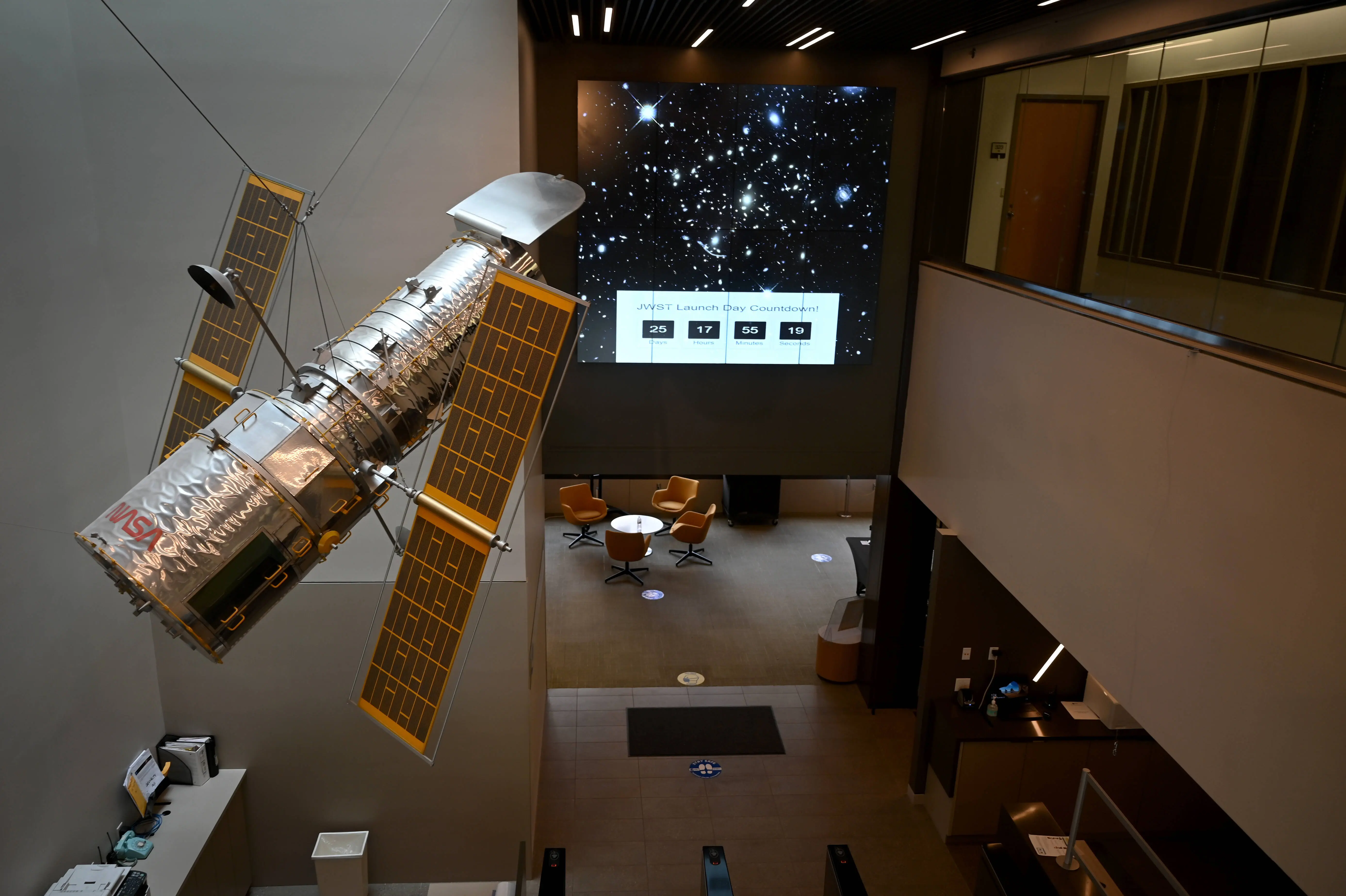 BALTIMORE, MD - NOVEMBER 22:A model of the NASA Hubble Space Telescope is seen at the Space Telescope Science Institute funded by NASA on the campus of Johns Hopkins University where the countdown of the James Webb Space Telescope has begun November 22, 2021 in Baltimore, MD. The James Webb Space Telescope, the successor to Hubble, is scheduled to launch in late December.(Photo by Katherine Frey/The Washington Post via Getty Images)
NASA’s James Webb Space Telescope has uncovered details of the inner star system's gas by detecting warm carbon monoxide within the inner region of the debris disk surrounding the young star HD 131488.
The observations show that this gas is located close to the star, within distances comparable to the inner planetary region of the Solar System.
Data from the telescope reveal that the gas displays ultraviolet-driven fluorescence and is not in thermal equilibrium.
According to Universe Today, these findings provide direct measurements of molecular gas in the inner disk and clarify the origin and physical state of material in this part of the star system.
The Star HD 131488 and Its Disk Environment
The Early A-type star named HD 131488 is situated in the Upper Centaurus Lupus subgroup of the Centaurus constellation, around 500 light-years away from us. It is thought to be about 15 million years old at most.
The Atacama Large Millimeter/submillimeter Array was the instrument used for the previous observations of HD 131488 which found a great amount of cold carbon monoxide gas and dust scattered from about 30 to 100 astronomical units from the star.
Infrared and optical studies added up to the evidence of hot dust and atomic gas in the proximity of the inner disk; however, no direct measurement of molecular gas near the star had been performed until then.
James Webb Observations of Inner Disk Gas
HD 131488 was observed by the James Webb Space Telescope in the month of February in the year 2023 through the use of infrared spectroscopy.
As stated by Universe Today, the said observations were capable of identifying the presence of a small quantity of warm carbon monoxide gas situated roughly between 0.5 and 10 astronomical units from the star.
The amount of this warm gas is considerably smaller than that of the cold gas in the outer disk, being approximately one hundred-thousandth of the outer reservoir.
The data mark the first detection of carbon monoxide in a protoplanetary debris disk through ultraviolet fluorescence, therefore extending the range of environments where such gas has been directly observed.
Temperature Structure and Non-Equilibrium Conditions
The detected carbon monoxide exhibits a clear difference between its rotational and vibrational temperatures.
The rotational temperature, which reflects the kinetic motion of the molecules, is measured at approximately 450 kelvin near the star and decreases to about 150 kelvin at larger distances.
In contrast, the vibrational temperature reaches about 8,800 kelvin, consistent with excitation by the star’s ultraviolet radiation.
According to Universe Today, this disparity indicates that the gas is not in local thermal equilibrium, confirming that radiative processes dominate its excitation rather than particle collisions alone.
Evidence for Exocometary Gas Production
Measurements of the carbon isotope ratio, specifically carbon-12 relative to carbon-13, show elevated values compared to typical interstellar environments.
The observations also indicate that carbon monoxide emission requires collisions with other molecules to match the detected spectral pattern.
Analysis discussed by Universe Today suggests that hydrogen is an unlikely collision partner, while water vapor released from evaporating or colliding comets provides a consistent explanation.
This supports a scenario in which the inner disk gas is continually replenished by the destruction of comet-like bodies rather than being a remnant from the star’s original formation.
Implications for Planet-Forming Regions
The presence of carbon- and oxygen-rich gas with relatively little hydrogen in the inner disk has implications for the composition of any planets forming in this region.
According to Universe Today, such conditions would favor the development of planets with higher proportions of heavy elements compared to hydrogen-rich primordial atmospheres.
These results demonstrate how James Webb observations can directly characterize the chemical environment of inner star systems and distinguish between competing explanations for gas retention in debris disks.
Stay tuned for more updates.
TOPICS: James Webb Space Telescope inner disk gas, exocometary gas replenishment, HD 131488 debris disk, protoplanetary disk infrared observations, warm carbon monoxide detection