
New study identifies exoplanets with potential atmospheres
-
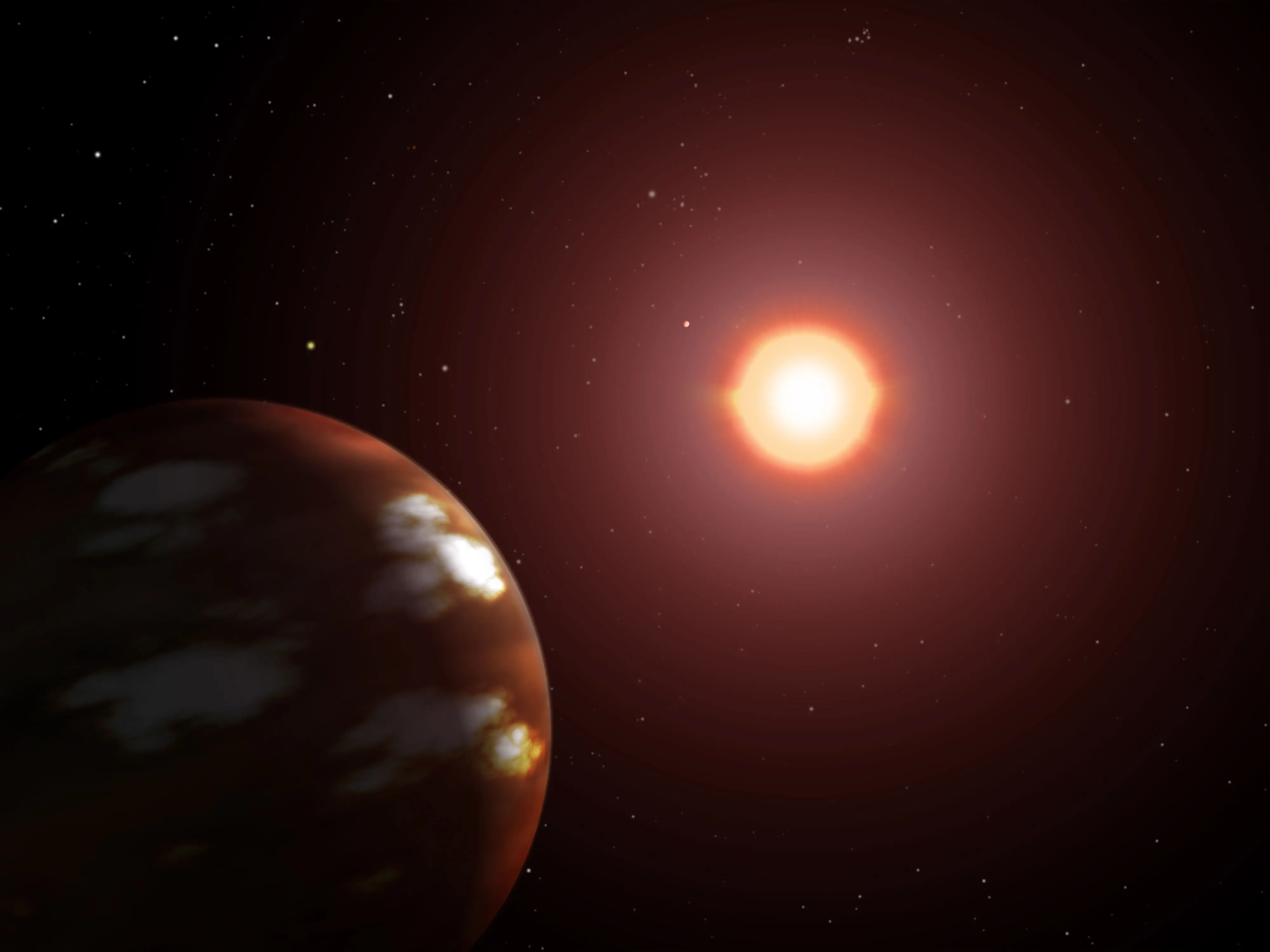 UNDATED: In this handout, an undated illustration shows a representation of a newly discovered Neptune-sized planet orbiting the M dwarf star Gliese 436. This is only the second planet to be discovered orbiting an M class dwarf. M class stars are about four tenths the size of our sun and appear a reddish color because they are much cooler. (Illustration by NASA via Getty Images)
A new study identifies exoplanets with potential atmospheres by statistically validating five transiting planets orbiting M-dwarf stars and assessing their ability to retain gaseous envelopes. According to Universe Today, the research focuses on planets discovered by the Transiting Exoplanet Survey Satellite and confirmed through extensive follow-up observations. The titled question is addressed by identifying TOI-5716 b and TOI-5728 b as planets whose sizes, orbital periods, and radiation environments allow evaluation of atmospheric retention. These planets provide measurable cases for current observatories, including the James Webb Space Telescope, to attempt atmospheric detection using established observational methods.
Confirmed M-Dwarf Planets Identified for Atmospheric Retention Studies
Discovery and Validation of Five Exoplanets
The Transiting Exoplanet Survey Satellite was the first to discover the five planets by means of their periodic dimming signals that are reflected in the stellar light curves.
Upon the discovery of these signals, TESS issued TESS Object of Interest alerts, which served to signal possible exoplanet candidates.
It was necessary to carry out more observations in the form of transit photometry & high-resolution imaging to get confirmation.
As per Universe Today, data from at least nine telescopes including the Keck II Observatory and the Hale Telescope were used.
These observations resulted in the confirmation of five planets in four different planetary systems, with one system TOI-5489 having two planets that are in orbital resonance.
Multi-color photometry from Palomar and Las Cumbres Observatory was among the follow-up observations to refine the transit depth and confirm planetary radii.
High-resolution imaging was performed to eliminate the possibility of nearby stellar companions that could produce a signal mistakenly interpreted as a planetary one.
Stellar spectroscopy was used to obtain the host star properties, such as metallicity and activity levels which are crucial for determining the environment around each planet.
Planetary Sizes, Orbits, and Host Stars
The validated planets include TOI-5716 b, TOI-5728 b, TOI-5736 b, TOI-5489 b, and TOI-5489 c.
According to Cornell University, TOI-5716 b has a radius of R_p = 0.96 ± 0.05 R_earth and orbits its host star every 6.766 days.
TOI-5728 b has a radius of R_p = 1.31 ± 0.05 R_earth with an orbital period of 11.497 days. TOI-5736 b measures R_p = 1.56 ± 0.07 R_earth and completes an orbit in 0.649 days.
The two planets in the TOI-5489 system have radii of R_p = 1.40 ± 0.05 R_earth and R_p = 1.28 ± 0.07 R_earth, with orbital periods of 3.152 and 4.921 days. All planets orbit M-dwarf stars.
Atmospheric Retention and the Cosmic Shoreline
The assessment of atmospheric retention was done through the application of the concept of cosmic shoreline, which juxtaposes planetary gravity against stellar insolation.
Radiation with higher levels leads to the loss of atmospheres, however, mass of the planet that is larger assists the retention of the atmosphere.
As per Universe Today, three out of the five planets are placed above the cosmic shoreline which is an indication of probable atmospheric loss.
TOI-5736 b occupies a separate category due to its large radius and mass despite receiving high radiation.
TOI-5716 b and TOI-5728 b have equilibrium temperatures ≤ 400 K, as stated by Cornell University, making them suitable for studies of atmospheric mass loss.
Implications for Atmospheric Observation
Among the sample, TOI-5728 b lies below the cosmic shoreline and may have retained a high mean molecular weight atmosphere if it has an Earth-like bulk composition, according to Cornell University.
TOI-5716 b also provides a comparable case due to its orbital and thermal properties.
Universe Today notes that the dim nature of M-dwarf stars allows improved contrast for atmospheric observations using the James Webb Space Telescope.
These validated planets represent specific targets for future atmospheric measurements based on confirmed orbital and physical parameters.
Stay tuned for more updates.
TOPICS: exoplanet atmospheres, James Webb Space Telescope, M-dwarf planets, TESS discoveries, TOI-5728 b