
Features
Satellite data tracks subtle La Niña signals in the Pacific Ocean
Satellite data from Sentinel-6 Michael Freilich and Sentinel-6B tracks weak La Niña conditions in the equatorial Pacific, monitoring sea surface temperatures, sea level changes, and atmospheric impacts.
-
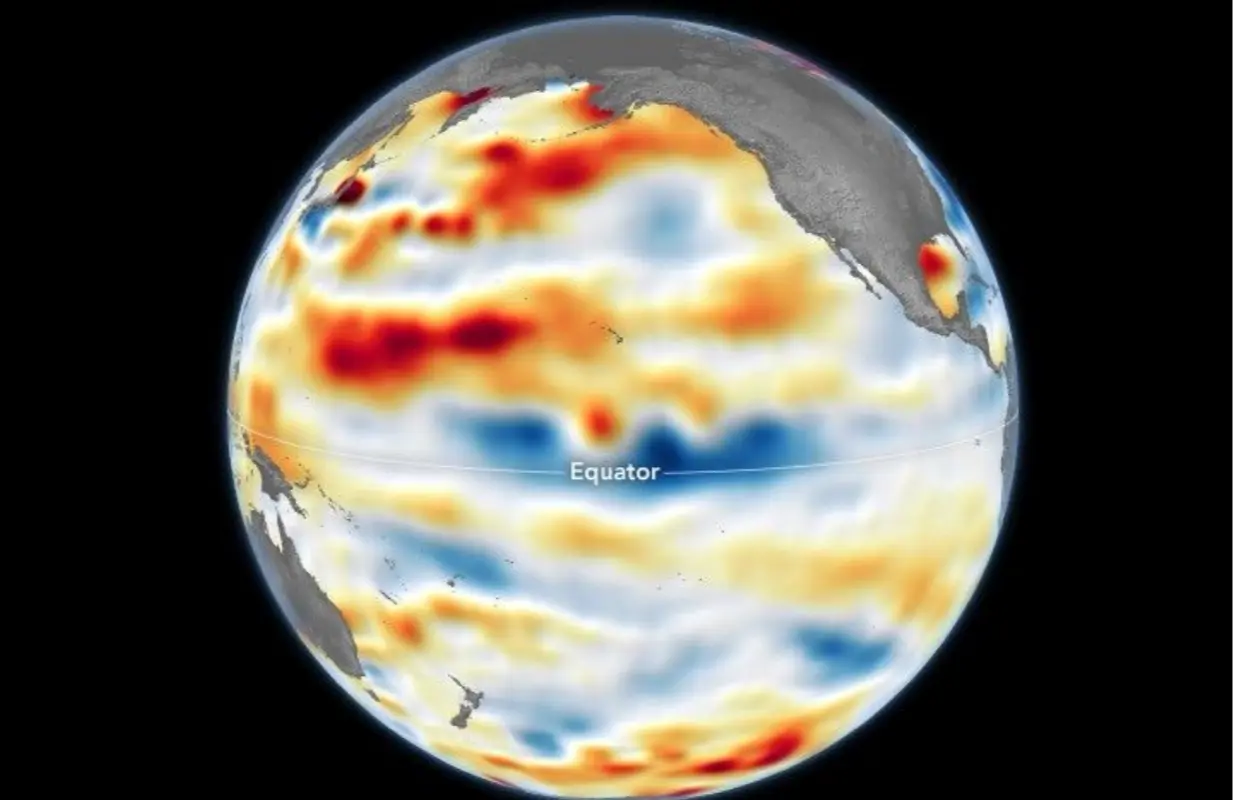 Sea surface height anomaly (Image via NASA)
La Niña returned to the equatorial Pacific Ocean in late 2025, with its effects observed through satellite measurements and oceanographic data.
The phenomenon, part of the El Niño-Southern Oscillation cycle, occurs when strengthened easterly trade winds enhance the upwelling of cooler water from the deep eastern tropical Pacific.
This cooling shifts warm surface waters westward toward Asia and Australia, affecting sea surface temperatures and global atmospheric patterns.
Satellite instruments, including Sentinel-6 Michael Freilich and its successor Sentinel-6B, have tracked these changes in sea level and surface temperature, helping scientists monitor the subtle signals of this weak La Niña and its potential influence on weather and climate.
Observing sea surface temperature changes
La Niña events are marked by cooler-than-average surface waters in the central and eastern equatorial Pacific.
In early 2025, NOAA confirmed that sea surface temperatures in the Niño 3.4 region, between 170° and 120° West longitude, were 0.7 degrees Celsius below average.
This measurement indicated the presence of weak La Niña conditions, which persisted into December 2025.
Satellite data processed by NASA’s Jet Propulsion Laboratory (JPL) removed seasonal and long-term trends to isolate short-term anomalies linked to ENSO.
These observations enable scientists to track how surface waters cool and migrate westward, providing insight into La Niña’s development over time.
Monitoring sea level variations
The cooling of equatorial surface waters directly affects sea levels. Cooler water is denser and occupies less volume, resulting in lower sea levels in the central and eastern Pacific.
Satellite measurements from Sentinel-6 Michael Freilich in December 2025 showed a strip of below-normal sea surface height, highlighted in blue on NASA’s visualizations.
Conversely, warmer waters in the western Pacific caused above-normal sea levels.
These variations are captured through precise satellite altimetry, which removes long-term trends to focus on short-term ENSO-related fluctuations.
Sentinel-6B, launched in November 2025, is expected to enhance monitoring capabilities in 2026, contributing additional data for ongoing analysis.
Atmospheric and climate interactions
La Niña cools the ocean surface which changes the way heat and moisture are exchanged between the ocean and atmosphere.
The process changes the global circulation patterns, the way the mid-latitude jet streams travel, among others.
The shifts have the potential to change the distribution of rain, according to the data, with some areas getting more rain and some getting less.
As a matter of fact, the La Niña event usually brings about less rainfall in the American Southwest and more in the Northwest.
Rainfall may increase over Indonesia and Australia due to the western Pacific, however, certain areas of South America may receive less precipitation.
Observations from satellites offer an unbroken record of such interactions which are used to determine the climate and make seasonal forecasts.
Continuing research and data collection
According to NASA and NOAA, weak La Niña events are notably more challenging to forecast than those of moderate or strong intensity.
Sentinel-6 satellites and other instruments are continually monitoring the situation, thus enabling scientists to see the changes as they happen and deepen their understanding of the ENSO mechanisms.
Late 2025 observations reveal that this La Niña is still a weak one with sea surface temperatures being below average and the sea levels of the central and eastern Pacific being lower than usual.
The record of the data is still going on and it is very instrumental in climate modeling, atmospheric research, and regional weather impact assessments.
The existence of La Niña is one of the factors causing short-term variations in global climate patterns. However, long-term trends are still the main determinants of the overall temperatures.
By detecting very small signs through satellite data, scientists are able to give up-to-date information which is essential for the understanding of the interaction between the ocean and the atmosphere and the resulting global weather systems.
Stay tuned for more updates.
TOPICS: La Niña 2025, ENSO satellite data, NASA, NASA JPL ENSO monitoring, NOAA La Niña report, Pacific Ocean La Niña, Pacific sea level changes, Sea surface temperature La Niña, Sentinel-6B, Sentinel-6 Michael Freilich, Weak La Niña signals