
Features
ULA conducts another Atlas V launch carrying 27 Amazon internet satellites
United Launch Alliance launched an Atlas V rocket carrying 27 Amazon Leo satellites on December 16, advancing Project Leo’s low Earth orbit internet constellation alongside other commercial rockets.
-
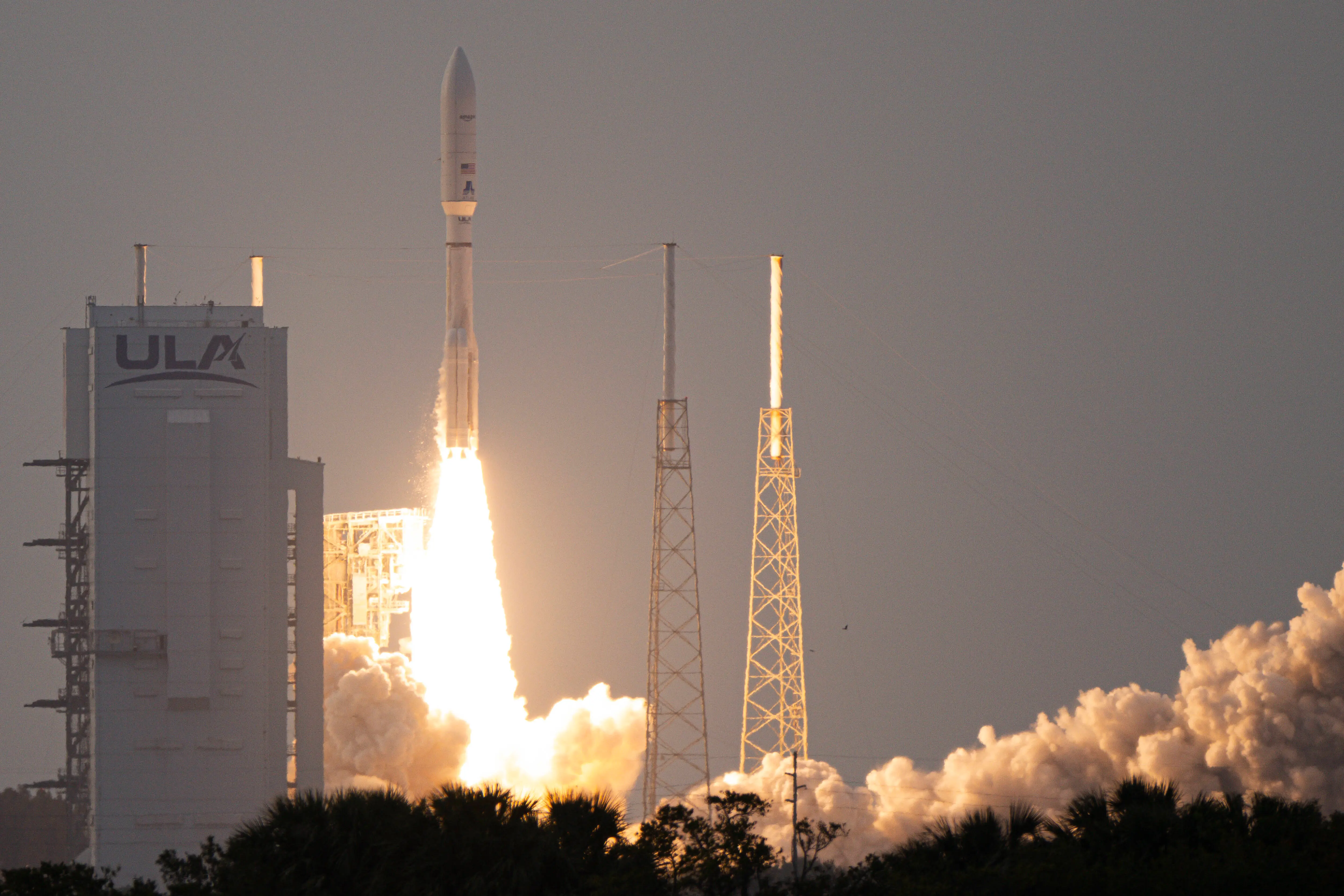 A United Launch Alliance Atlas V rocket carrying Amazon Project Kuiper lifts off to launch the first production satellites from Space Launch Complex 41 on April 28, 2025, in Cape Canaveral, Florida. Project Kuiper intends to provide high-speed internet, with service expected later this year. The KA-01 mission is scheduled for April 28 at 7:00 p.m EST (Image via Getty)
United Launch Alliance (ULA) flew the Atlas V rocket with the 27 Amazon Leo satellites onboard from Cape Canaveral Space Force Station, Florida on Tuesday, December 16, to great success.
The rocket went up at 3:28 a.m. EST (0828 GMT). With this launch, an Atlas V was used for the fourth time to carry a payload to build Amazon's satellite-based internet network, as the project was earlier known as Project Kuiper.
The Amazon LEO network is planned to achieve a global coverage of internet access by the deployment of around 3,200 satellites through over 80 launches. They will use various rockets like Atlas V, Vulcan Centaur, SpaceX Falcon 9, Blue Origin’s New Glenn, and Arianespace’s Ariane 6.
Before Tuesday, there were six successful Atlas V missions that had put a total of 153 satellites in orbit. A test flight in October 2023 was not included in this count.
Atlas V launch details
The Atlas V rocket for this mission is a two-stage launch vehicle by United Launch Alliance, which includes a joint venture between Boeing and Lockheed Martin, and is operated by the launch vehicle.
The first stage has a Russian-made RD-180 engine that runs on kerosene and liquid oxygen, while the second stage uses an American RL10 engine, which is also powered by liquid hydrogen and liquid oxygen.
The rocket may have up to three solid rocket boosters on the 400 series and up to five on the 500 series, depending on the payload requirements.
An Atlas V rocket is capable of lifting 8,250 to 20,520 kilograms to a low Earth orbit and 4,750 to 8,900 kilograms to a geostationary transfer orbit.
Where does the Atlas V launch? There are Space Launch Complex 41 (SLC-41) at Cape Canaveral and Space Launch Complex 3 (SLC-3) East at Vandenberg Air Force Base in California.
They chose the Atlas V setup for this mission to be able to carry the mass and deployment of the 27 Amazon Leo satellites.
Deployment of Amazon Leo satellites
The 27 Amazon Leo satellites were supposed to be released within a 15-minute interval starting around 20 minutes after the rocket launch.
About five minutes into the flight, ULA stopped its live webcast. Therefore, the deployment was not visible to the public.
The Project Leo system is a network aimed at delivering the internet through low Earth orbit and will be a rival to SpaceX’s Starlink constellation, which has over 9,000 satellites in total, of which more than 3,000 will be launched in 2025.
Additionally, Amazon has a deal with SpaceX to launch some of the Leo satellites with the Falcon 9 rocket.
Atlas V mission history
The Atlas V rocket was first fired on August 21, 2002. It was initially created by Lockheed Martin Commercial Services for the U.S. Air Force Evolved Expendable Launch Vehicle program.
Some of the significant missions are NASA’s Mars Reconnaissance Orbiter in 2005, the New Horizons mission to Pluto in 2006, the Curiosity rover to Mars in 2011, and the Juno spacecraft to Jupiter in 2011.
Besides these, the rocket has also been used for the MAVEN Mars orbiter, OSIRIS-REx asteroid mission, Lunar Reconnaissance Orbiter, Solar Dynamics Observatory, Van Allen Probes, and the next Mars InSight lander.
Moreover, Atlas V rockets have been instrumental in the delivery of supply missions to the International Space Station and in the execution of testing for the Boeing CST-100 crewed spacecraft.
Reliability and previous incidents
Between August 2002 and March 2018, Atlas V rockets have carried out more than 75 missions without any total failures.
There have been partial anomalies, for instance, a 2007 mission that launched two reconnaissance satellites into a lower orbit than planned and a 2016 Cygnus resupply flight with early first-stage shutdown; however, in both cases, the missions were not aborted.
The rocket is being phased out slowly and replaced with ULA’s Vulcan Centaur, which has only three missions under its belt so far.
The launch on December 16 is a part of the ongoing deployment of Amazon’s internet satellites, and it is also a continuation of Atlas V’s long operational record of commercial and governmental space missions.
Stay tuned for more updates.
TOPICS: Atlas V launch, Amazon Leo satellites, Falcon 9 satellite launch, LEO internet satellites, SpaceX Starlink competition, United Launch Alliance