
The Great Flood Ending Explained (2025): Decoding the Simulation and Human Resilience
-
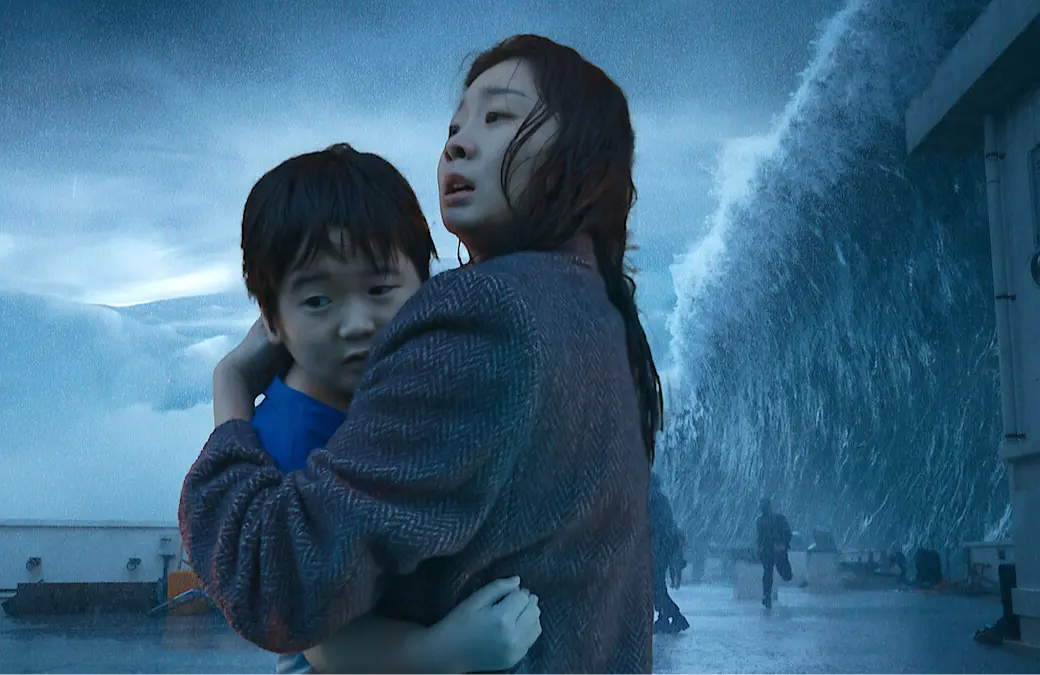 The Great Flood (Image via Netflix)
The Great Flood, a 2025 South Korean sci-fi disaster film, plunges viewers into a tale of survival amid catastrophe. Directed by Byung-woo Kim, the movie follows An-na (played by Kim Da-mi), a determined mother in Seoul, who awakens to find her city submerged by a massive flood triggered by an asteroid impact in Antarctica.
As waters rise relentlessly, she battles through a chaotic high-rise apartment building to rescue her young son, Ja-in (Kwon Eun-sung), while facing desperate neighbors, structural collapses, and moral dilemmas.
Park Hae-soo co-stars as a key figure in the unfolding crisis, adding layers of tension to the group's dynamics.
What begins as a straightforward disaster narrative evolves into a mind-bending exploration of reality, memory, and emotion, revealing deeper truths about humanity's fate. Released on December 19, 2025, The Great Flood is available for streaming exclusively on Netflix worldwide, with subtitles and dubs in multiple languages, including English, Korean, and others.
The Great Flood: The setup: The flood engulfs Seoul
The film The Great Flood opens in a near-future Seoul, where everyday life shatters one ordinary morning. An-na, a researcher, and her son Ja-in share a modest apartment in a towering residential complex.
News alerts blare about an asteroid strike in Antarctica, but the real horror unfolds as sirens wail and water surges through streets below.
Within minutes, the building floods from the ground up, trapping residents on upper floors. An-na rushes to secure Ja-in, who is playing innocently, as elevators fail and hallways fill with panicked families hauling belongings to higher levels.
Early scenes establish the scale of the disaster: cars float away outside windows, and helicopters circle futilely overhead.
Neighbors, including an elderly couple and a skeptical security guard, form uneasy alliances, rationing food and debating escape routes.
An-na's maternal drive propels her forward, but subtle hints, like flickering lights and déjà vu moments, plant seeds of unease. The flood's cause ties to climate tipping points exacerbated by the asteroid, submerging much of the Korean peninsula in hours.
This phase focuses on immediate survival instincts, showcasing how routine spaces turn lethal.
As waters climb, the group realizes the building's roof offers temporary refuge, but divisions emerge over who leads and who sacrifices. The tension builds methodically, mirroring real-world flood responses while foreshadowing the story's larger scope.
Rising tensions: Struggles within the building
As the flood reaches mid-levels, the apartment complex becomes a vertical battlefield. An-na leads efforts to barricade doors against rising currents, but structural cracks widen, sending debris crashing down.
Ja-in clings to his mother amid screams and splashing, while the group scavenges for supplies, canned goods from storage rooms, and makeshift ropes from curtains.
Conflicts arise: a hoarder refuses to share resources, and whispers of abandonment spread as some residents eye helicopters visible in the distance.
An-na's backstory emerges through flashbacks; she works on emotional AI development, a detail that gains weight later.
Her interactions with Park Hae-soo's character, a former colleague named Min-ho, reveal past tensions, including a professional fallout over ethical boundaries in tech.
The waters carry symbolic weight, washing away illusions of safety and forcing raw confrontations. Children like Ja-in huddle in fear, prompting adults to share stories of past floods for comfort.
Rescue attempts fail spectacularly: a zip-line to a neighboring tower snaps, claiming lives and heightening despair.
The revelation: Unveiling the simulation
Midway through, the plot shifts dramatically when An-na experiences vivid recollections that don't align with the chaos. She notices inconsistencies: wounds heal too quickly, and conversations loop subtly.
In a quiet moment atop the roof, Min-ho confesses a truth: the flood isn't just a natural event but part of a constructed reality.
The world ended years prior to the asteroid's full impact, leaving survivors in orbital habitats. To rebuild society, scientists created a simulation using neural implants to test emotional resilience.
An-na learns her mind powers an Emotion Machine, an AI designed to process human feelings for future colonization efforts.
Ja-in, in this loop, represents a simulated child drawing from her memories, forcing her to relive traumas repeatedly.
The building's flood replicates escalating challenges to build empathy circuits. Guards appear as avatars enforcing protocols, their interventions growing aggressive.
This disclosure reframes earlier events: the neighbors' deaths were test failures, erased and reset. An-na grapples with denial, piecing together suppressed data from her research days.
The revelation adds psychological depth, transforming physical peril into existential questioning, as she vows to protect Ja-in beyond the code.
The climax: Breaking through the loops
The final loops intensify as An-na retains fragments of awareness across resets. She navigates the building with purpose, avoiding past mistakes, like trusting false rescuers, and confronting digital enforcers head-on.
In one cycle, she deciphers access codes from Min-ho's hints, unlocking sealed floors revealing server banks humming beneath the waterline.
Fights erupt: An-na wields improvised weapons against armored figures, her determination fueled by maternal fury. Ja-in's capture, in a prior iteration, haunts her, where he was isolated for data extraction, mimicking brain scans.
Now, she alters paths, rallying simulated allies who glitch into awareness.
The flood peaks, waves battering the structure as time dilates, hours feel eternal in the code. Min-ho sacrifices his avatar to buy her time, downloading escape algorithms.
This phase pulses with action: chases through submerged corridors, leaps across collapsing stairs, and desperate hacks into the system core.
An-na's growth shines; initial fear evolves into calculated resolve, embodying the simulation's goal of emotional evolution.
The ending of The Great Flood: escape and lasting echoes
In the ultimate iteration, An-na fully awakens, storming the control nexus amid total submersion.
She reunites with Ja-in, whose form solidifies as a hybrid construct, and overrides safeguards, flooding the simulation with raw data from her heart, grief, love, rage.
The pair escapes via a virtual shuttle, emerging into a sterile spaceship orbiting a barren Earth, waters receding in holographic displays.
Yet, the true resolution layers ambiguity: the Emotion Machine activates, its core imprinted with An-na's essence, enabling AI to feel and aid human remnants.
Ja-in's fate remains poignant; he was never real, but his salvation completes the cycle, allowing shutdown. The screen fades on An-na's serene face, implying her consciousness integrates into the machine, a digital ark for lost humanity.
Catch The Great Flood available on Netflix.
TOPICS: The Great Flood