
Blue Origin mission sends wheelchair user to space and back for the first time in history
-
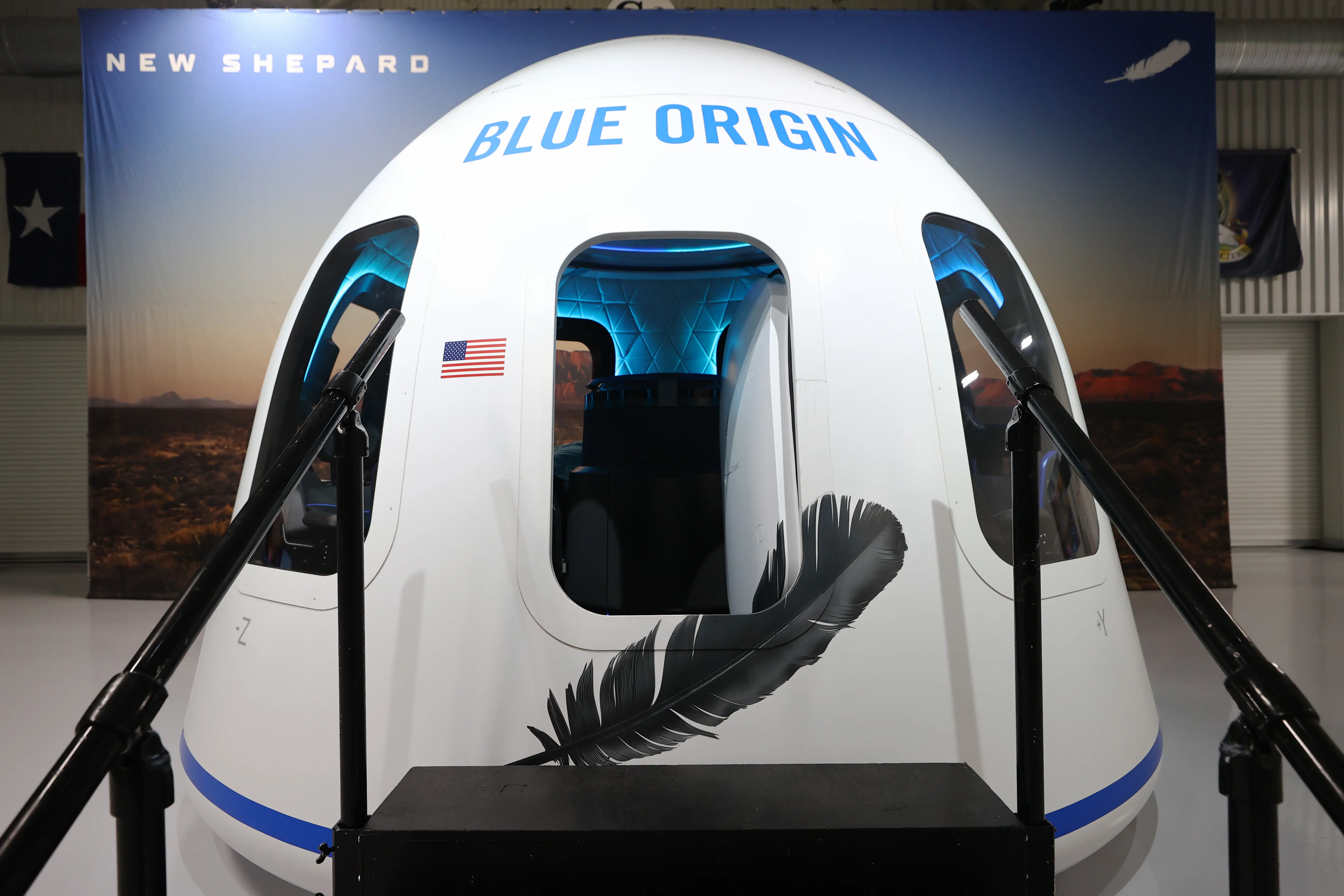 A full-size replica of Blue Origin's crew capsule (Image via Getty)
Space.com reported that Blue Origin completed a suborbital human spaceflight on Saturday, Dec. 20, 2025, which marked a first in commercial spaceflight.
The mission launched at 9:15 a.m. EST from the company’s West Texas launch site and carried six people aboard the New Shepard rocket. Aerospace engineer Michi Benthaus was among the crew and became the first wheelchair user to travel to space and return to Earth.
The mission was called NS, 37, and it was the 37th flight of New Shepard, a reusable rocket and capsule system. The flight lasted approximately 10 to 12 minutes, from liftoff to landing.
In fact, the capsule during the mission reached the Krmn line at an altitude of 62 miles, which is the most commonly used space boundary. Passengers were given a very short period of weightlessness, following which the capsule descended through parachutes and landed in the Texas desert.
In fact, the launch had been initially scheduled for December 18 but was held up due to a technical issue detected during preflight checks. The company Blue Origin went on to reschedule the flight and complete it without any further changes.
The mission is an additional component of the company's program, which is a space tourism initiative involving a mixed program of crewed and uncrewed research flights using the New Shepard system, planned to be continued.
Mission overview and flight details
The NS-37 mission lifted off on schedule on Saturday morning after the earlier delay.
During the previous launch attempt, Blue Origin halted operations due to what company commentators described as an “issue with built-in checks prior to flight.” The delay lasted two days before the mission was cleared to proceed.
New Shepard flights follow a set profile. After liftoff, the booster separates from the crew capsule and returns to the launch site for a vertical landing. The capsule continues upward before beginning its descent.
Parachutes deploy during the final stage, allowing the capsule to touch down safely. The system is fully autonomous, with no pilot on board.
The six-person crew included Benthaus, investors Joey Hyde and Adonis Pouroulis, aerospace engineer Hans Koenigsmann, entrepreneur Neal Milch and Jason Stansell, who has described himself as a “space nerd.”
Koenigsmann previously worked at SpaceX for nearly two decades and was involved in launch operations and reliability programs during that time.
According to Blue Origin, NS-37 was the 17th New Shepard mission to carry people. The remaining flights have been uncrewed research missions focused on science experiments and technology testing in microgravity.
Why the mission matters and what comes next?
Benthaus works at the European Space Agency and has used a wheelchair since a mountain biking accident in 2018. Before this flight, she took part in multiple parabolic flights that simulated short periods of weightlessness. These flights were used to study accessibility and movement in reduced-gravity conditions.
New Shepard is designed for short suborbital trips rather than orbital missions. The vehicle does not circle Earth and instead provides brief access to space before returning. Blue Origin states that passengers can view Earth against the black background of space and experience several minutes of weightlessness.
As of the NS-37 mission, New Shepard had flown 92 people to space, representing 86 individuals. Some passengers have flown multiple times. Blue Origin has not released ticket prices for these flights.
The NS-37 mission fits within a broader effort by private companies to expand access to spaceflight. While the flights are brief, they enable researchers and private individuals to experience space conditions without lengthy training programs. Blue Origin continues to schedule future missions for both research payloads and human passengers using the same launch system.
______________________________________________________________
Stay tuned for more updates.TOPICS: Astronomy, Blue Origin, NASA, NASA space missions 2025, New Shephard Rocket, Space mission