
Culinary Class Wars: Season 2 redraws the class war by stacking the Black Spoon side with overqualified elites
-
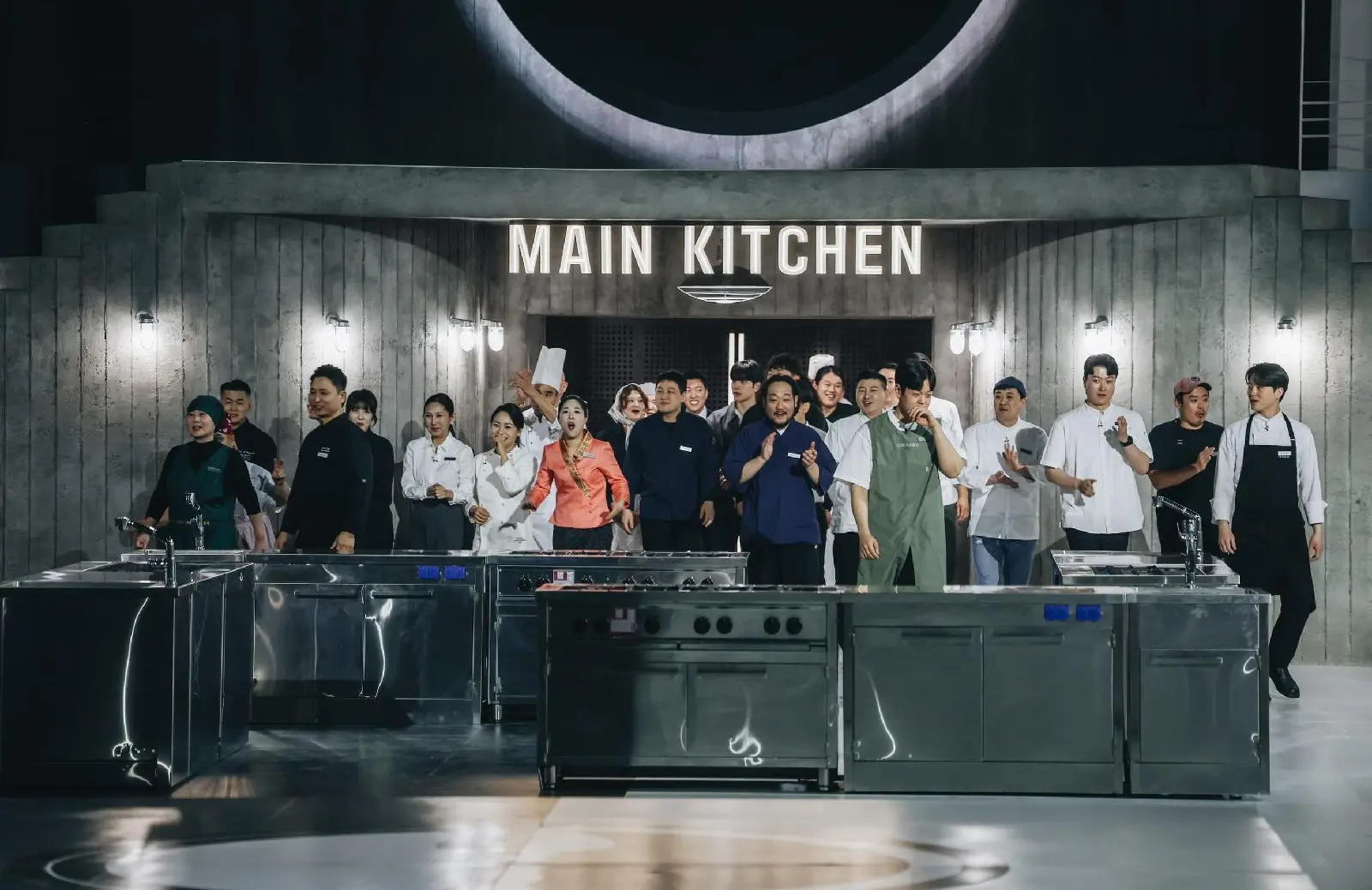 Culinary Class Wars 2 (Image via Netflix)
From its opening minutes, Culinary Class Wars Season 2 makes one thing unmistakably clear: the competition’s central divide has shifted.
The second season of Netflix’s hit cooking series no longer reserves prestige for the White Spoons alone.
Instead, Culinary Class Wars Season 2 redraws the class war by stacking the Black Spoon side with overqualified elites, chefs whose résumés, reputations, and technical authority would have placed them among the top tier in any conventional hierarchy.
Episodes 1 and 2 establish this imbalance immediately. As the 80 Black Spoon chefs enter the arena, reaction shots reveal disbelief not at the scale of the competition, but at who has been placed below.
Established restaurant owners, Michelin-recognized cooks, and internationally experienced chefs stand shoulder to shoulder under anonymous aliases, openly questioning whether the labels still carry meaning.
The show’s premise remains intact in name, but Culinary Class Wars has altered its internal logic.
Culinary Class Wars Season 2 reframes the Black Spoon tier
The scale of overqualification becomes impossible to ignore as individual Black Spoon introductions unfold.
Among them are chefs with decades of experience, Bib Gourmand credentials, international acclaim, and singular culinary identities.
Dweji-Gomtang in NY, the chef-owner of Okdongsik, enters with a résumé that includes Michelin Bib Gourmand recognition and global expansion, stating,
“The New York waitlist once had a thousand people.”
Brewmaster Yun arrives with a decade of fermentation expertise and a fully operational traditional soju still, distilling alcohol live during the elimination round.
French Papa, a classically trained French bistro chef, brings both technical grounding and personal history that command respect across the room.
Even more striking are the Black Spoons, whose reputations precede the show entirely.
Shin Dong-min, introduced as “Culinary Innovator,” is identified by peers as a molecular gastronomy pioneer who “started practicing even before it took off in Korea.”
His placement among the Black Spoons triggers open disbelief. “If this was the first season, he’d be up there,” one chef says. Another adds,
“He more than qualifies to be up here.”
The designation becomes less a reflection of ability and more a narrative device, one that Culinary Class Wars Season 2 actively destabilizes.
The effect is cumulative. By the time all 80 Black Spoons have entered, contestants begin to openly speculate that the traditional hierarchy has collapsed. One chef admits,
“If we’d known who we were up against, I’m sure people would’ve backed out.”
The Black Spoon tier is no longer an underdog pool; it is a pressure chamber filled with elite-level competition.
This reframing reaches its sharpest point during the Black Spoon Elimination Round.
Rather than a gradual thinning of weaker entries, the judges immediately eliminate chefs whose techniques would be celebrated elsewhere.
Shin Dong-min’s -196°C Apple, a dish he explains was first developed in 2007, is dismissed as technically dated.
Judge Anh Sung-jae states, “It reminds me of 20 years ago,” before concluding,
“That’s why you’ve been eliminated.”
The moment lands not as a rejection of skill, but as proof that Culinary Class Wars Season 2 has recalibrated its standards upward.
The same pattern repeats across Episode 2. Korean comfort dishes—long treated as safe ground—become liabilities when executed without absolute precision.
Judges repeatedly cite imbalance, chewiness, or lack of distinction. Another is dismissed as “too ordinary.”
These eliminations reinforce the new reality: reputation no longer buffers risk, and familiarity offers no protection.
By stacking the Black Spoon side with chefs who already operate at elite levels, Culinary Class Wars Season 2 forces the competition inward.
Survival is no longer about climbing a ladder toward the White Spoons; it is about enduring a trial by fire among equals.
Even the White Spoon balcony becomes a place of unease. Watching from above, several White Spoon chefs openly question why certain Black Spoons are not standing beside them.
The result is a season where class warfare is less about social hierarchy and more about structural pressure.
Titles, accolades, and past victories are rendered provisional. As one contestant puts it bluntly,
“This doesn’t feel like Black Spoons versus White Spoons. It feels like we’re up against diamond-encrusted silver spoons.”
Through Episodes 1 and 2, Culinary Class Wars Season 2 transforms its foundational divide into a paradox.
By overloading the Black Spoon tier with elite talent, the show exposes how fragile its own classifications have become.
The war remains, but the sides are no longer clearly defined—and survival, not status, is the only measure that holds.
Stay tuned for more updates.
TOPICS: Culinary Class Wars , Culinary Class Wars season 2 , Culinary Class Wars season 2 Episode 1
- Culinary Class Wars Season 2 quietly dismantles the Black Spoon vs. White Spoon divide
- Who is Jun Lee from Culinary Class Wars season 2? Everything to know about the chef explored
- Who is Hu Deok-juk from Culinary Class Wars season 2? Everything to know about the chef explored
- Who is Son Jong-won from Culinary Class Wars season 2? Everything to know about the chef explored