
Features
NASA’s Parker Solar Probe observes solar wind reversing direction
NASA’s Parker Solar Probe observed solar wind reversing direction, capturing inflows and coronal material returning to the Sun, providing new insights into solar magnetic field dynamics.
-
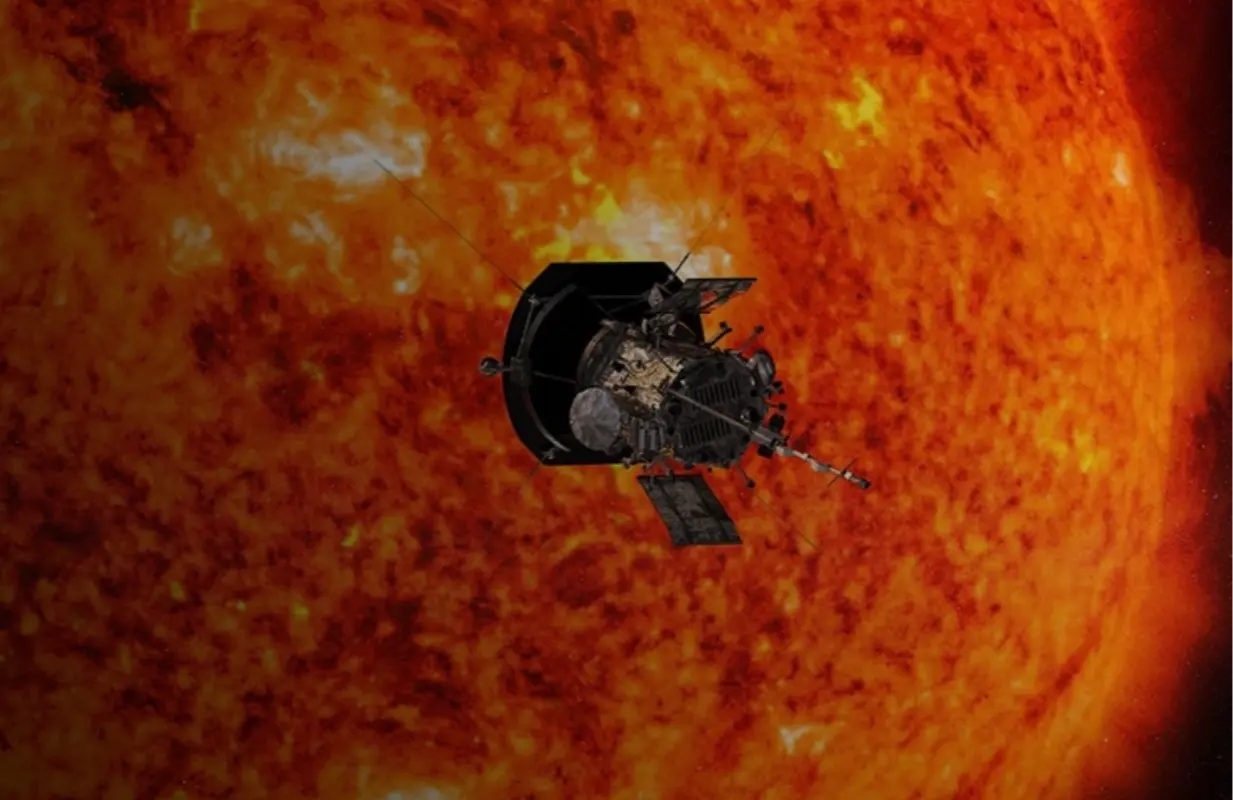 NASA's Parker Solar Probe (Image via NASA)
NASA’s Parker Solar Probe has observed instances where solar wind reverses direction after being ejected from the Sun.
During its closest approach to the Sun on December 24, 2024, the spacecraft captured coronal mass ejections, or CMEs, and detected that not all material expelled from the Sun escapes.
Some solar material returned toward the Sun in a process known as inflows, affecting the structure of the solar atmosphere.
These observations were recorded by the Wide-Field Imager for Solar Probe, or WISPR, and published in the Astrophysical Journal Letters.
The data indicate that the Sun recycles magnetic material in ways that influence both its outer atmosphere and the propagation of future CMEs.
Observing inflows in the solar atmosphere
Inflows consist of elongated blobs of solar plasma falling back toward the Sun following a CME. These occur when stretched magnetic field lines reconnect, pulling material trapped along them toward the solar surface.
Earlier NASA missions, such as SOHO, the Solar and Heliospheric Observatory, and STEREO, the Solar Terrestrial Relations Observatory, have identified inflows from faraway regions.
In contrast, the Parker Solar Probe gave the very first visual impressions that were near, of high-resolution, and allowed the researchers to quantify the speed, size, and direction of the returning matter.
Nour Rawafi, a project scientist at Johns Hopkins Applied Physics Laboratory, said the data shows the returning of coronal magnetic fields and material from one continuous cycle.
Mechanisms of Magnetic recycling
CMEs are generated when twisted magnetic field lines undergo magnetic reconnection, releasing bursts of charged particles and magnetic fields.
As the CME moves outward, it stretches nearby magnetic field lines, which can tear and subsequently reform as separate loops.
Some of these loops continue outward, while others reconnect back to the Sun, forming inflows.
Angelos Vourlidas, WISPR project scientist at Johns Hopkins Applied Physics Laboratory, explained that returning inflows drag solar material and modify magnetic fields beneath the solar surface.
This interaction reshapes the solar magnetic environment, which can influence the paths of subsequent CMEs emerging from the same region.
The reconfiguration can shift the direction of a CME by a few degrees, potentially affecting which planets or spacecraft encounter the ejected material.
Implications for Space weather and solar modeling
The detection of inflows provides detailed information for understanding the Sun’s magnetic field dynamics and CME behavior.
Returning material affects the solar magnetic landscape and has consequences for predicting solar eruptions.
Knowing precisely where these particles come from helps scientists predict the impact of such events on Earth, the Moon, Mars, as well as spacecraft that are anywhere in our solar system.
The discoveries made here are very important to different kinds of space expeditions that are out of Earth’s protective shield, for example, NASA’s Artemis program, where radiation coming from the Sun may be harmful to both astronauts and devices.
Through the different encounters of Parker Solar Probe with the solar atmosphere, the scientists will have an opportunity to follow the inflows over the period of time and thus they will be able to figure out how the Sun’s magnetic activity changes as it goes from solar maximum to solar minimum.
NASA’s observations confirm that solar wind does not always move directly away from the Sun; some material returns as inflows, carrying magnetic fields and plasma back into the solar atmosphere.
These high-resolution images from Parker Solar Probe provide the first detailed measurements of this process, showing the recycling of magnetic fields and their influence on future solar eruptions.
The data, published in the Astrophysical Journal Letters, expand knowledge of the Sun’s magnetic environment and support more accurate modeling of space weather effects across the solar system.
Stay tuned for more updates.
TOPICS: NASA Parker Solar Probe, NASA, Parker Solar Probe December 2024, solar inflows, solar wind reversal, Sun’s magnetic environment, WISPR observations