
Schott and AZUR Space develop advanced cover glass for high-performance space missions
-
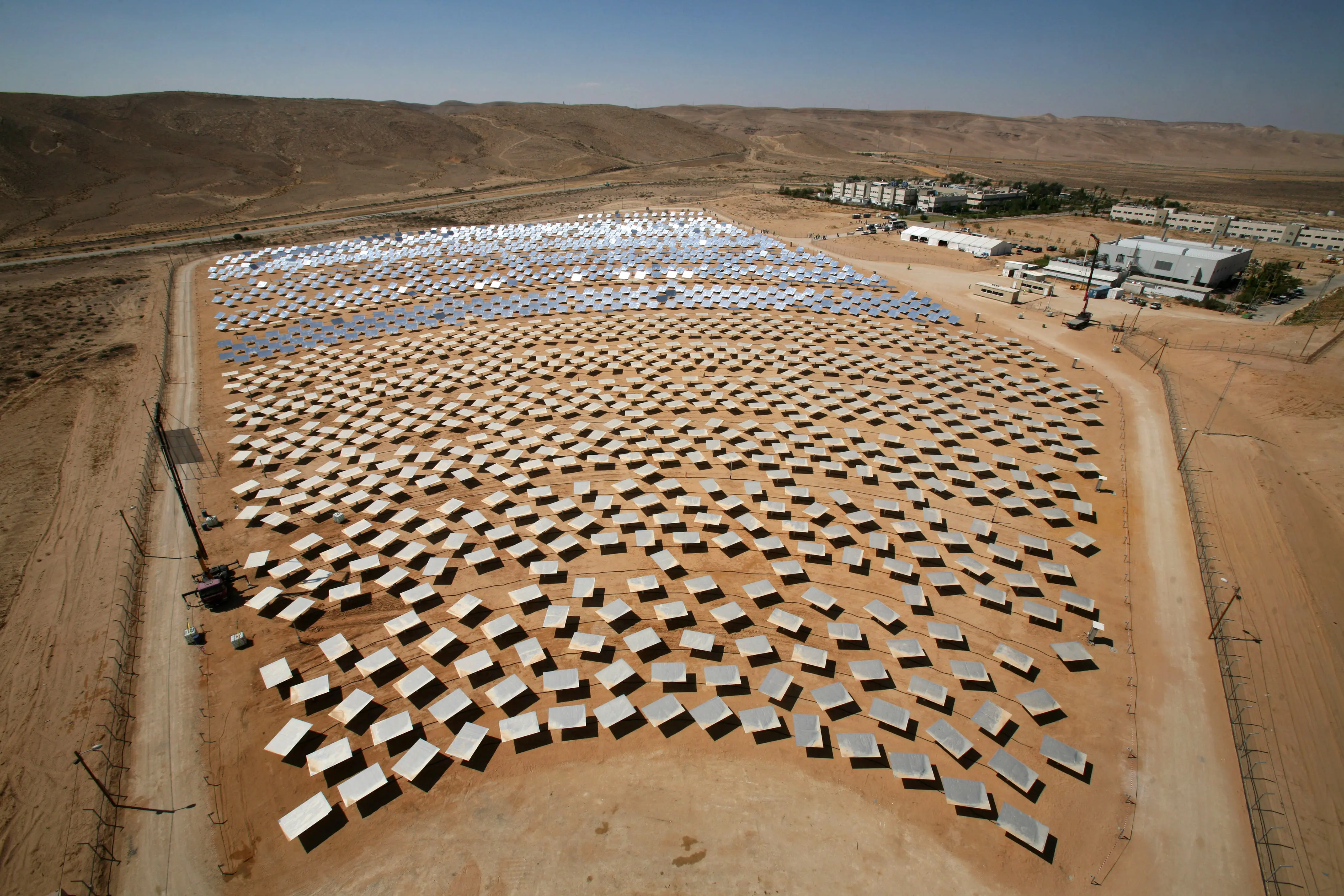 Solar energy development centre in Rotem industrial parK (Image via Getty)
SpaceNews reported that Schott introduced Solar Glass exos, a new cover glass developed for next-generation satellite solar cells.
The material was created with AZUR Space Solar Power GmbH and received support from the European Space Agency and the German Aerospace Center.
The two companies completed testing and early validation to confirm that the glass could support silicon cells as well as III-V multijunction solar cells used in many satellite systems.
The announcement explained that the material was built for long mission durations and changing environmental conditions in orbit.
Schott stated that the glass structure maintained stable transmission after radiation exposure and allowed manufacturers to control UV levels by choosing the appropriate thickness.
The coefficient of thermal expansion was matched to GaAs cells to help limit stress during temperature shifts.
The collaboration also fit into European plans to strengthen supply chains for satellite power systems.
Schott said, “Our collaboration with AZUR SPACE demonstrates how close cooperation can deliver space-qualified solutions at scale.”
AZUR Space stated that the project supported a stable supply chain for future missions.
___________________________________________________________________Development and technical features
Schott stated that Solar Glass exos was intended for satellite missions across LEO, MEO, and GEO. The announcement noted that the glass composition supported stable optical transmission after long periods of radiation exposure.
The material also included a UV cut-off edge that could be adjusted through thickness selection to manage UV exposure during assembly.
Thermal compatibility formed a key part of the development work. Schott explained that the coefficient of thermal expansion was matched to GaAs cells to reduce stress created by heating and cooling cycles in orbit.
The material moved through ECSS qualification as part of its planned use in satellite platforms.
Schott noted that the design supported a wide range of cell types and production needs, allowing manufacturers to integrate the cover glass into different system layouts for upcoming missions.
AZUR Space carried out testing and validation to confirm compatibility with multijunction solar cell designs.
The company said that AZUR SPACE was "proud to work with SCHOTT to secure a stable and large-scale, 100% European supply chain for solar cell assemblies.”
It also stated,
“This collaboration strengthens Europe’s technological independence and ensures the reliable availability of high-performance solar power solutions for future space missions.”
These points described how the material and the partnership supported long-term mission planning and power system design.
Industry context and partnership impact
The announcement placed the new cover glass within the broader needs of satellite power systems, where mission operators worked to maintain power output in radiation and changing thermal conditions.
Schott stated that Exos was developed to support these operational demands across multiple orbits and mission durations.
Schott described the role of joint development in meeting industry needs, saying, “Our collaboration with AZUR SPACE demonstrates how close cooperation can deliver space-qualified solutions at scale.”
The company also noted expected growth in spacecraft production and the rising number of satellite constellations.
Schott said, “As we expect that the demand for satellite constellations will continue to expand, we’re excited to provide the industry with a reliable, high-performance solar cell cover glass.”
This project is also connected to broader work in Europe to support space programs with a consistent component supply. ESA and DLR backed the development as part of efforts to advance solar power technology for spacecraft.
The partnership linked material research, solar cell engineering, and production planning so that the cover glass could be prepared for long-term mission needs and future scaling across the satellite market.
_________________________________________________
Stay tuned for more updates.TOPICS: Astronomy, AZUR space, Solar cells, Space mission
- Saudi Arabia prepares for heightened solar storms with new space-weather satellite
- Muon Space wins $1.9M contract to develop infrared missile-tracking payload
- ‘Galactic Brain’ initiative seeks to move high-demand AI processing off Earth and into space
- Supermassive black hole unleashes ultra-fast winds moving at 20% the speed of light