
Features
3I/ATLAS shows sunward anti-tail in latest Hubble images
Hubble images of interstellar object 3I/ATLAS reveal a sunward anti-tail, showing a teardrop-shaped coma with separated non-volatile objects, as reported by Avi Loeb and NASA observations.
-
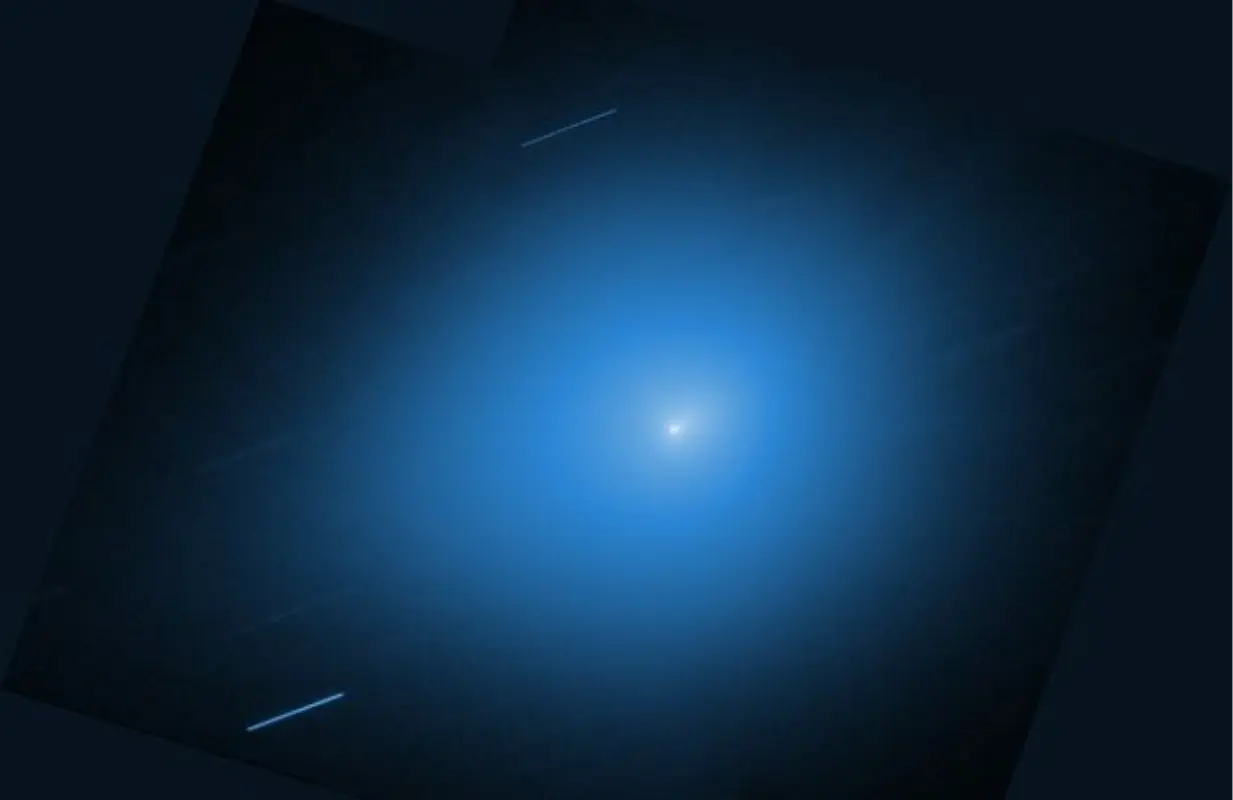 Comet 3I/ATLAS (Image via NASA)
The interstellar object 3I/ATLAS was reobserved by the Hubble Space Telescope on November 30, 2025, at a distance of 286 million kilometers from Earth.
The new images show a teardrop-shaped coma with an extension towards the Sun, referred to as a sunward anti-tail.
This feature was also visible in the pre-perihelion Hubble image taken on July 21, 2025, when 3I/ATLAS was approaching the Sun from a distance 56 percent larger than in the November observations.
According to Avi Loeb, the radius of the coma in the post-perihelion image is about 40,000 kilometers, with the anti-tail extending approximately 60,000 kilometers.
NASA confirmed that the Wide Field Camera 3 on Hubble captured the comet as it moved across the sky, with background stars appearing as streaks due to the comet's motion.
Observations of 3I/ATLAS are expected to continue as it travels away from the Sun.
Hubble observations and anti-tail formation
The Hubble images collected in November 2025 show the teardrop shape of 3I/ATLAS’s coma extending sunward.
Avi Loeb reported that this configuration corresponds to the presence of a large number of macroscopic non-volatile objects that separated from the main body of 3I/ATLAS due to its measured non-gravitational acceleration away from the Sun.
The predicted separation between these objects and 3I/ATLAS at the time of the November observations is about 60,000 kilometers, which matches the observed sunward extension in the Hubble images.
NASA noted that Hubble’s Wide Field Camera 3 instrument captured these images at a distance of 178 million miles, confirming the comet’s movement across the sky relative to background stars.
Non-gravitational acceleration of 3I/ATLAS
According to Loeb, JPL Horizons tracking reports show that 3I/ATLAS experiences a small non-gravitational acceleration directed radially away from the Sun.
The acceleration is a fraction of 0.0002 of the Sun’s gravitational acceleration, and it scales inversely with the square of the heliocentric distance.
This effect causes 3I/ATLAS to move slightly away from the Sun compared with the surrounding swarm of objects that do not experience the same acceleration.
The displaced objects, if they started with the same velocity and position as 3I/ATLAS, remain approximately 54,000 kilometers closer to the Sun, creating the observed anti-tail geometry.
The configuration points toward the Sun and converges to 3I/ATLAS’s location at perihelion, remaining consistent as the comet moves away from the Sun.
Composition and large-scale imaging
Loeb suggested that the swarm of objects around 3I/ATLAS could carry a small fraction of the comet’s mass, yet their combined surface area would be significantly larger than that of 3I/ATLAS itself.
For example, a trillion objects comprising 0.001 of 3I/ATLAS’s mass would create a total surface area about 100 times larger than the main body, producing most of the observed sunlight reflection in the coma.
The full Hubble data set, which includes ultraviolet spectroscopy, has not yet been released and is expected to provide information on the composition of the gas and material around 3I/ATLAS.
In parallel, amateur astronomers continue to capture large-scale images of the comet, extending millions of kilometers, which complement the Hubble observations.
The sunward anti-tail of 3I/ATLAS in the Hubble images is consistent with the predicted separation of non-volatile objects influenced by the comet’s non-gravitational acceleration, as reported by Avi Loeb.
Observations from NASA and Hubble confirm the movement and structure of the comet and its surrounding coma as it travels through the solar system.
Stay tuned for more updates.
TOPICS: 3I/ATLAS
More 3I/ATLAS
on Primetimer:
- Constraints on nucleus size of 3I/ATLAS from dust measurement
- Interstellar comet 3I/ATLAS raises new questions as Apophis approaches a historic close pass
- Observations and calculations of micron-scale dust emission from 3I/ATLAS
- Harvard astrophysicist Avi Loeb says 3I/ATLAS shows a sunward jet dominated by unusually large particles