
James Webb Space telescope confirms first known runaway supermassive black hole
-
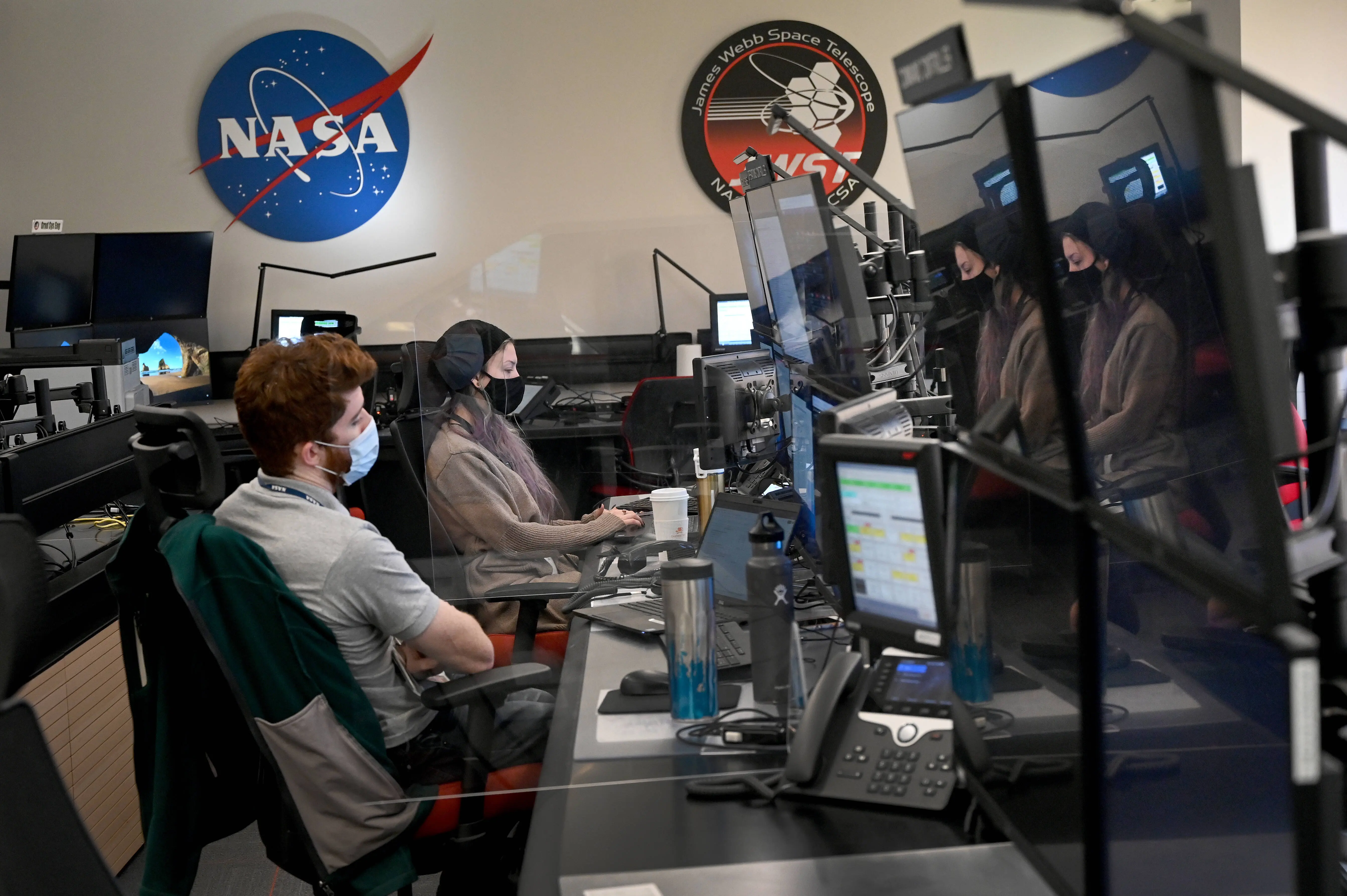 JWST Mission Operations Center Flight Control room at the Space Telescope Science Institute (Image via Getty)
Space.com reported that astronomers using the James Webb Space Telescope (JWST) have confirmed the first known case of a runaway supermassive black hole.
The object has a mass about 10 million times that of the sun. It is moving at roughly 1,000 kilometers per second, fast enough to escape the gravitational pull of its home galaxy.
The black hole is located in a system known as the Cosmic Owl, a pair of interacting ring galaxies around 9 billion light-years from Earth.
The discovery confirms earlier observations made with the Hubble Space Telescope, which revealed a long, narrow streak of gas and stars that could not be easily explained.
JWST data showed clear signs of shock waves in gas at the leading edge of this streak, with the black hole positioned at its tip.
One of the theories is that the black hole was flung out in a violent event during a galaxy merger, probably after two supermassive black holes merged and got a hefty gravitational-wave recoil.
The black hole is dragging a long stream of gas behind it in which new stars are being born as it continues its journey. The discoveries made help to consolidate speculative ideas that have been around for a long time concerning the ejection of black holes and also provide a new method to search for such entities in space.
_________________________________________________________________How did astronomers identify the runaway black hole?
The object was first noticed in 2023, when Hubble images showed a thin streak extending far from the center of the Cosmic Owl galaxies. At the time, researchers suspected that the streak might be linked to a massive object moving through the gas, but direct proof was lacking.
JWST provided that confirmation by detecting strong shock signatures at the front of the streak.
“The black hole is, well, black, and is very difficult to detect when it is moving through empty space,” said Pieter van Dokkum of Yale University. “The reason why we spotted the object is because of the impact that the passage of the black hole has on its surroundings.”
Using JWST’s infrared instruments, the team measured how gas near the front of the streak was being pushed sideways at very high speeds.
“The velocity of the displaced gas is directly related to the velocity of the black hole,” van Dokkum explained. From these measurements, the team calculated that the black hole is moving at about 1,000 kilometers per second.
The black hole is now around 230,000 light-years from its original location. Its motion is fast enough to overcome the gravity of the merged galaxy system. According to van Dokkum, “It is this high speed that enabled the black hole to escape the gravitational force of its former home.”
__________________________________________________________What caused the ejection, and why does it matter?
Researchers describe two main ways a supermassive black hole can be ejected from a galaxy. One involves the merger of two black holes, where uneven emission of gravitational waves can give the newly formed black hole a strong kick.
The other involves interactions among three black holes, where one is expelled from the system. In this case, the team favors the merger scenario.
“The forces that are needed to dislodge such a massive black hole from its home are enormous,” van Dokkum said. “And yet, it was predicted that such escapes should occur.”
Throughout its journey in the universe, the black hole is said to be forcibly collecting the gas that lies ahead of it and leaving a kind of trail behind.
The gas in this trail has cooled down, and new stars have formed. The total mass of these newly formed stars is estimated to be around one hundred million times that of the sun.
Such a stellar birth, at a significant distance from the center of a galaxy, has only been very faintly outlined, if not entirely unknown, before.
The team suggests that the escaped black hole would have a negligible impact on its original galaxy. However, an encounter with another galaxy might cause the release of intense shocks and the creation of new stars.
By looking for similar thin gas and star streaks over large sections of the sky, upcoming missions like the Roman Space Telescope and Euclid could help astronomers locate more runaway black holes.
_______________________________________________________
Stay tuned for more updates.TOPICS: Astronomy, Blackholes, James Webb Space Telescope, JWST NASA, NASA
- Swift telescope uncovers unexpected water activity in interstellar comet 3I/ATLAS
- Vast invites scientists to pitch microgravity experiments for its upcoming Haven-1 commercial space station
- Stargazing tonight, December 17: Jupiter dominates as the Geminids fade and Ursids begin
- James Webb Space Telescope uncovers clues to colossal stars in the early universe