
Space.com reports that NASA has begun using a high-altitude aircraft to search for critical minerals across large parts of the American West.
Features
NASA hunts critical tech minerals from 60,000 feet above Earth
NASA is using a high-altitude ER-2 aircraft and the AVIRIS-5 sensor to map critical minerals across the American West, supporting research on resources used in electronics, clean energy, and national security
-
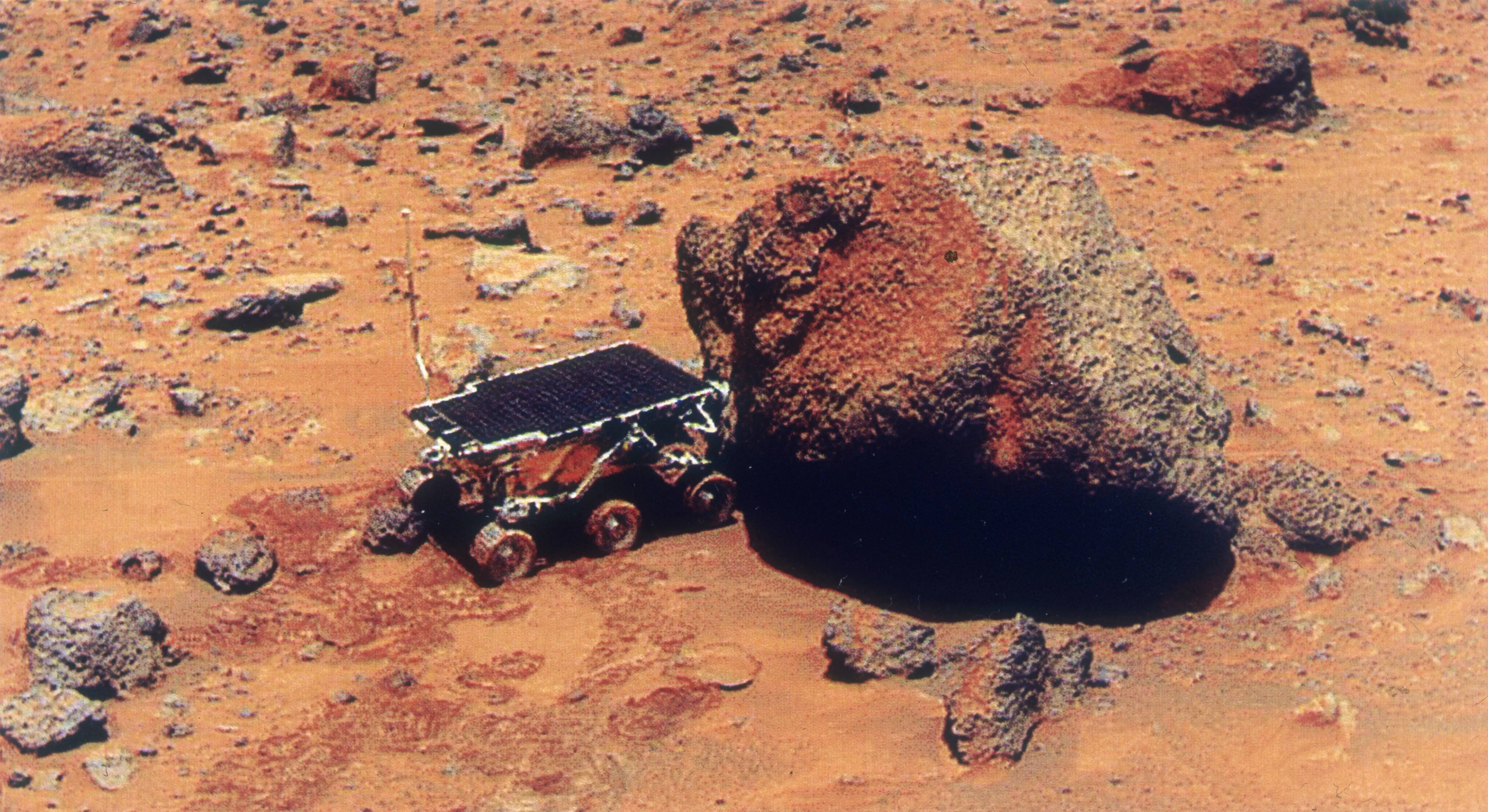 Yogi Rock on the surface of Mars. The rock was thought to be composed of basalt. (Photo for reference, Image via Getty)
The work uses a new sensor called AVIRIS-5, flown aboard NASA’s ER-2 research aircraft at about 60,000 feet above Earth. The project is part of a joint effort between NASA and the U.S. Geological Survey known as GEMx.
Its goal is to detect surface signs of minerals that are important for technology, energy systems, and national security.
AVIRIS-5 builds on imaging spectrometer technology first developed by NASA’s Jet Propulsion Laboratory in the 1970s. The sensor measures how sunlight reflects off the ground in many wavelengths.
Different minerals reflect light in specific ways, allowing scientists to identify them from the air. Since 2023, the GEMx team has surveyed more than 366,000 square miles across desert regions, where limited vegetation makes detection easier.
The data collected may help improve understanding of domestic mineral resources. It may also support land planning and other Earth science studies. NASA notes that related instruments have been used in space missions to study planets and moons, showing how tools designed for exploration beyond Earth can also be applied closer to home.
High-altitude sensor and how it works
The AVIRIS-5 sensor is mounted inside the nose of NASA’s ER-2 aircraft, a high-flying plane based at Armstrong Flight Research Center in California. Roughly the size of a microwave oven, the instrument collects detailed images of Earth’s surface using visible and infrared light.
By analyzing reflected wavelengths, scientists can identify what NASA calls “spectral fingerprints” of minerals exposed at the surface.
Many of the minerals targeted by the GEMx project have distinct chemical structures that interact with light in measurable ways. These include aluminum, lithium, zinc, graphite, tungsten, and titanium.
Such materials are used in products like semiconductors, solar power systems, and electric vehicle batteries. According to the U.S. Geological Survey, critical minerals are those with “significant consequences for the economic or national security of the U.S.”
NASA says the same type of technology has long been used beyond Earth. A spokesperson from the Jet Propulsion Laboratory noted that one similar instrument “is en route to Europa, an ocean moon of Jupiter, to search for the chemical ingredients needed to support life.” This link between Earth science and planetary missions remains central to the program.
Policy details and future uses
The mineral survey effort comes as the U.S. government places more focus on domestic supply chains.
In March 2025, the White House issued an executive order calling for expanded mineral production, stating that national and economic security are “now acutely threatened by our reliance upon hostile foreign powers’ mineral production.”
Data from projects like GEMx may help inform future decisions, though NASA emphasizes that the program itself is scientific rather than commercial.
Beyond mineral detection, researchers see broader uses for AVIRIS-5. Dana Chadwick, an Earth system scientist at JPL, said, “The breadth of different questions you can take on with this technology is really exciting, from land management to snowpack water resources to wildfire risk.” She added,
“Critical minerals are just the beginning for AVIRIS-5.”
The GEMx project is ongoing, and flights are expected to continue over selected regions of the western United States. The collected data may support multiple agencies and research fields.
NASA notes that imaging spectrometers like AVIRIS-5 show how tools first designed for space exploration can be adapted to study Earth systems, resources, and environmental change using the same core methods.
Stay tuned for more updates.
TOPICS: Astronomy, ER-2 aircraft, NASA, NASA AVIRIS-5 sensor, U.S. Geological Survey
More Astronomy
on Primetimer:
- NASA and Artemis II crew complete full dress rehearsal for first crewed lunar flight
- Space weather stirs, raising hopes for a Christmas aurora display
- Avi Loeb reports new radio constraints and size estimates for interstellar object 3I/ATLAS
- Interstellar comet 3I/ATLAS shows rotating jets in a rare sun-facing tail